When you are running autonomous systems in production, the component everyone forgets about is also the one that breaks everything first: time.
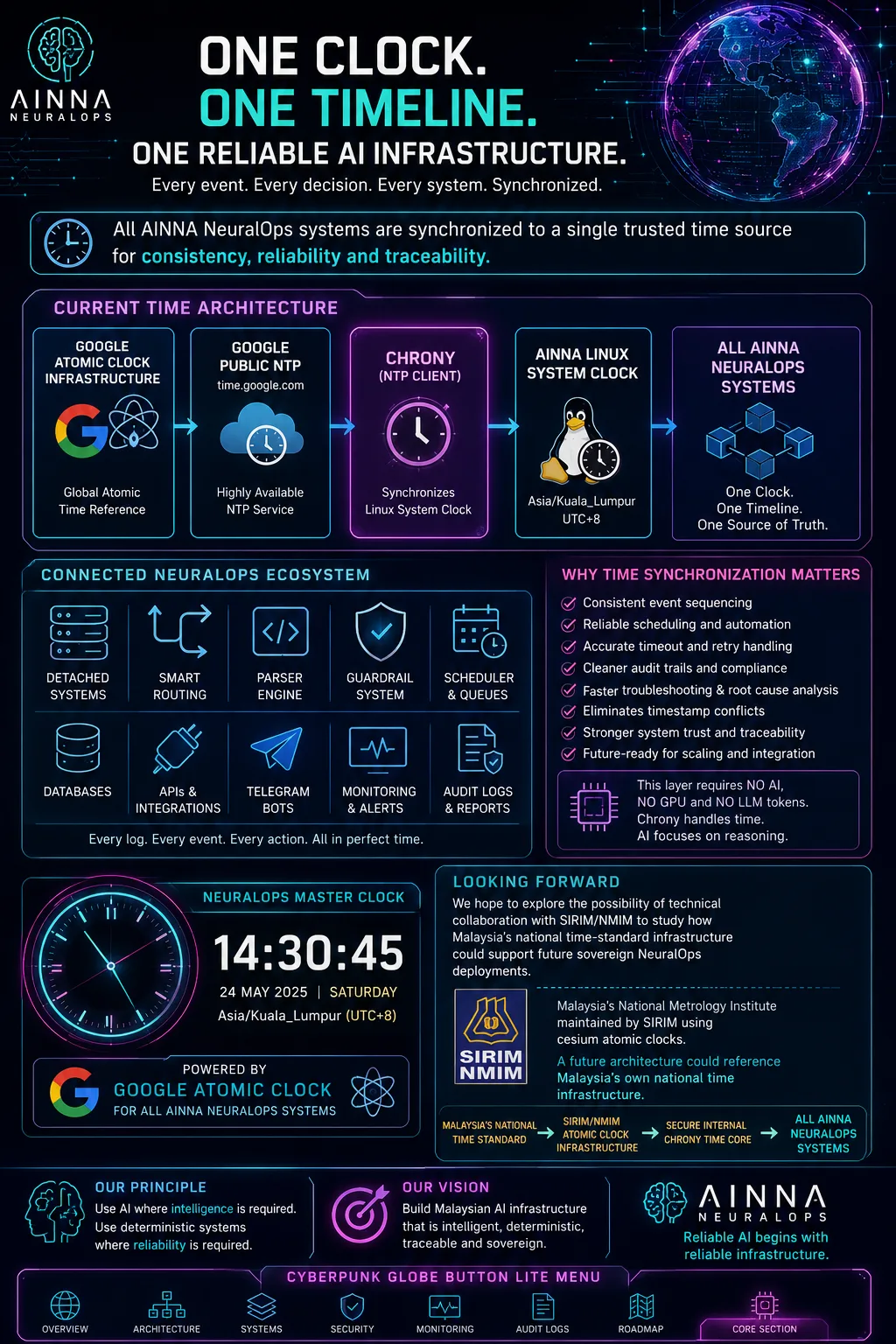
Detached Systems, Smart Routing, Parsers, Guardrails, Schedulers, Databases and APIs all do different jobs, but in our stack they all pull from the same trusted timeline.
At AINNA, we keep the NeuralOps time layer intentionally simple:
Google Public NTP
↓
Chrony
↓
AINNA Linux System Clock (Asia/Kuala_Lumpur, UTC+8)
↓
Every NeuralOps System
Rather than have every service phone home to its own external source, every component reads the same synchronized Linux system clock.
That single source of time gives us real operational wins in production:
Consistent event ordering
Reliable scheduling
Cleaner audit trails
Faster incident tracing
Predictable timeout and retry behavior
Simpler infrastructure with fewer moving parts
And this layer uses no AI, no GPU and no LLM tokens.
AI is for reasoning problems.
Infrastructure should stay deterministic.
That is a core engineering principle behind NeuralOps.
Going forward, we are exploring a technical collaboration with SIRIM/NMIM to see how Malaysia's national time-standard infrastructure could back future sovereign NeuralOps deployments.
Malaysia's National Metrology Institute (NMIM), operated by SIRIM, keeps the country's official time standard on cesium atomic clocks. A NeuralOps architecture that references Malaysia's own national time infrastructure would be a significant milestone for locally built AI systems.
Reliable AI does not start with a bigger model.
It starts with reliable infrastructure.
One Clock. One Timeline. One Reliable NeuralOps Ecosystem.
#NeuralOps #AINNA #AIInfrastructure #DetachedSystems #SmartRouting #Chrony #GooglePublicNTP #SIRIM #NMIM #Automation

















Ruang pembaca
Apa pendapat anda?
Komen disemak sebelum diterbitkan. Email diperlukan untuk moderasi dan tidak dipaparkan kepada pembaca.
الأرقام حول هذا الموضوع أكثر منطقية من معظم ما قرأت.
هذا الجزء هو الجزء الذي سأرسله لمديري.
This is where infrastructure should stay deterministic finally makes sense.
Short and clear. time-standard is worth sending to my team.
Worth reading just for malaysia's national metrology institute (NMIM.
Masih fikir tentang google public NTP.
First piece that handles every component reads honestly.
Saya baca dua kali. Google public NTP yang paling melekat.