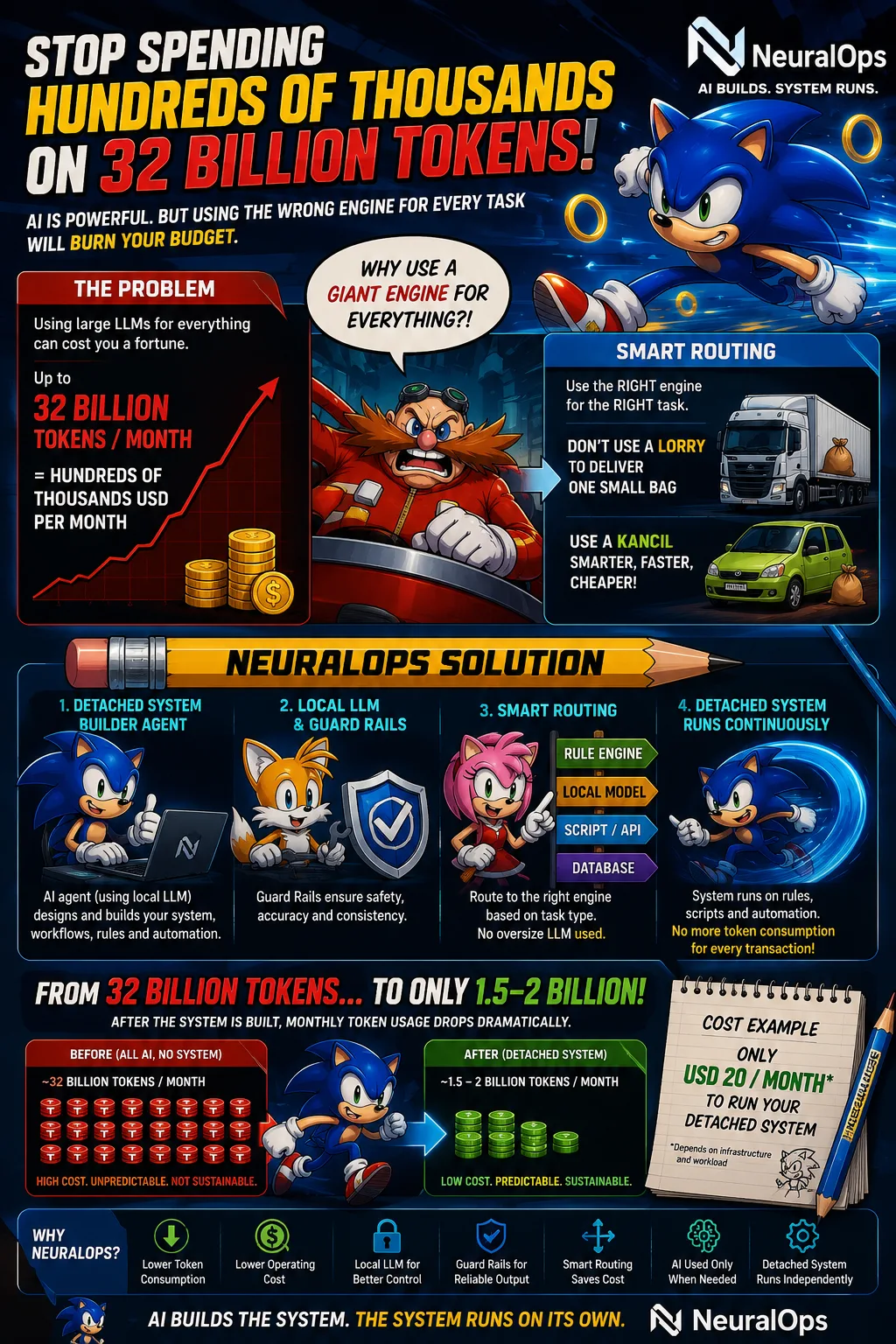
Thirty-two billion tokens per month is not a flex. At that scale, inference alone can run into hundreds of thousands of dollars, depending on the model, architecture, and call patterns. The real issue is usually not that AI is expensive. The issue is that large LLMs are being asked to do everything-including work that deterministic rules, database queries, scripts, or small local models could handle faster and cheaper.
I compare it to sending a heavy-duty lorry from Melaka to Kuala Lumpur just to deliver one small bag. The lorry can do it, but a Kancil will deliver the same item with far less fuel and cost. That is the idea behind Smart Routing: assign the right engine to the right job.
At NeuralOps, the Detached System Builder Agent uses local LLMs, Guard Rails, and Smart Routing to design and assemble the system. The agent may burn through serious tokens during initial learning, development, testing, and validation-but that is temporary. It is the build phase, not the run phase.
Once the Detached System is complete, routine operations are pushed down to fixed rules, PHP services, automation scripts, databases, and validated workflows. From then on, the system does not need an LLM call for every transaction. Tokens are reserved for exceptions, unknown cases, system improvements, and the tasks that actually require AI.
The result: monthly usage can fall from about 32 billion tokens to roughly 1.5–2 billion tokens. In many deployments, the core detached workflow itself can run for about USD20 per month, depending on infrastructure and workload.
Key outcomes we see in the field:
Lower token consumption at scale
Lower long-term operating costs
Local LLM usage for tighter control
Guard Rails for predictable outputs
Smart Routing that avoids oversized models
AI invoked only when it is genuinely required
Detached workflows that keep running without repeated token charges
The NeuralOps principle is simple:
Do not use a lorry when a Kancil can complete the job. AI builds the system. Then the system runs independently.














Ruang pembaca
Apa pendapat anda?
Komen disemak sebelum diterbitkan. Email diperlukan untuk moderasi dan tidak dipaparkan kepada pembaca.
حفظته، خصوصًا من أجل 32.
Still thinking about assign the right engine.
The case for thirty-two billion tokens per month is well made.
The framing on from about 32 32 billion is better than expected.
Read this twice. inference alone can run into is what stayed with me.