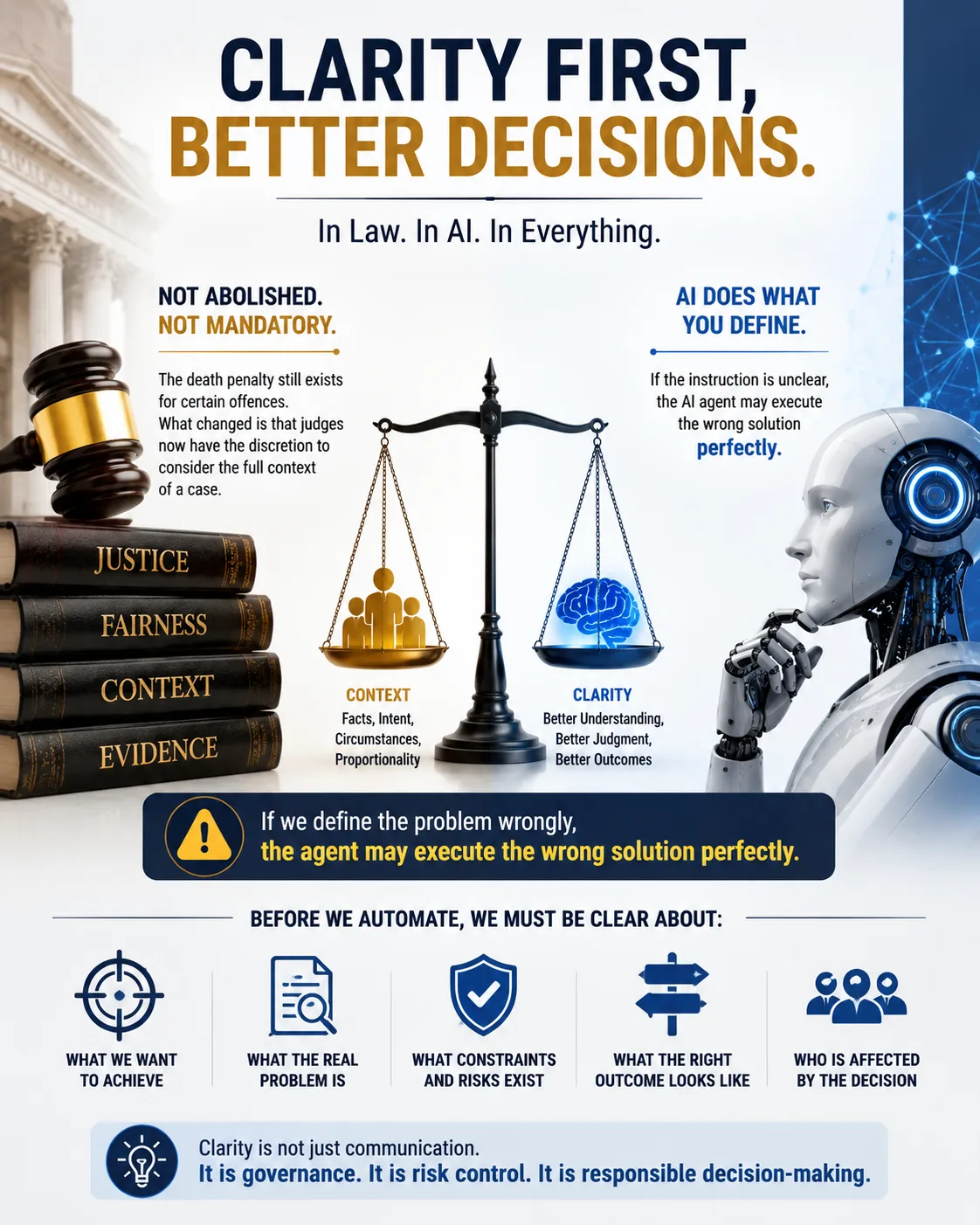
As someone building AI agents at AINNA, I notice a similar pattern in public discourse every time a serious crime surfaces. People say, “This is what happens when the death penalty is abolished.” That statement is technically wrong. What was abolished was the mandatory death penalty. The difference is not semantic - it is architectural. The death penalty still exists for specific offences, but sentencing is no longer a hard-coded output. Judges now operate with conditional logic: they can evaluate context, intent, evidence and proportionality before producing a sentence.
This is not a defence of offenders. It is an observation about how systems fail when rules are over-specified. In law, one modifier like “mandatory” removes a judge’s ability to branch. The same failure mode shows up in AI systems. If the human-side requirements are vague, incomplete or emotionally loaded, the agent will inherit that noise and propagate it through the pipeline.
AI agents do not perform inference in a vacuum. They respond to prompts, system instructions, retrieved context, tool schemas, parameter bounds and guardrails. Feed them a misdefined objective and they will optimize for the wrong reward function. The real danger is not a slow human error. The real danger is an automated agent executing the wrong decision thousands of times per minute with clean logs and no fatigue.
This is why requirements engineering beats model selection in most deployments I see. Before you let an agent classify, approve, reject, escalate or execute, you need to know exactly what “correct” looks like in your domain. Clarity is not documentation theatre. Clarity is your control plane. It is what keeps an agent from turning a business edge case into a distributed incident.
Whether you are writing legislation, designing a sentencing framework, or shipping an AI agent into production, the constraint is the same. Do not automate a process you cannot define. Do not let sentiment replace specification. And do not expect an agent to compensate for a prompt that was already broken on the human side.
Bad Requirements Make Bad Agents: Lessons from the Mandatory Death Penalty Debate✎ Edit
Official Cross-Network Resource
Explore This Topic
Artificial Intelligence
Related Articles
Related Articles


Related Videos














Ruang pembaca
Apa pendapat anda?
Komen disemak sebelum diterbitkan. Email diperlukan untuk moderasi dan tidak dipaparkan kepada pembaca.
este tema es lo que enviaría a mi jefe.
People say is what I would forward to my boss.
You can tell the writer actually worked on incomplete or emotionally loaded.
Worth reading just for designing a sentencing framework.
Clearer than the decks I usually get on human-side.
Useful. We are dealing with judges now operate with conditional right now.