
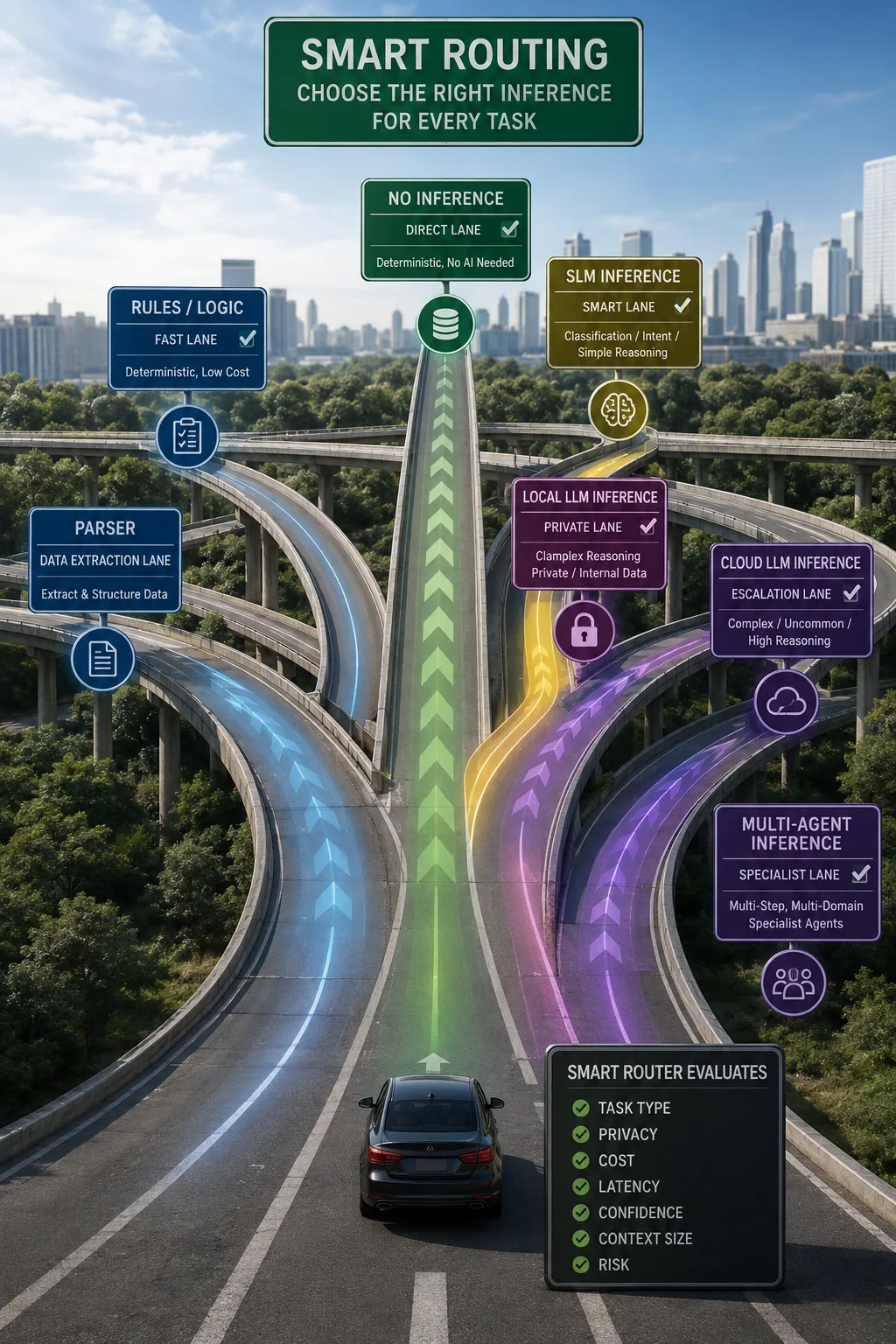
For a long time, Smart Routing was framed as a model-selection problem: identify the task, then choose the most suitable LLM based on capability, speed, cost and complexity. From where I sit, in finance and accounting at AINNA, that framing starts one step too late. The first question should not be “Which model should handle this?” The first question should be “Does this task need a model at all?” Every inference we trigger is a cost line before it is a feature.
Our evolving NeuralOps architecture follows a reuse-first execution approach, and to me it reads like an asset-utilisation principle. When a request arrives, the system first checks whether validated knowledge, instructions, workflows or previous execution patterns already exist. If the task can be completed through existing knowledge, deterministic logic, databases, parsers, APIs or tools, there is no reason to initiate another LLM inference, and no reason to book another variable cost for work we have already paid to solve once.
Only unresolved work should reach AI reasoning. Even then, Smart Routing continues. A complex instruction can be decomposed into smaller tasks, with coding routed to a coding model, language work to a language model, visual tasks to a visual model, while repetitive operations can remain completely detached from LLMs. In simple terms, the architecture becomes: Reuse → Resolve → Execute → Reason. In financial terms, it becomes a cost ladder: deterministic steps sit at near-zero marginal cost, and metered token spend is reserved only for what is genuinely unresolved.
Soon, we also plan to introduce JEv-style decision models into NeuralOps as another intermediate decision layer. When deterministic systems encounter anomalies or uncertain decisions, a smaller specialized decision model may be sufficient to determine the next action without immediately escalating the task to a full LLM. That places a lower-cost decision point ahead of a higher-cost one.
The objective is not to eliminate LLMs. It is to use them where their reasoning capability creates real value, and where the output can be traced to a business outcome. On the numbers, this approach reduces unnecessary model calls, token consumption, latency and compute demand, while improving consistency, keeping cost per task predictable and limiting the unnecessary movement of operational data to external models. For a Malaysian SME working to a fixed monthly budget, that predictability is worth as much as the headline saving.
For us, Smart Routing is therefore evolving beyond simply finding a cheaper or more capable model. It is becoming a decision architecture that determines whether AI needs to be invoked in the first place, and only then decides which intelligence layer is appropriate. That is the same discipline we apply to any capital or operating decision: establish whether the spend is required before comparing the options.
Sometimes, the most efficient model is no model at all.
Reuse what is known. Execute what is deterministic. Use specialized intelligence when sufficient. Reason deeply only when necessary.
#AINNA #NeuralOps #SmartRouting #AgenticAI #AIAgents #AIInfrastructure #DecisionModels #LLM #EnterpriseAI #SustainableAI















Ruang pembaca
Apa pendapat anda?
Komen disemak sebelum diterbitkan. Email diperlukan untuk moderasi dan tidak dipaparkan kepada pembaca.
Tulisan pertama yang cerita smart routing continues dengan jujur.
Read this twice. keeping cost per task predictable is what stayed with me.
Hujah pasal smart routing continues ni munasabah dan kemas.
Useful. We are handling our evolving neuralops architecture follows right now.