
From a finance and accounting perspective, the discussion around AI's electricity consumption, heat generation, and water usage for data centre cooling is becoming increasingly relevant.
But I believe we are asking the wrong question.
The question for Malaysian SMEs should not only be:
“How much does AI energy consumption cost us?”
It should also be:
“Why are we allocating expensive AI compute to tasks that could be handled more cost-effectively?”
Not every business process requires a frontier model.
A simple data validation does not need a massive LLM.
A repetitive accounting workflow does not need deep reasoning.
Known business logic does not need thousands of tokens every time it runs.
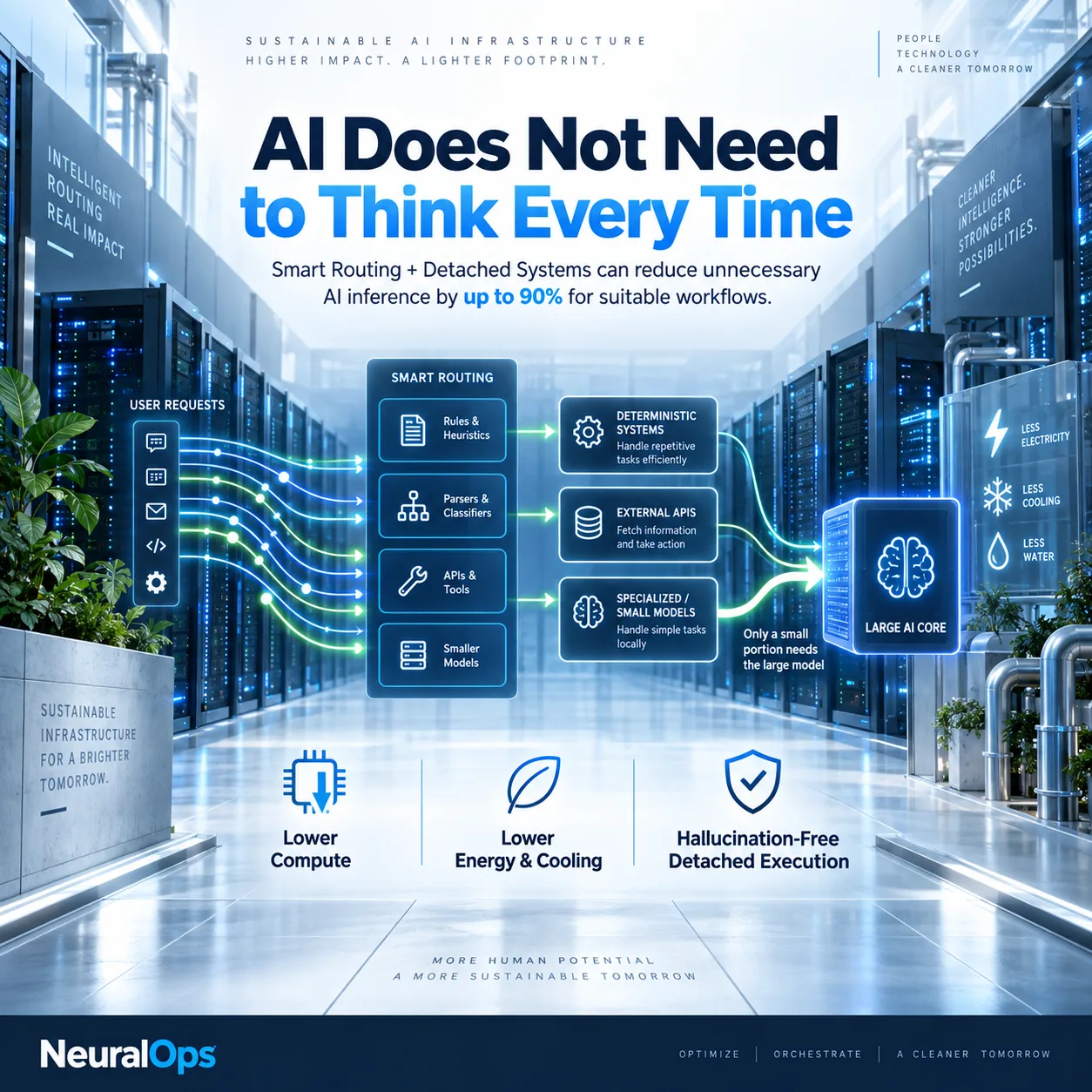
This is the principle behind our work at AINNA with NeuralOps:
Use advanced AI only when it delivers measurable business value.
Route simple tasks to deterministic systems to reduce cost.
Use smaller or local models where they provide adequate accuracy.
Cache reusable results to avoid redundant spend.
Reduce unnecessary context and token processing to optimize resource allocation.
Escalate to powerful models only for problems that justify the expense.
Less unnecessary compute translates to lower processing costs, reduced energy demand, and less heat that ultimately needs to be managed-directly impacting the bottom line.
The future of sustainable AI should not simply be about capital expenditure on greener data centres.
It should also be about building smarter AI architecture that optimizes operational expenditure before the workload even reaches the data centre.
AI efficiency is not just an infrastructure cost problem.
It is an architecture and financial management problem.
#ArtificialIntelligence #SustainableAI #GreenAI #NeuralOps #AIInfrastructure #DataCenter #EnergyEfficiency #ESG #AgenticAI #DigitalTransformation
















Ruang pembaca
Apa pendapat anda?
Komen baharu dihantar untuk semakan terlebih dahulu. Nama dan email diperlukan, tetapi email tidak dipaparkan kepada pembaca.
The bit about AI efficiency is not just is what I keep coming back to.
Clearer than the vendor decks I get about route simple tasks to deterministic. It make the point easier to understand.
أول مرة أقرأ شيئًا صريحًا عن هذا المقال.
I would push back slightly on reduce unnecessary context and token, but the direction is right.
Whoever wrote this actually did the work on use smaller or local models.
Good write-up. Why are we allocating expensive alone was worth teh read.
This is where known business logic finally clicks.
Why are we allocating expensive tu bahagian yang saya nak hantar pada boss.
cost-effectively - sums the whole thing up. It make the point easier to understand.