Strategic Social Commerce Capability and Revenue Performance Among Malaysian Agropreneurs
An Institutional Orchestration Perspective on the Agromarketing Masterclass TikTok Shop Edition
Abd Razzif Abd Razak*, Siti Faizah Zainal, Siti Nurulaini Azmi, Nur Hafizah Roslan, Nur Syairah Ani Faculty of Management and Economics, Universiti Pendidikan Sultan Idris, Perak, Malaysia
Entirely new AJoBSS manuscript repositioned from the published JIBE article. Theoretical framing: strategic social commerce capability, institutional orchestration and government-led digital transformation. Includes 6 tables, 3 figures, 51 APA references and 5 mandatory AJoBSS citations.
Abstract
Governments across emerging economies are investing heavily in social commerce training, yet scholarly understanding of how such interventions build strategic capability and translate into measurable revenue remains limited. This study examines the Agromarketing Masterclass TikTok Shop Edition through the lens of strategic social commerce capability and institutional orchestration, using official archival records covering 80 companies, 160 entrepreneurs and seven programme months from June to December 2024.
The programme generated RM6,205,957.06 in cumulative sales and an approximate return on investment of 1:30.64. Short-video and livestream channels accounted for the majority of monetised revenue, while content volume alone was not a consistent predictor of sales. The top ten sellers contributed 26.4% of total gross merchandise value and 25 sellers recorded zero sales. The article reframes a public-sector social commerce intervention as a strategic capability development problem rather than a programme outcome audit.
Keywords: strategic social commerce capability; institutional orchestration; agropreneur revenue performance; government-led digital transformation; SME competitiveness
Introduction
Competitive advantage now depends on the capacity to orchestrate digital customer journeys across social platforms. For SMEs, social commerce lowers entry barriers but raises capability requirements in content production, audience engagement, offer design and performance analytics.
The Agromarketing Masterclass TikTok Shop Edition, implemented by the Federal Agricultural Marketing Authority, provides a valuable empirical setting because it links institutional support with observable sales records. Mohd Noor and Afief El Ashfahany (2025) confirm that institutional framework influences young entrepreneurs' digital business performance in Malaysia, yet no prior AJoBSS study has examined a government social commerce intervention using official sales archives.
Research gap: Limited evidence connects institutional orchestration, strategic social commerce capability and revenue performance using administrative sales data. Objectives: Examine revenue structure, analyse monetised channel indicators, assess seller concentration and develop an institutional orchestration explanation for capability among Malaysian agropreneurs.
Theory & Conceptual Framework
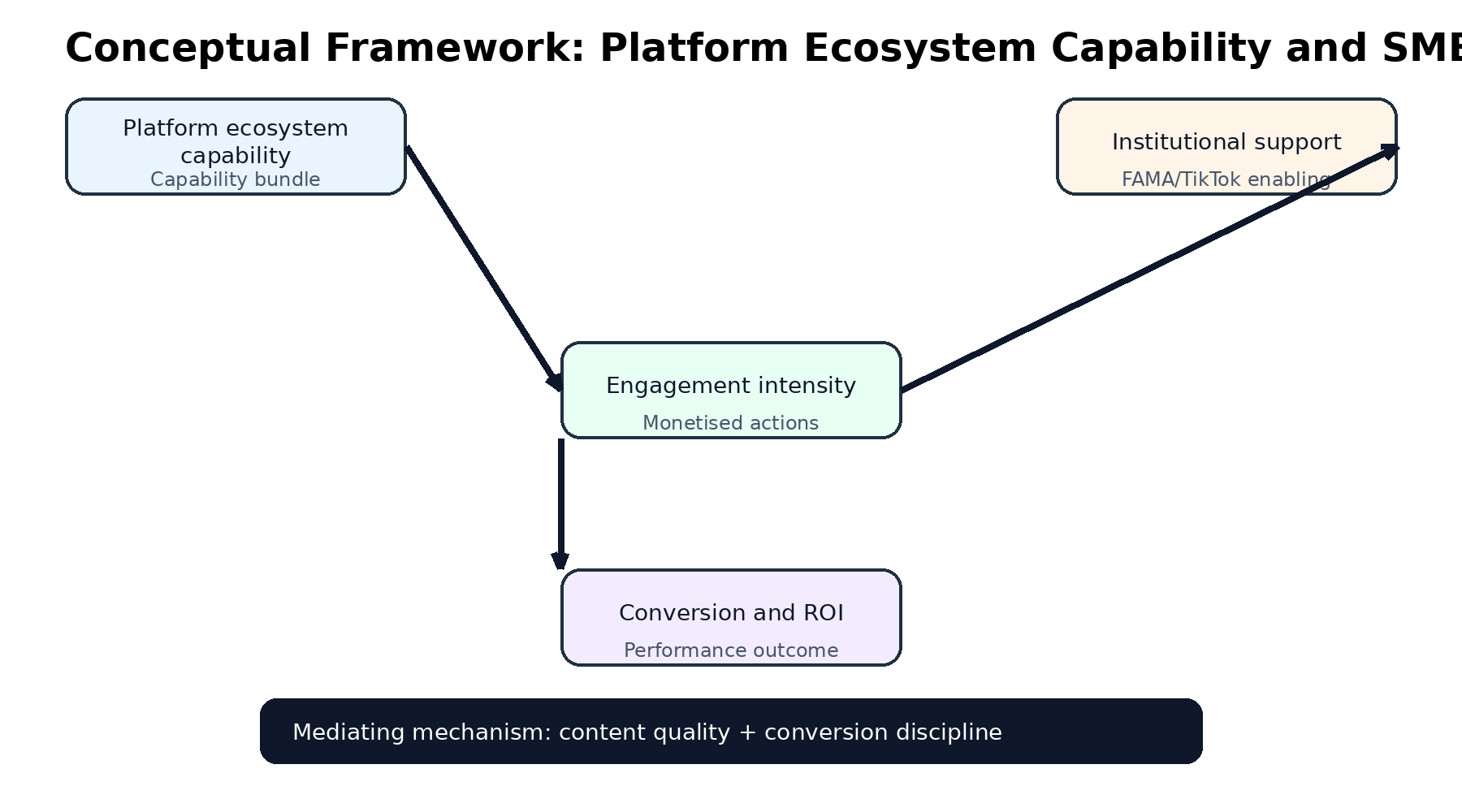
RBV + Dynamic Capabilities + Institutional Theory + TOE Framework → Strategic Social Commerce Capability (SSCC)
Strategic social commerce capability is defined as the integrated ability to design, execute and adapt monetisation-oriented social commerce activities across content, engagement and transaction pathways. Conversion intensity mediates the relationship between capability and revenue performance. Institutional orchestration by FAMA moderates the capability–conversion link.
Hypotheses: H1 SSCC positively associated with conversion intensity. H2 Conversion intensity positively associated with revenue performance. H3 Monetised channel activity more strongly associated with revenue than content volume. H4 Institutional orchestration strengthens the SSCC–conversion relationship. H5 Revenue concentrated among high-conversion sellers. H6 Inclusion depends on capability access, not participation alone.
Methodology
Post-positivist quantitative archival design using the official Projek Perintis Report (December 2024). Dataset: 80 companies, 160 entrepreneurs, 425 SKUs, June–December 2024. Analytical procedures: descriptive statistics, channel decomposition, geographic distribution, seller concentration analysis and Pearson correlation (n = 7 months). Ethics approval not required secondary official data without personal identifiers.
Findings
Reinterpreted through strategic social commerce capability not programme evaluation.
Table 1: Programme Profile
| Indicator | Value |
|---|---|
| Participating companies | 80 |
| Participating entrepreneurs | 160 |
| Stock keeping units marketed | 425 |
| PWD-owned companies | 13 |
| Cumulative sales (Jun–Dec 2024) | RM6,205,957.06 |
| Return on investment | 1:30.64 |
Source: Projek Perintis Report (December 2024).
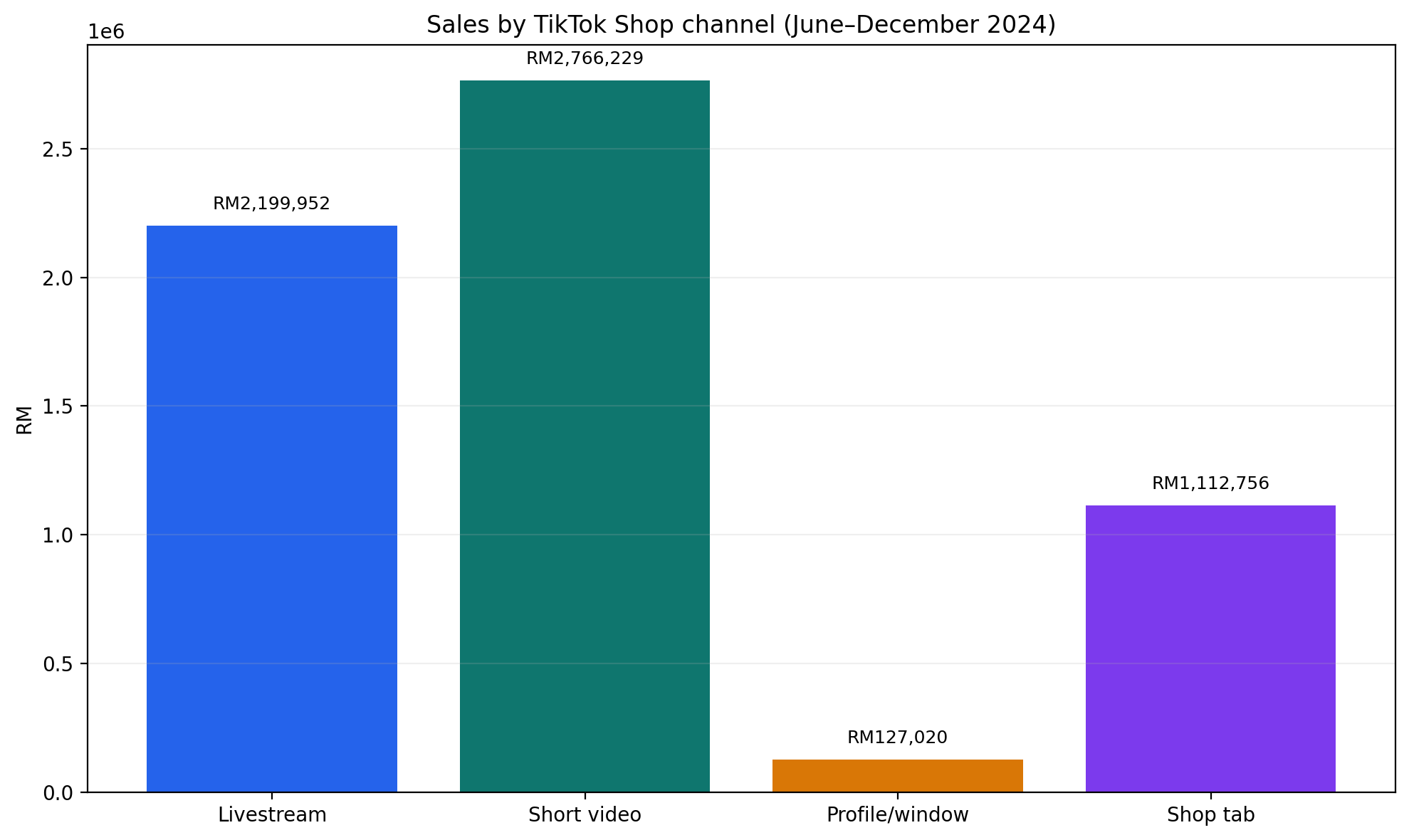
Table 2: Sales by Channel
| Channel | Sales (RM) | Share (%) |
|---|---|---|
| Short video | 2,766,229.44 | 44.6 |
| Livestream | 2,199,951.99 | 35.4 |
| Shop tab / others | 1,112,755.54 | 17.9 |
| Profile / window | 127,020.07 | 2.0 |
| Total | 6,205,957.06 | 100.0 |
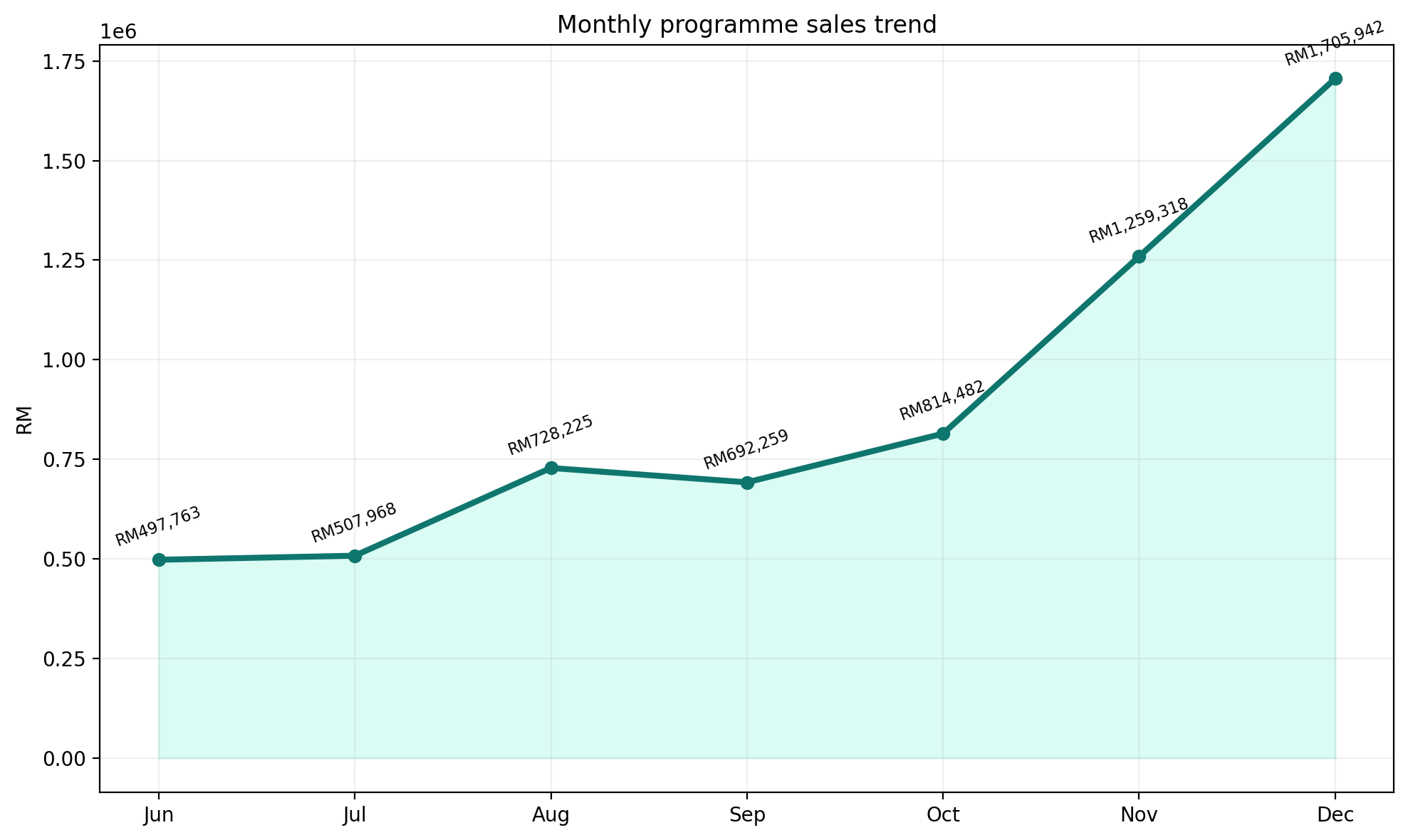
Table 3: Geographic Distribution
| State | Companies | Share (%) |
|---|---|---|
| Selangor | 33 | 41.3 |
| Perak | 8 | 10.0 |
| Kelantan | 8 | 10.0 |
| Kuala Lumpur | 6 | 7.5 |
| Negeri Sembilan | 5 | 6.3 |
| Johor / Terengganu | 4 each | 5.0 |
| Total | 80 | 100.0 |
Table 4: Top Ten Sellers by GMV
| Rank | Shop Name | GMV (RM) |
|---|---|---|
| 1 | Chef Ustazah HQ | 689,517.94 |
| 2 | kerepek azharfood | 533,945.85 |
| 3 | Munif Cocoa @ Koko Spread Sedap | 173,804.07 |
| 4 | DASTO HQ | 107,254.26 |
| 5 | Dapur Pak Amir | 39,562.30 |
| 6–10 | Baja Taiping, Ayamhalalbismi, RIZQ MART, Corndog Anak Ramai HQ, agromasmalaysia | 93,405.80 |
Top 10 = 26.4% of total sales. 55 sellers positive GMV; 25 sellers zero GMV.
Table 5: Pearson Correlation (n = 7)
| Indicator | r | p | Sig. |
|---|---|---|---|
| Short-video sales | .997 | <.0001 | ** |
| Livestream sales | .989 | <.0001 | ** |
| Orders | .977 | .0002 | ** |
| Products sold | .930 | .0024 | ** |
| Short-video content volume | .414 | .3556 | ns |
| Total content volume | .538 | .2133 | ns |
Monetised channels correlate strongly; content volume does not. Supports H3.
Contributions
Theoretical: Extends RBV by distinguishing exposure resources from conversion resources. Advances institutional theory by positioning FAMA as an orchestrator of platform-based revenue systems. Introduces conversion intensity as a programme-level mediator.
Practical: FAMA should segment sellers (high/moderate/inactive), deploy conversion clinics and track activation rates. TikTok Shop partnerships should support merchant conversion workflows. Policymakers should judge programmes by monetisation and inclusion outcomes, not attendance.
Social: Programme involved entrepreneurs from 14 states and 13 PWD-owned firms. Inclusion must be measured by monetisation access, not enrollment alone. Supports capability-based digital inclusion policy for rural and agro-based communities.
AJoBSS citations integrated: Mohd Noor & Afief El Ashfahany (2025) literature review gap; Mohd Yunos et al. (2025) theory development; Lasmini et al. (2025) discussion comparison; plus Yahaya (2025) and Amran et al. (2025).
Conclusion
The Agromarketing Masterclass TikTok Shop Edition should be understood as a strategic social commerce capability intervention, not a simple training audit. Revenue was driven by monetised channels and accumulated over time, but seller concentration reveals uneven capability distribution. Future research should incorporate seller-level longitudinal analytics, profit measures and experimental programme designs.
Download
Publication-ready manuscript 51 APA references, 6 tables, 3 figures, ethics/author/acknowledgement sections. Formatted with official AJoBSS template.
Download DOCXPublished JIBE article empirical dataset source only. The AJoBSS manuscript uses entirely new framing, theory and scholarly contribution.
Download PDFOfficial journal template: Template of Article_AJoBSS_new.docx
Download TemplateFull manuscript text in markdown for review and editing.
View Markdown