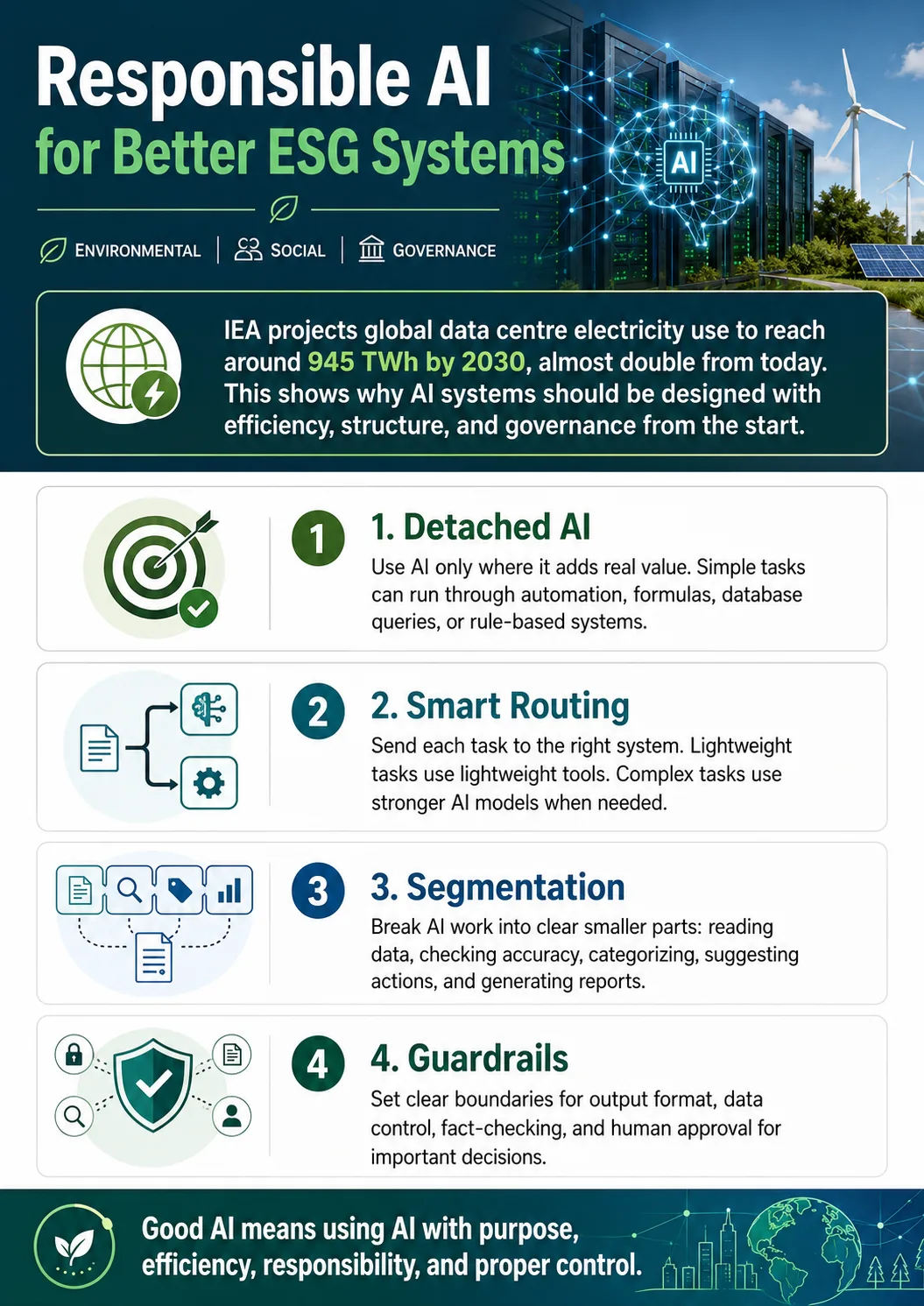
Data centre power demand is projected to climb from 415 TWh in 2024 to 945 TWh by 2030, with emissions potentially rising from roughly 185 Mt CO₂ to 421 Mt CO₂. At AINNA, we see this as a systems-operations problem first and an ESG problem second. AI has to be powerful, yes-but in production it also has to be efficient, modular, and tightly governed.
1. Detached AI
Detached AI means not coupling AI into every process by default. Not every task needs a model. Deterministic automation, formulas, database queries, and rule-based engines often handle simple work faster, cheaper, and more predictably. We attach AI only where it produces clear marginal value. That reduces unnecessary compute load, latency, and infrastructure churn, and it enforces the kind of resource discipline ESG frameworks expect.
2. Smart Routing
Smart routing means sending each task to the right component. Lightweight work-lookups, classification, validation-should run on lightweight tools. Heavy generative or reasoning tasks should hit larger models only when the complexity actually demands it. This keeps GPU utilization proportional to the problem and prevents over-provisioning. From an ESG angle, it means better energy efficiency, tighter cost control, and a more sustainable operational footprint.
3. Segmentation
Segmentation means breaking AI workloads into discrete, observable stages: ingestion, validation, categorization, reasoning, action recommendation, reporting. A single monolithic model is harder to debug, optimize, and audit than a pipeline of focused components. Segmented architectures give us clearer monitoring, version control, and failure isolation. They also make the system more transparent, which is essential for governance and accountability under ESG standards.
4. Guardrails
Guardrails are the operational boundaries that keep AI predictable and responsible. We enforce structured output formats, fact-checking against trusted sources, least-privilege data access, and human-in-the-loop approval for high-impact decisions. The goal is not autonomous replacement of judgment; it is decision support that stays inside known-safe bounds. For ESG, that means safer, explainable, and governable AI.
Good AI is not the result of using models everywhere. It is the result of using them with purpose, efficiency, clear architecture, and strong operational control.
Official Cross-Network Resource














Ruang pembaca
Apa pendapat anda?
Komen disemak sebelum diterbitkan. Email diperlukan untuk moderasi dan tidak dipaparkan kepada pembaca.
Lebih jelas daripada dek vendor yang saya terima pasal 415.
The direction on in 2024 to 945 is spot on.
The numbers around CO₂ to 4 421 M make more sense than most posts I read.
The bit about data centre power demand is what I keep coming back to.