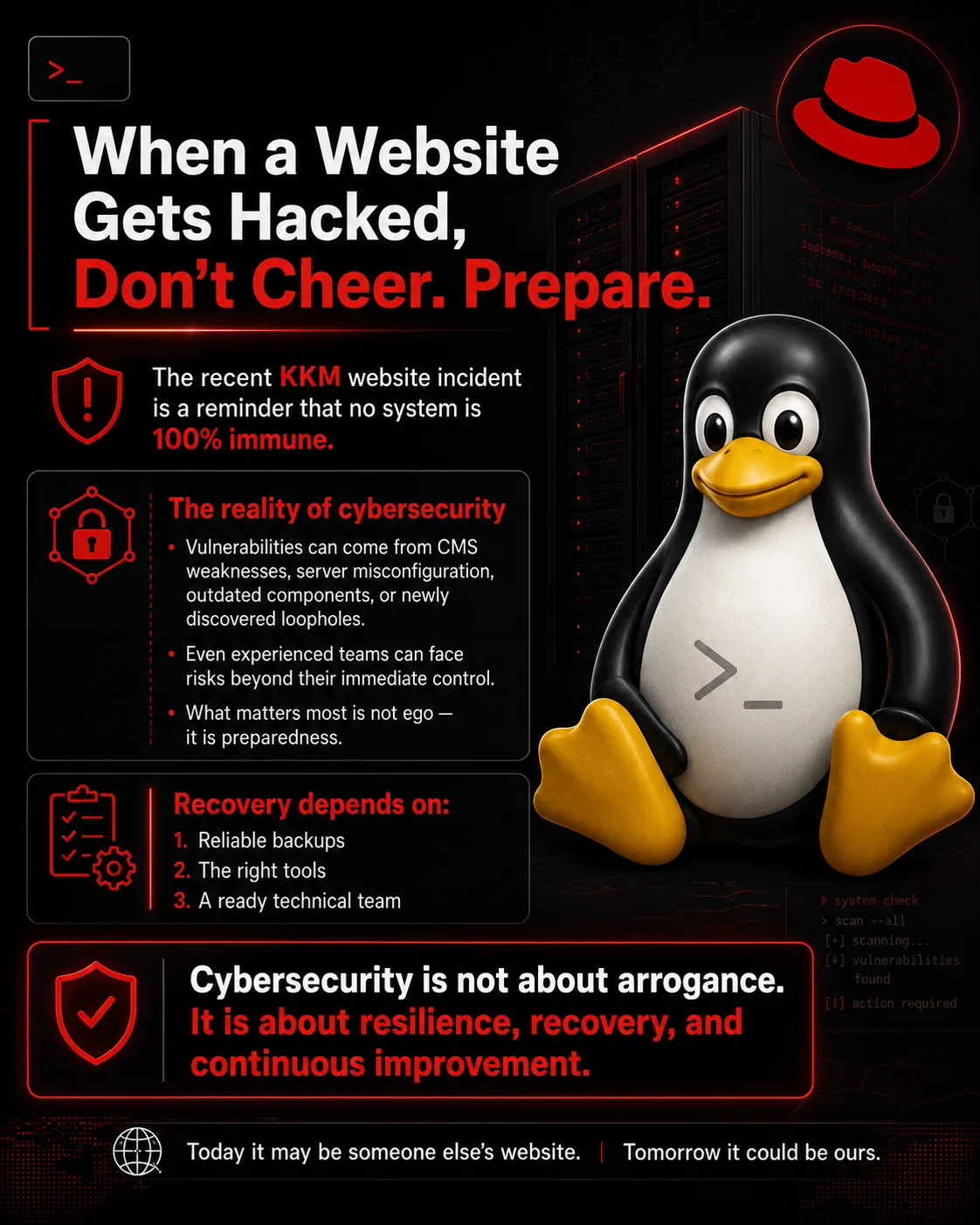
From an engineering and integration standpoint, reports that the KKM website was hacked or defaced are a useful field reminder: in production systems, security is not a place for ego.
Whenever a high-profile site goes down, the public response is usually criticism. Security consultants, AI engineers, and tech commentators often talk as if their own stacks are somehow exempt from the same failure modes.
The field reality is different.
No live system is 100% safe. Government portals, corporate platforms, SME sites, CMS instances, and even hardened servers can still take a hit. Attack paths are real: stale CMS versions, vulnerable plugins, misconfigured servers, weak access controls, patch lag, or zero-day gaps that were not known at the last review.
Sometimes the issue is not whether the team is competent. It is whether the organization has rehearsed what happens when a layer fails.
This is why backups, monitoring, scheduled audits, server hardening, incident-response playbooks, and recovery drills matter in production.
A defaced site is not only a technical outage. It is a business-continuity event, a trust hit, and a reputational signal.
Mean time to recovery hinges on three operational factors:
- Backup integrity and coverage
- Tooling and automation on hand
- Team readiness under pressure
Security work should not be about pointing at another team's outage. It should be about learning from it and tightening your own stack before you face the same failure.
Today, it is someone else's production surface.
Tomorrow, it could be ours.
Good security is not about being the loudest voice in the room. It is about being prepared, disciplined, and continuously improving.
#CyberSecurity #WebsiteSecurity #BusinessContinuity #DigitalRisk #IncidentResponse #SME #Technology #NeuralOps

















Ruang pembaca
Apa pendapat anda?
Komen baharu dihantar untuk semakan terlebih dahulu. Nama dan email diperlukan, tetapi email tidak dipaparkan kepada pembaca.
Bookmarked, mostly for backup integrity and coverage tooling. Still thinking this one through.
Not convinced on vulnerable plugins, misconfigured servers yet, but fair argument.
Clear and short. Sharing security is not a place with my team.
Still thinking about security consultants, AI engineers.
Sent this to two people already. Attack paths are real: stale is why.
เห็นด้วยเรื่อง100% แต่ทำจริงยาก