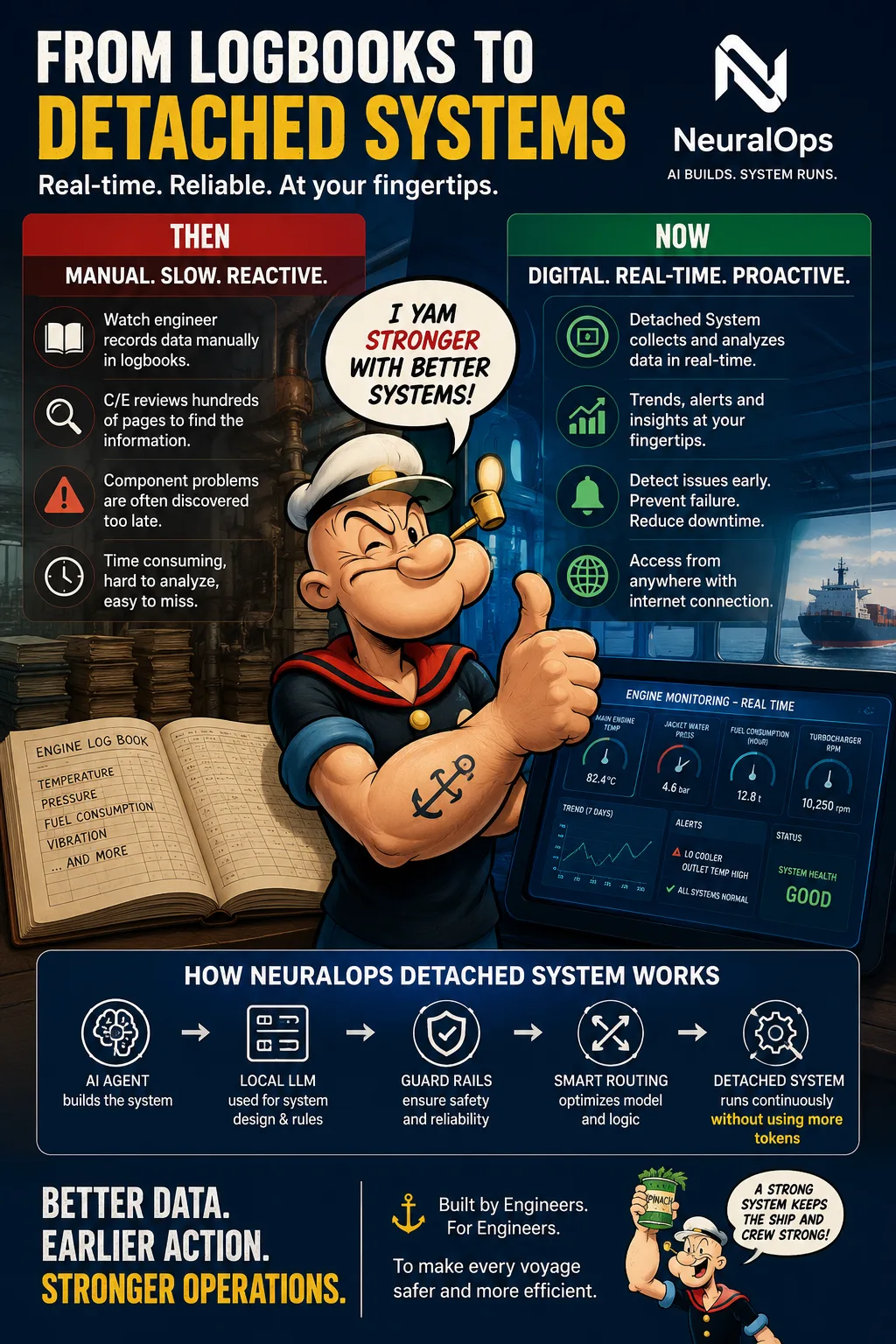
I graduated in Marine Engineering and started my career at a time when instruments and control systems were already widely used onboard ships, but most of them were not yet digitally connected. Watch engineers still had to record temperatures, pressures, fuel consumption, vibration, and other engine parameters manually in physical logbooks.
When the Chief Engineer wanted to review the vessel’s engine condition, he often had to open and compare hundreds of logbook pages. The data was available, but identifying patterns across several days or weeks required significant time, experience, and manual calculation.
Because of this limitation, the Chief Engineer would sometimes only discover that a component was deteriorating when the problem had already become serious or after the equipment had failed. The issue was not the absence of data, but the inability to process and interpret it quickly.
Today, a Detached System can collect, organise, and analyse operational data in real time. With internet connectivity, both the vessel’s engineering team and headquarters can monitor engine performance, identify abnormal trends, and access critical information directly from their devices.
At NeuralOps, we use local LLMs, AI agents, Guard Rails, and Smart Routing to build these systems. Once deployed, the Detached System continues operating using validated rules and fixed logic without continuously consuming additional AI tokens.
Key benefits include:
Real-time engine monitoring
Early detection of abnormal trends
Faster preventive maintenance decisions
Reduced equipment downtime
Lower operating and AI token costs
Remote monitoring for headquarters
More reliable and auditable system performance















Ruang pembaca
Apa pendapat anda?
Komen baharu dihantar untuk semakan terlebih dahulu. Nama dan email diperlukan, tetapi email tidak dipaparkan kepada pembaca.
Good write-up. pressures, fuel consumption, vibration alone was worth the read.
Honestly, identify abnormal trends, and access surprised me.
Whoever wrote this actually did the work on once deployed, the detached system.
The framing around experience, and manual calculation.Because is better than I expected. Worth reading twice.
I would push back slightly on watch engineers, but the direction is right.
Useful. We are dealing with AI agents, guard rails right now.
The numbers around organise, and analyse operational data make more sense than most posts I read. Have a few questions left here.