AINNA NeuralOps Infrastructure: Private LLM Server, VPN-Secured vLLM, VPS Agent Layer, Detached Systems and Hermes - A Finance and Asset-Control Perspective
AINNA NeuralOps is structured as a capital-efficient, modular AI operations stack where the LLM server is treated as a protected business asset rather than a public-facing service.
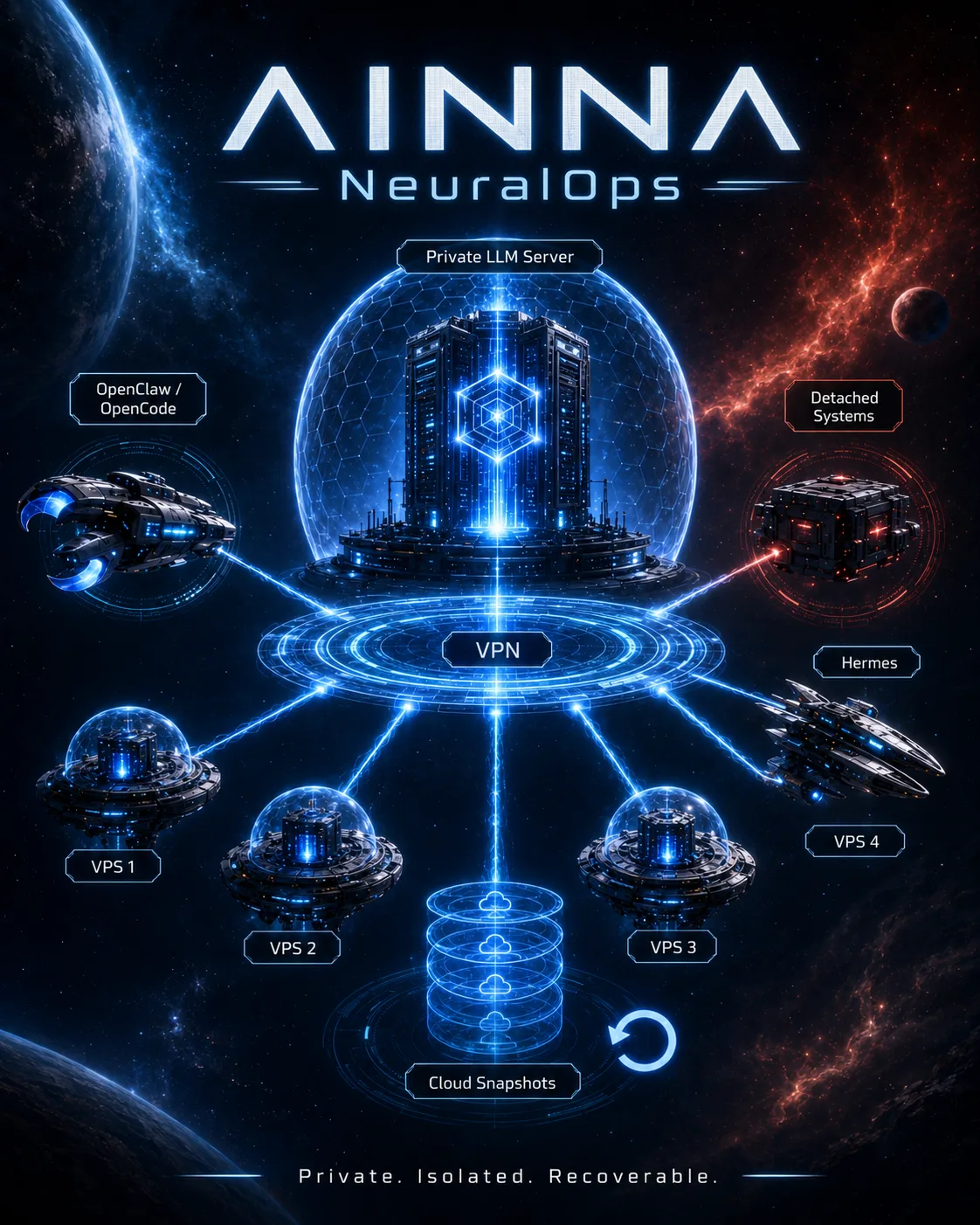
At the center of this architecture sits a private LLM server running vLLM, capable of supporting up to 7 LLM models across distinct operational workloads. The server runs entirely behind a VPN-secured private network, with administrative access limited to authorized personnel only. From an asset-management standpoint, this means the core compute asset is not depreciated prematurely by public exposure, unauthorized usage, or uncontrolled load.
The public internet has no direct line of sight into the LLM server.
No public admin panel.
No exposed model backend.
No open inference ports.
No direct access to GPU resources.
No unnecessary attack surface that could trigger remediation cost, downtime, or data liability.
The VPS layer carries a clearly defined cost and operational role in this infrastructure.
The VPS functions as an agent execution layer, not as a public LLM exposure layer. It supports OpenClaw or OpenCode agents, together with Detached Systems and Hermes operational workflows. In accounting terms, this is the operational expenditure layer: it absorbs variable execution workloads without placing load on the capital-intensive LLM server.
Each VPS is isolated from other VPS instances at the cloud infrastructure level. This separation functions like cost-center segregation: one workload cannot drain budget, compute, or stability from another, and different agents, systems, or operational services run in their own controlled environments.
Snapshots form part of the financial risk-control strategy. Before major changes, deployments, or agent-driven system modifications, the VPS environment can be snapshotted. If a change causes failure, rollback to a previous stable state is fast. This reduces downtime cost, protects committed operational budget, and makes experimentation, automation, and agent execution safer without endangering the entire asset base.
The VPS layer handles controlled, budget-tracked execution tasks such as:
OpenClaw / OpenCode agent execution
system auditing
website monitoring
automation workflows
Detached System operations
Hermes integration
logs, audit trails, and reporting workflows
lightweight orchestration between cost-controlled services
snapshot-based recovery and rollback
The LLM server remains isolated behind the VPN. The VPS communicates with the LLM server through a controlled private route, using a restricted API access policy for model inference only. The agent layer can request model output, but it cannot freely access the LLM server environment. This is a clear segregation of duties: the expensive inference asset is protected, while the variable execution layer performs work without inheriting unnecessary risk.
This separation gives each layer a clear financial and operational responsibility.
The LLM server is the capital-intensive inference asset.
The VPS is the variable-cost agent execution layer.
The Detached System is the operational workflow control layer.
The Hermes system is the internal business operations layer.
The VPN is the security and access-control boundary.
The cloud snapshot is the risk-recovery layer.
By separating these responsibilities, AINNA NeuralOps delivers measurable risk reduction, better cost control, and easier maintenance. If one VPS fails, other VPS instances remain isolated, limiting financial exposure. If an agent workflow causes damage, the affected VPS can be reverted using snapshots, avoiding full rebuild cost. If the VPS layer has a problem, the LLM server remains protected behind VPN, preserving the value of the core asset. If Hermes requires automation, reporting, or operational processing, it works through the Detached System instead of touching the LLM backend directly.
AINNA NeuralOps is not a simple chatbot project.
It is a modular AI operations stack built for real business workflows and audited operational outcomes:
Private LLM Server + vLLM + VPN + Isolated VPS Agent Layer + Cloud Snapshots + Detached System + Hermes
This infrastructure gives AINNA better control over AI execution cost, model access rights, operational automation, system recovery, security boundaries, and long-term scalability for Malaysian SMEs.
AI infrastructure is not only about model performance or benchmark scores.
It is about cost control.
It is about asset isolation.
It is about auditability.
It is about maintainability.
It is about recoverability.
And most importantly, it is about protecting the organization's most valuable digital assets from public exposure and unbudgeted loss.
https://ainna.bond/ainna-ai/ - Our protected LLM Server asset













Ruang pembaca
Apa pendapat anda?
Komen disemak sebelum diterbitkan. Email diperlukan untuk moderasi dan tidak dipaparkan kepada pembaca.
Ang bahagi tungkol sa bahaging ito ang pinag-isipan ko nang matagal.
Bookmarked, mostly for modular AI operations stack.
This is where together with detached systems finally makes sense.
Honestly, rollback to a previous stable surprised me.
The numbers around openClaw / opencode agent execution make more sense than most posts I read.