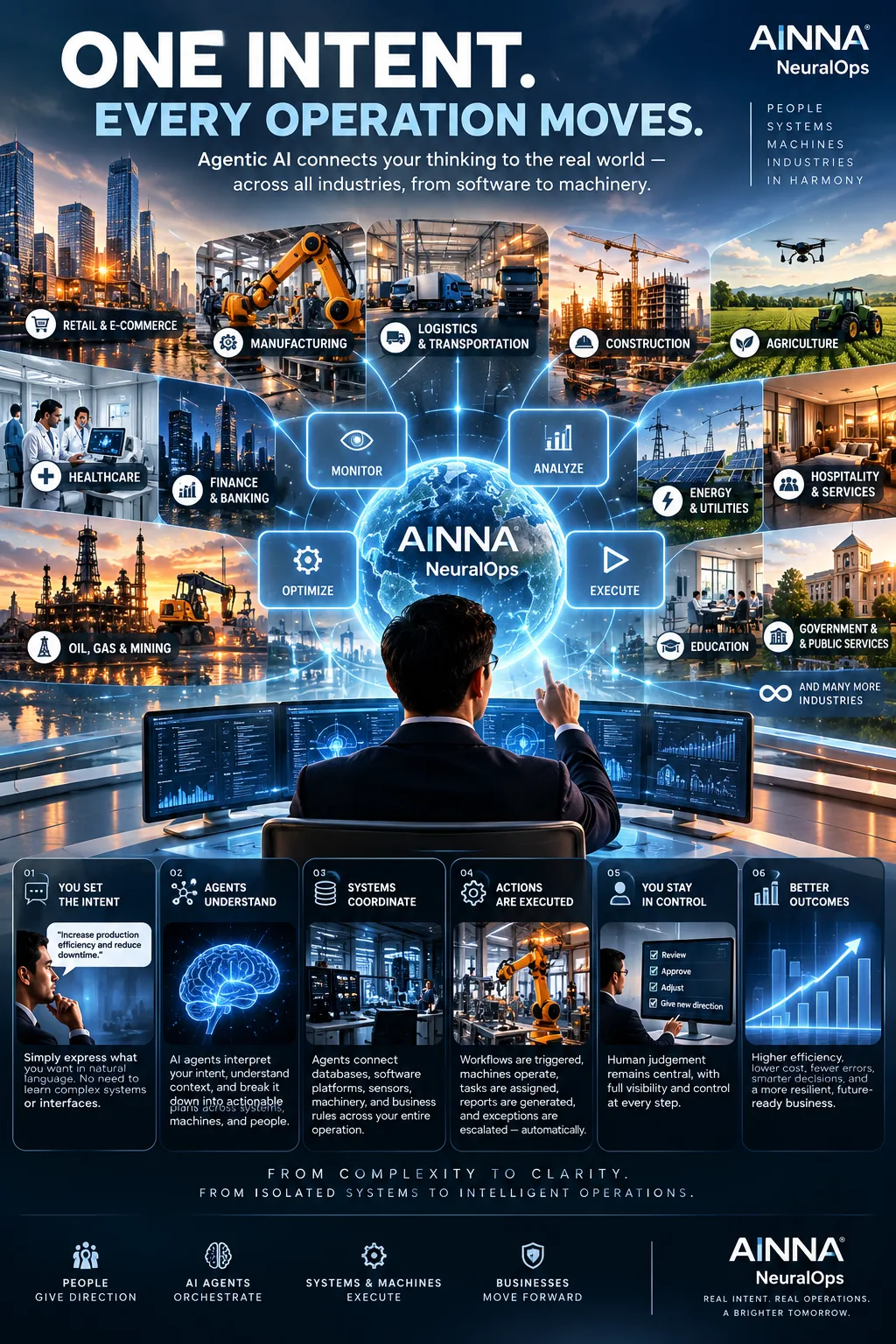
From a finance and accounting perspective, the next major shift in technology may not be another app, another dashboard, or even another generation of smarter software. It may be the disappearance of the boundary between human intent and machine execution. In the near future, Agentic AI could become the operational layer connecting people directly with the systems, software, equipment, and machinery around them-transforming how we manage financial operations and asset data.
For decades, every industry has required humans to adapt to machines. Factory operators learn control panels. Finance teams learn accounting systems. Logistics teams learn warehouse software. Farmers learn equipment interfaces. Engineers learn industrial systems. Managers move between dozens of applications just to keep operations running. The next era may reverse that model-technology begins adapting to the way people think, communicate, decide, and work. As someone who deals with financial systems daily, I see this as a shift that could finally reduce the manual effort spent on data entry, reconciliation, and report generation.
A manager may simply define an outcome: increase production efficiency, reduce downtime, monitor energy consumption, detect abnormal machine behaviour, schedule maintenance, rebalance inventory, prepare financial reports, optimise delivery routes, or escalate an operational risk. Intelligent agents can then coordinate software, databases, sensors, APIs, industrial equipment, automation systems, and business rules behind the scenes. From a finance perspective, this means financial reports can be generated automatically from real-time operational data, ensuring accuracy and freeing up the accounting team for more strategic analysis.
This is where Agentic AI becomes much larger than a chatbot. It becomes an orchestration layer across entire industries-manufacturing, agriculture, logistics, retail, construction, energy, finance, healthcare, hospitality, transportation, and services. Machinery no longer operates as an isolated asset. Data no longer sits inside disconnected systems. Each component can become part of a coordinated operational environment working toward the same objective. For Malaysian SMEs, this could mean better asset utilisation, lower operational expenditure, and more accurate financial forecasting.
The principle is not to replace human judgement. It is to remove unnecessary complexity between a decision and its execution. AI handles interpretation and coordination. Automation handles repetition. Deterministic systems handle consistency. Machines execute physical tasks. Humans remain responsible for direction, boundaries, approvals, and strategic decisions. In finance and accounting, this means we retain control over approvals, compliance, and strategic financial planning, while AI and automation handle routine data processing and reconciliation.
At AINNA, this is the future we see through Agentic AI and NeuralOps: moving from organisations that operate separate software and machinery, toward environments where digital systems and physical machines respond coherently to human intent. From the finance and accounting side, we see this as a path to measurable business value-reduced manual effort, improved data accuracy, and better financial visibility for Malaysian SMEs. What looks advanced today may soon become standard infrastructure-a world where the technology around us operates increasingly like an extension of how we think, decide, and lead.















Ruang pembaca
Apa pendapat anda?
Komen disemak sebelum diterbitkan. Email diperlukan untuk moderasi dan tidak dipaparkan kepada pembaca.
Terus terang, agentic AI could become ni menarik.
简单直接。这篇文章就能说明问题。
关于这个主题这部分写得很扎实,整体也站得住。
Sent this to two people already. Intelligent agents can then coordinate is why.
Useful. We are dealing with farmers learn equipment interfaces right now.
Finance teams learn accounting systems - sums the whole thing up.