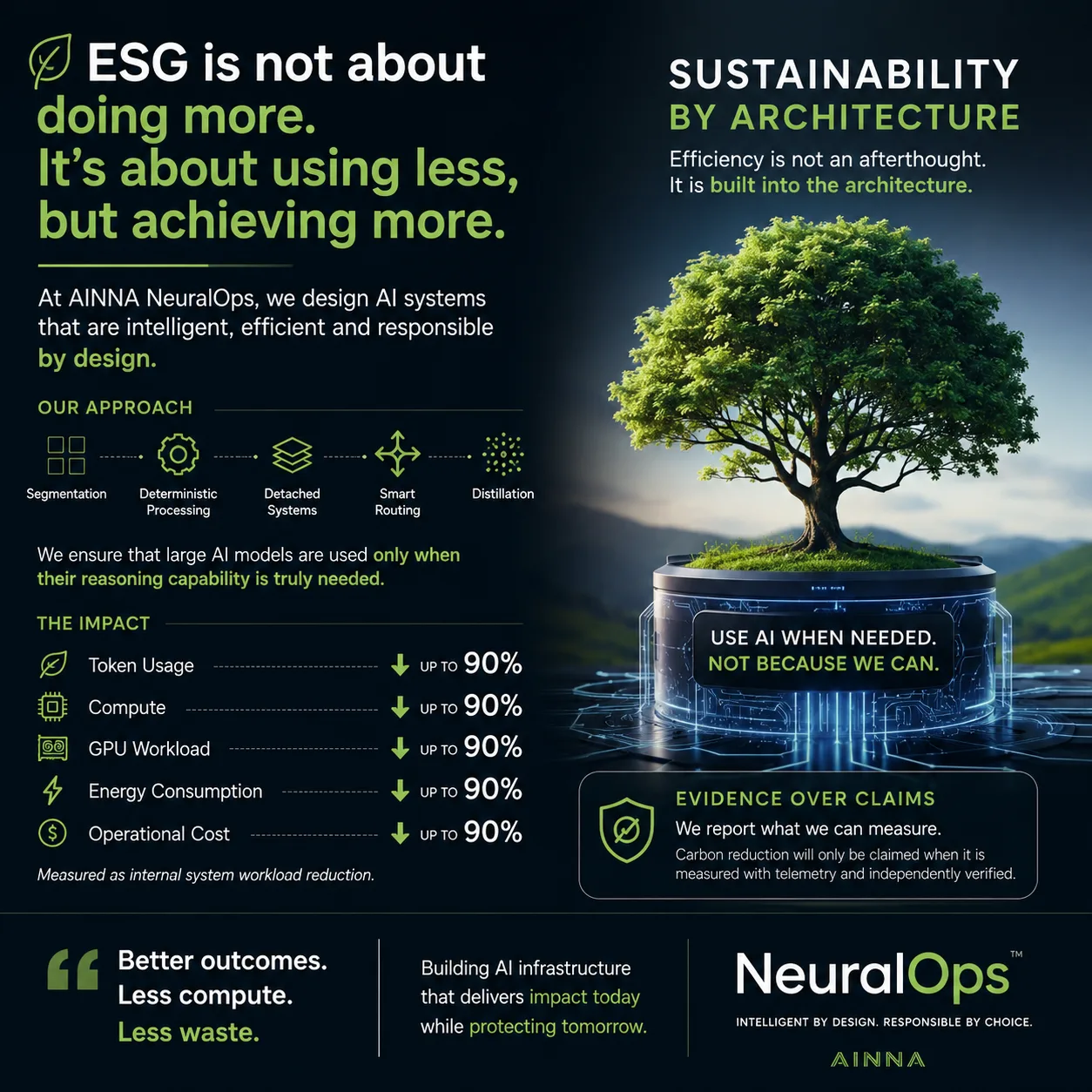
From a finance and accounting standpoint, ESG is not just a disclosure requirement, a certification badge, or a marketing narrative.
It starts with a straightforward financial question:
Can we deliver the same - or better - business outcome while consuming significantly less capital and operating expenditure?
In AI deployments, I often see systems defaulting to large models for nearly every task.
But not every request justifies the compute cost associated with heavy AI reasoning.
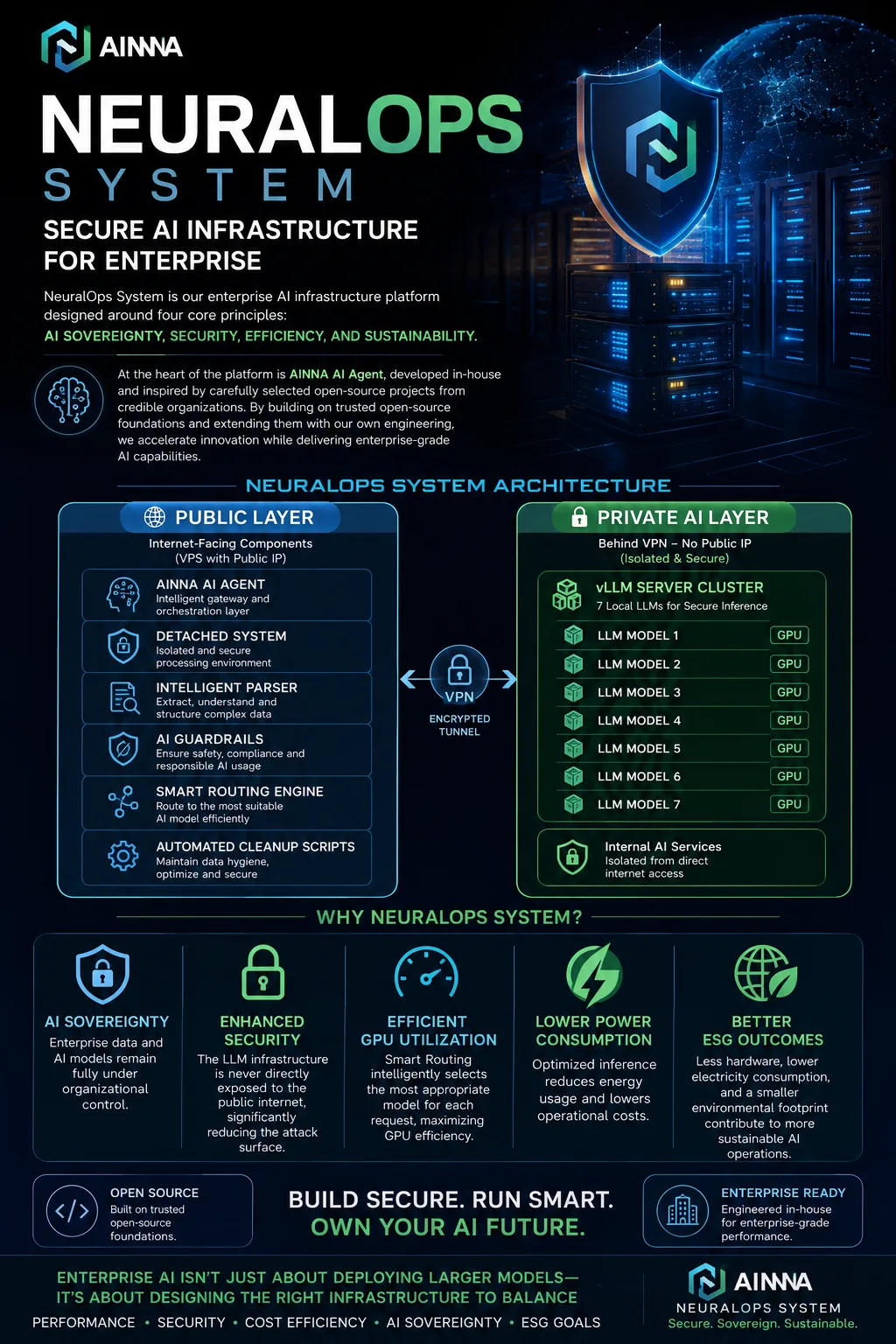
At AINNA, through NeuralOps, we are approaching this from a cost-to-serve and asset-utilization angle.
We apply segmentation, deterministic processing, detached systems, smart routing, and model distillation so that larger AI models are invoked only when their reasoning capability is genuinely required by the workload.
The financial objective is clear:
Reduce token spend.
Reduce compute overhead.
Improve GPU asset utilization.
Lower energy costs.
Shrink operational expenditure.
While preserving - or improving - the measurable business outcome.
For me, this is a more finance-grounded interpretation of ESG:
Sustainability through capital-efficient architecture.
Rather than retrofitting an “ESG layer” once a system is already in production, we should design the infrastructure upfront to extract more value from every Ringgit of compute and every hour of asset life.
There is a second principle that is equally important from an accounting and governance perspective:
Do not overclaim.
If we can measure a meaningful reduction in processing workload, token volume, or GPU utilization, we record it as a quantified operational result.
But if carbon reduction has not yet been tracked through telemetry and independently validated, it does not belong in the books or in public claims.
Because credible ESG reporting - like credible financial reporting - requires auditable evidence.
Better business outcomes. Lower compute cost. Less waste.
That is the financial direction we are pursuing with NeuralOps - building AI infrastructure where cost discipline and asset efficiency are engineered into the design, not patched on later.
#ESG #SustainableAI #GreenAI #ArtificialIntelligence #NeuralOps #AIInfrastructure #Sustainability #DigitalTransformation #SovereignAI #Innovation #AINNA














Ruang pembaca
Apa pendapat anda?
Komen disemak sebelum diterbitkan. Email diperlukan untuk moderasi dan tidak dipaparkan kepada pembaca.
Ringkas dan jelas. Reduce token spend boleh kongsi dengan team saya.
先存起来,主要是为了这篇文章。
The case for asset-utilization is well made.