
SMART CITY COST LEDGER: DIRECT AI VS NEURALOPS
For a chief financial officer or asset manager, a city of 1 million people represents a large operating entity that may emit approximately 8.3 million tonnes of CO₂e annually.
If smarter management of traffic, energy, water, waste, buildings, and infrastructure trims that footprint by just 6%, the municipality avoids around:
498,000 tonnes of CO₂e per yearThat is equivalent to roughly:
46 days of emissions from one average coal-fired power plantThe real question is therefore not whether a city has deployed AI.
It is how efficiently its AI budget and compute assets are used.
The direct-AI cost profile
Every task-simple check, alert, calculation, or routine workflow-is sent to the largest available AI model.
This inflates the operating statement and the carbon ledger:
❌ Higher token consumption
❌ Longer GPU utilisation
❌ Higher electricity demand
❌ Higher data-centre and cooling costs
❌ A larger AI-related carbon exposure
The NeuralOps value proposition
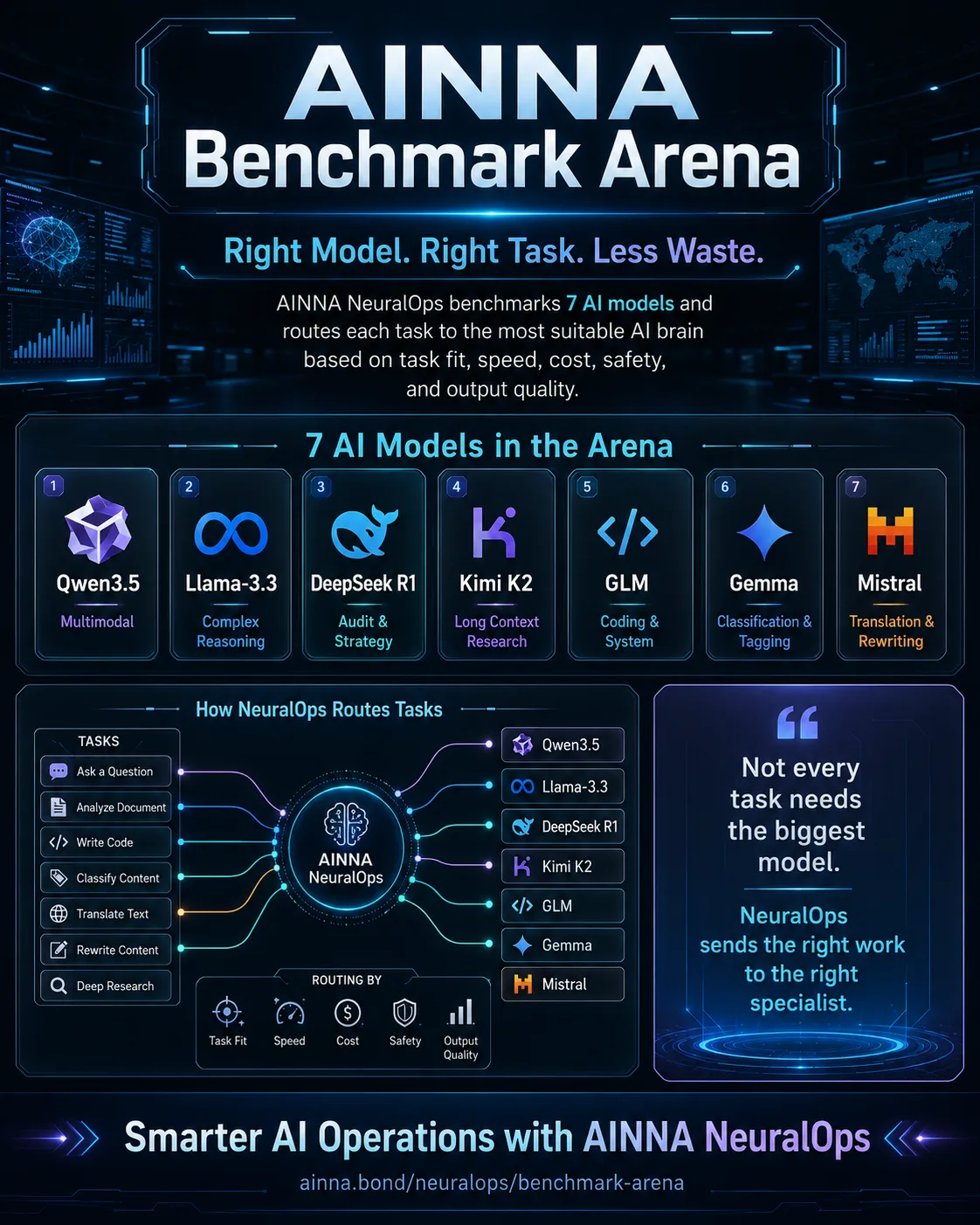
NeuralOps treats inference as an asset-allocation problem. It combines:
✅ Smart Routing
✅ Detached Systems
✅ Model Segmentation
✅ Specialised AI Agents
✅ Deterministic Validation
✅ Small models for simple tasks
✅ Large models reserved for complex decisions
Inside AINNA’s own operations, estimated workload fell from approximately 32 billion tokens to 2–3 billion tokens.
That is a 90.6%–93.8% reduction in computational workload.
Carbon emissions do not fall in lockstep, but the financial and environmental impact is material: lower inference spend, fewer GPU hours, reduced electricity and cooling bills, and lighter carbon-reporting exposure.
The IPCC has noted:
“An increasing share of emissions can be attributed to urban areas.”
A Smart City should not be measured by the volume of AI it deploys.
It should be measured by the waste, cost, energy use, and carbon it removes per ringgit of public or private investment, and the same capital-efficiency discipline is what lets Malaysian SMEs protect margins, extend hardware life, and lower ESG compliance costs.
Direct AI asks:
Which model should answer this?
NeuralOps asks:
Does this task require AI at all?
And when it does:
What is the smallest, most cost-efficient model capable of completing it accurately?
Less computation.
Better capital allocation.
Lower operating expenditure.
Lower emissions exposure.
#NeuralOps #AINNA #SmartCity #GreenAI #CostEfficiency #CapexOptimization #OPEX #CarbonAccounting #ESG #AssetManagement
















Ruang pembaca
Apa pendapat anda?
Komen disemak sebelum diterbitkan. Email diperlukan untuk moderasi dan tidak dipaparkan kepada pembaca.
还在消化1这一段。
The framing around estimated workload fell is better than I expected.
Honestly, 46 days of emissions surprised me.