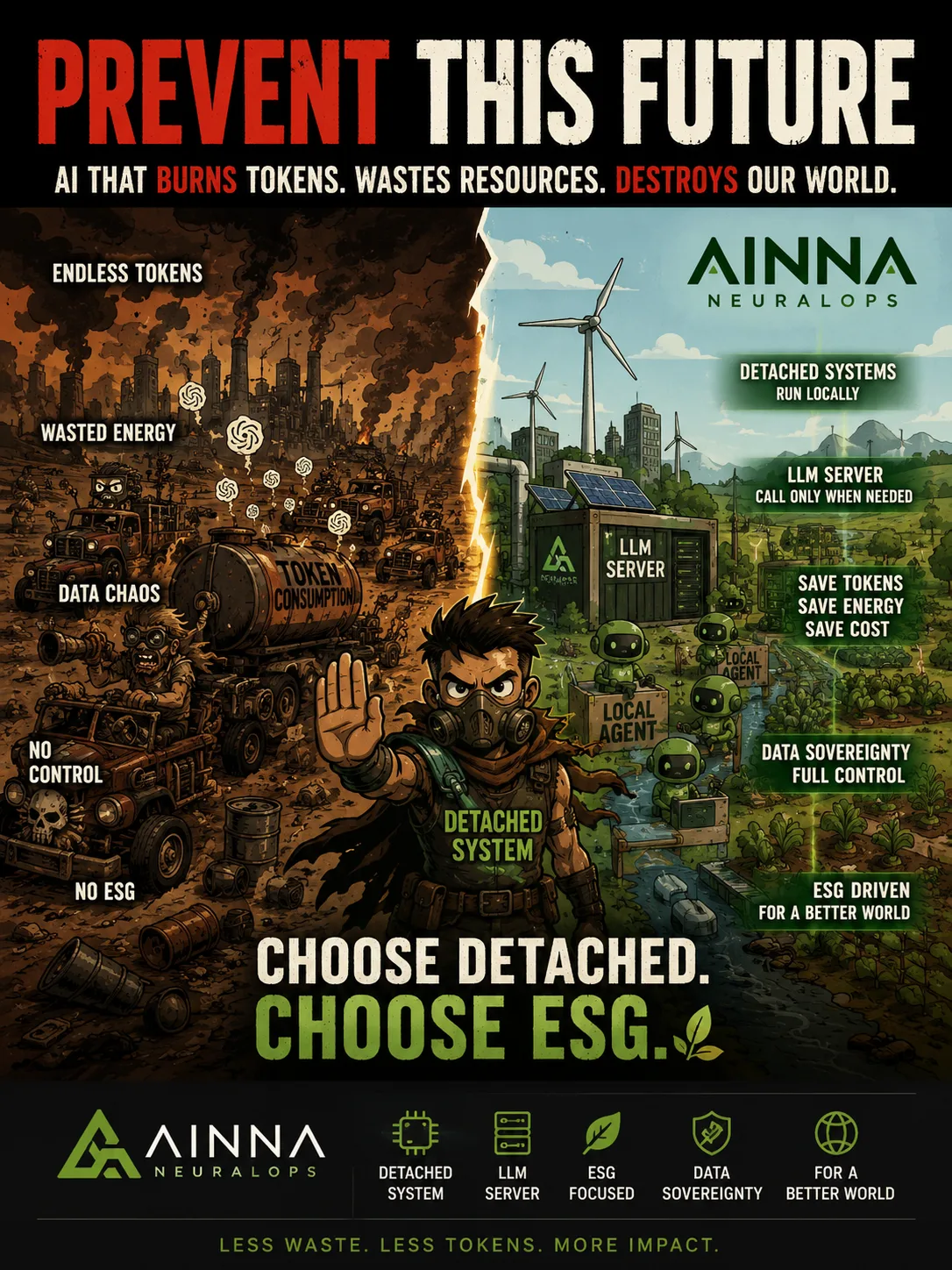
Imagine running hundreds of AI detached systems continuously in the background without paying token costs every second.
That is the architecture we are building with AINNA NeuralOps: Detached System + LLM Server.
From a system builder's view, the real problem with AI today is not only cost. It is architecture. Too many workflows still route directly to large language models, even when routine work can be handled by smaller systems - local scripts, databases, rule engines, sensors, schedulers, and lightweight agents.
When every operation triggers an LLM call, token burn becomes uncontrolled. With the right architecture, we can reduce token usage dramatically - in some workflows, by up to 90%.
The design principle is straightforward: do not send everything to a large model. Use detached systems for routine monitoring, data ingestion, classification, validation, formatting, and preprocessing. Reserve the LLM Server for tasks that actually need reasoning, summarization, decision support, report generation, or human-readable explanation.
In practice, this means ecommerce backends can monitor orders all day, accounting pipelines can extract financial structures from bank statements, farm operations can process sensor data locally, and manufacturing systems can consume machine logs, alarms, PLC/SCADA exports, and maintenance records - all without continuous inference costs.
This is not just cost optimization. It is better AI system design.
We move from AI as a chatbot to AI as an operational layer. From sending everything to a large model, to local-first intelligence. From continuous token usage, to event-driven reasoning.
It also matters for ESG. A leaner AI architecture means less redundant compute, lower energy waste, reduced cloud dependency, and more efficient use of digital infrastructure. For businesses, that translates to lower operating cost and better scalability. For countries, it supports data sovereignty. For the planet, it means more responsible computing.
The future of AI is not only about building bigger models. It is about building smarter systems around them.
That is the vision behind AINNA NeuralOps - Detached System, LLM Server, local-first AI, data sovereignty, ESG-friendly automation, and AI architecture for a better world.
#AINNA #NeuralOps #DetachedSystem #LLMServer #ArtificialIntelligence #AgentAI #LocalAI #DataSovereignty #ESG #SustainableAI #ResponsibleAI #BusinessAutomation #IndustrialAI #MalaysiaAI #AIForGood













Ruang pembaca
Apa pendapat anda?
Komen disemak sebelum diterbitkan. Email diperlukan untuk moderasi dan tidak dipaparkan kepada pembaca.
Ringkas dan jelas. 90% boleh kongsi dengan team saya.
关于90%这部分写得很扎实,整体也站得住。
The case for token burn becomes uncontrolled is well made.
The section on reserve the LLM server is the strongest part for me.
The bit about accounting pipelines can extract financial is what I keep coming back to.