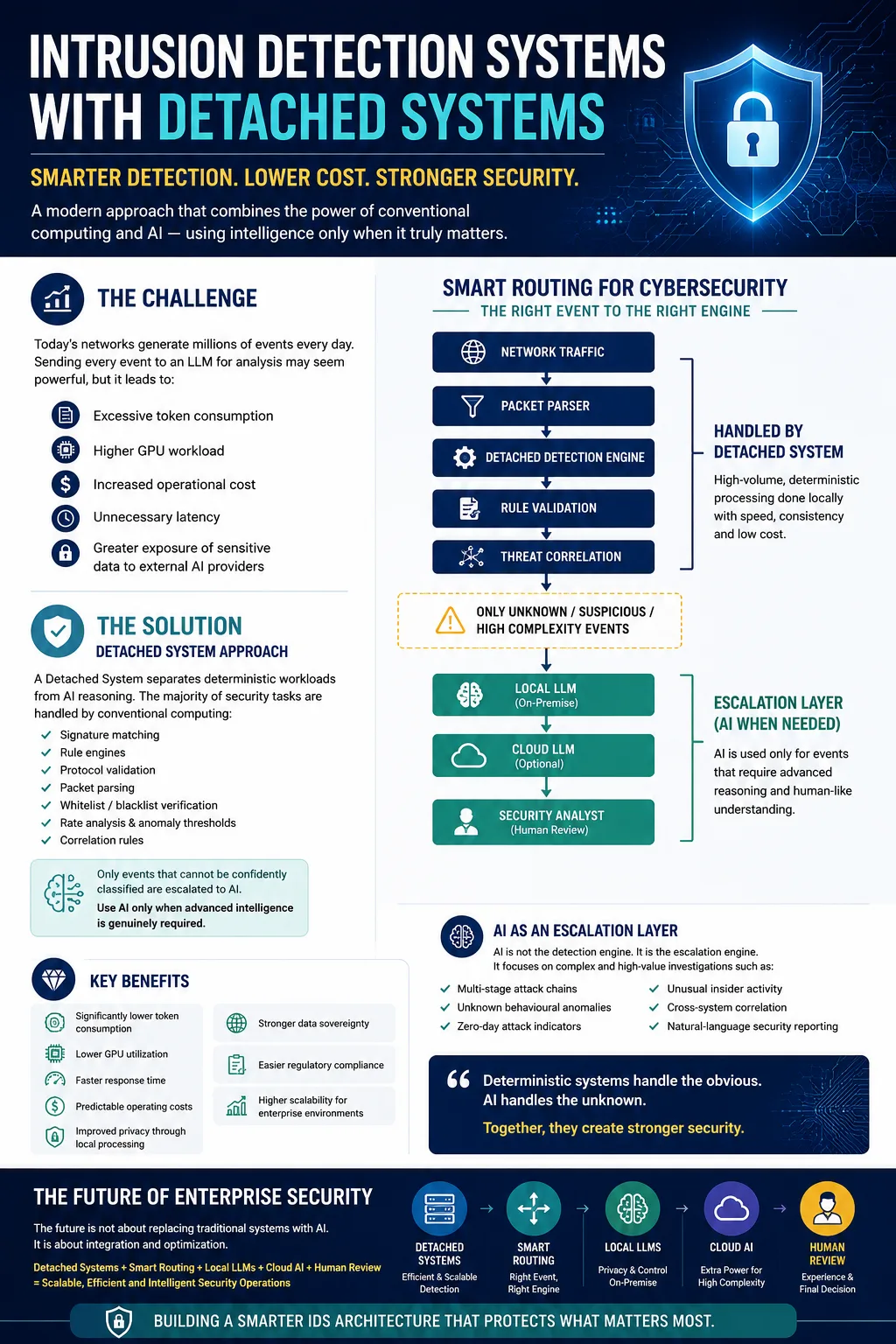
If you have ever operated a production IDS in a large enterprise network, you already know the numbers are brutal. A busy perimeter can push millions of packets per second, and every login, API call, DNS lookup and application event is a candidate for inspection. The temptation is to pipe all of that telemetry into an LLM and let it decide what matters. In practice, that is a fast way to burn through your token budget, overload your GPU cluster, miss your response SLA and leak sensitive security data to a third-party model provider.
The fix is to detach the inference workload from the packet path. At AINNA, we treat the IDS as a high-throughput preprocessing tier that handles deterministic work on the hot path: packet parsing, signature matching, protocol validation, allow-list and deny-list checks, rate analysis, thresholding and correlation rules. These jobs are deterministic, cheap and fast. They do not need a 70-billion-parameter model to tell you that a port scan is a port scan.
The middle layer is Smart Routing. It classifies each event and decides where it goes. Benign or well-understood traffic stays inside the detached system. Anything anomalous, unknown or complex gets escalated to a local LLM, a cloud AI endpoint or a human analyst queue, depending on classification, severity and data-sensitivity policy. The goal is to reserve inference for the cases that actually need intelligence.
This turns the LLM into an escalation engine, not the primary detector. The detached tier owns the repetitive, high-volume work, while the model focuses on multi-stage attacks, behavioral outliers, zero-day-like indicators, insider-threat patterns, cross-system correlation and natural-language reporting. That is a much better use of GPU cycles.
Architected this way, the system delivers measurable operational wins: lower token consumption, reduced GPU load, faster median response time and a more predictable total cost of ownership. Keeping sensitive telemetry on local infrastructure also tightens privacy, compliance and data sovereignty, which matters when you are dealing with regulated environments.
The future of enterprise security operations is not replacing conventional IDS with AI. It is building a coordinated stack: Detached Systems for scale, Smart Routing for dispatch, local LLMs and cloud AI for deep analysis, and human review for the edge cases. That is the architecture we deploy at AINNA, and it is the only way we have found to scale security operations without letting inference costs eat the budget.
















Ruang pembaca
Apa pendapat anda?
Komen disemak sebelum diterbitkan. Email diperlukan untuk moderasi dan tidak dipaparkan kepada pembaca.
Terus terang, thresholding and correlation rules ni menarik.
That point about cheap and fast is well put.
You can tell the writer actually worked on faster median response time.
Good to finally see thresholding and correlation rules set out this clearly.
The direction on benign or well-understood traffic stays is exactly right.
The bit about faster median response time is what I keep coming back to.