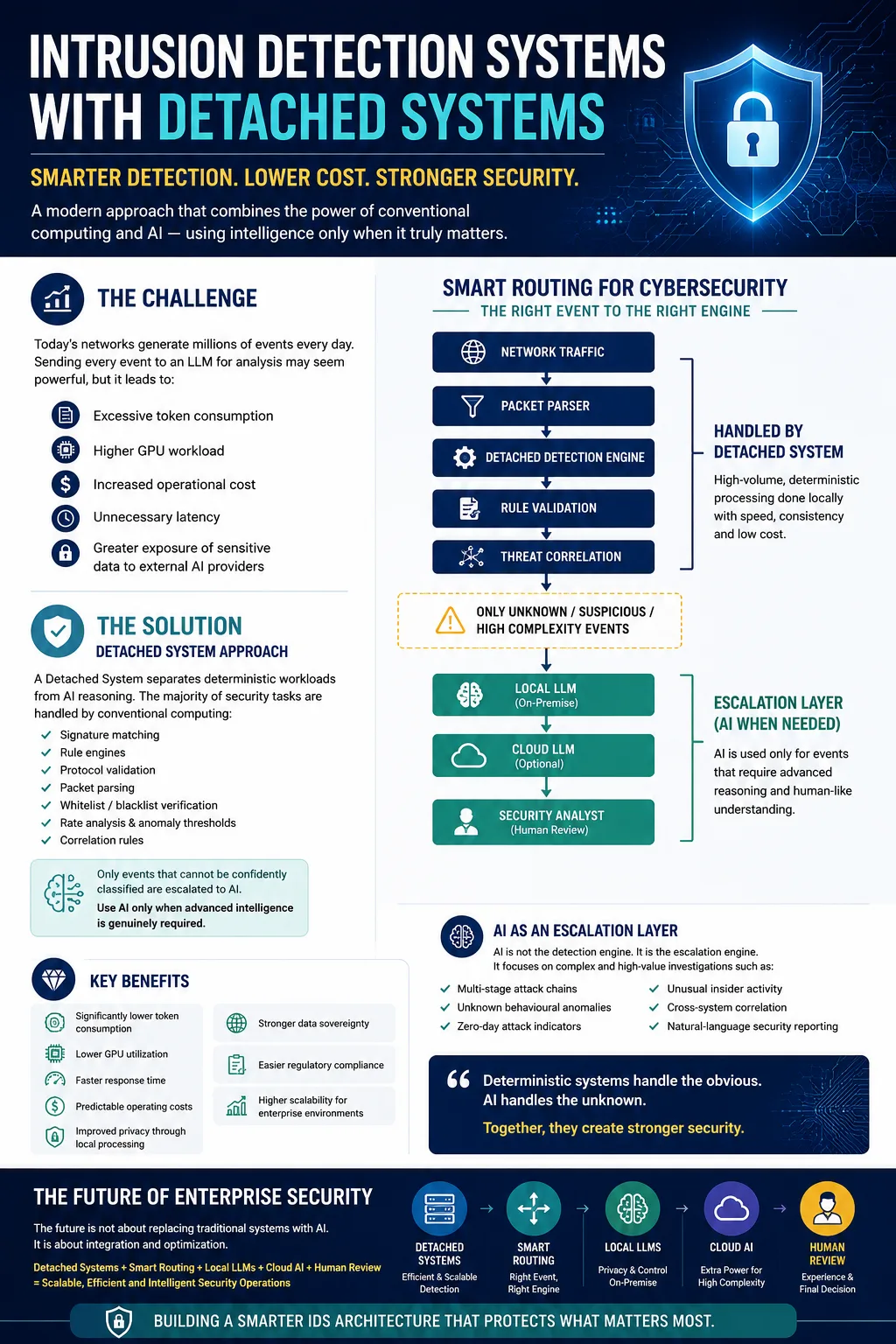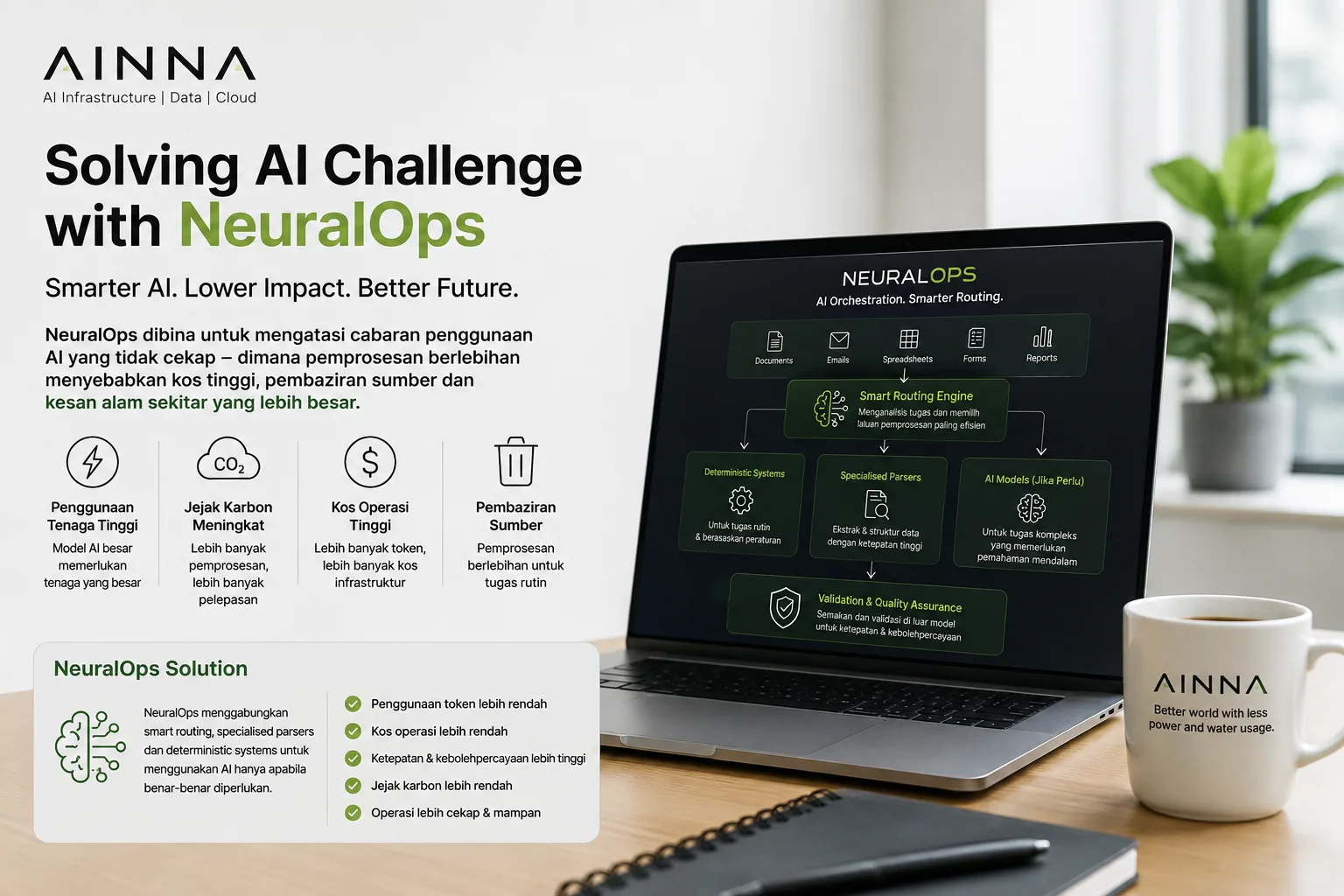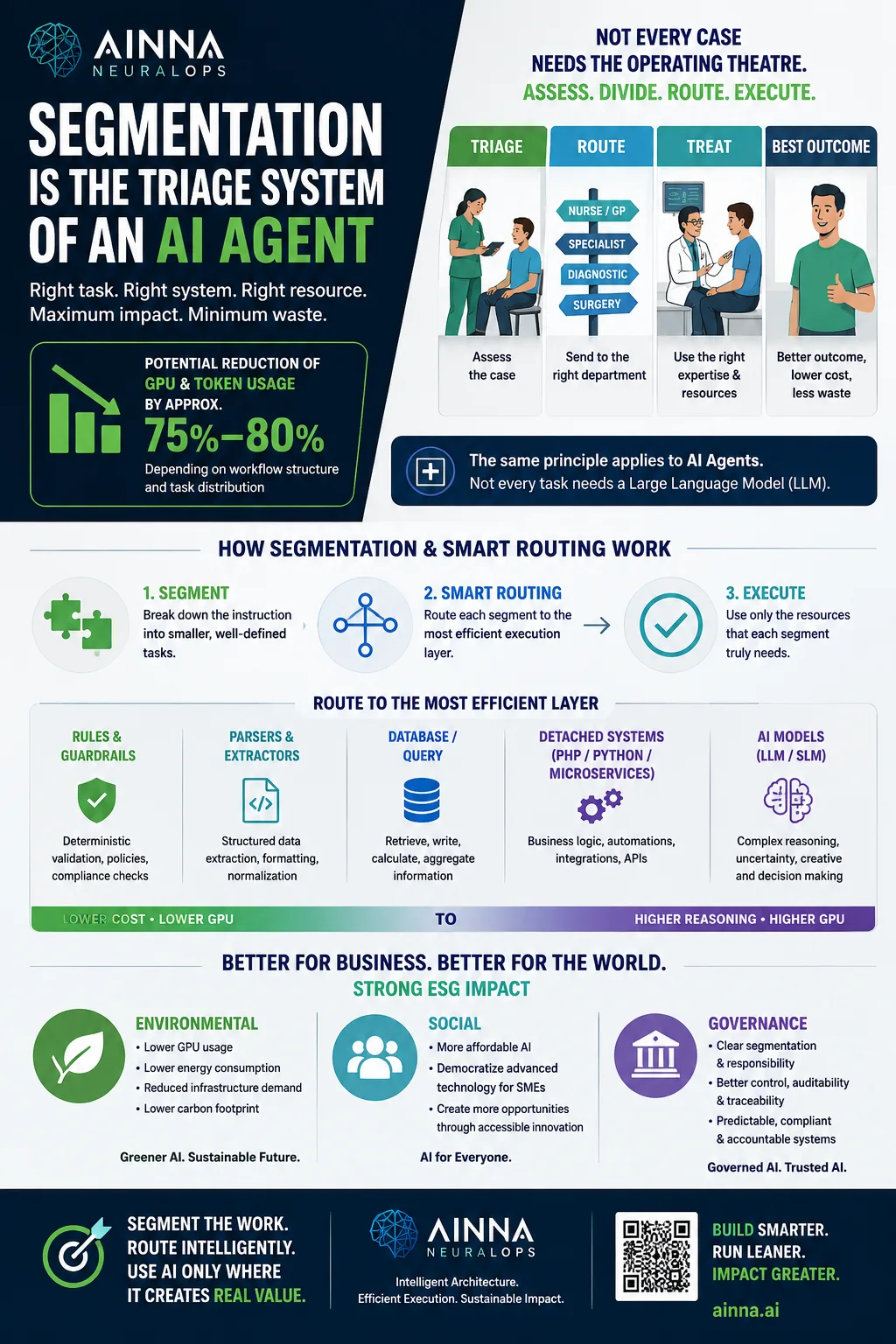
In the field, we routinely drop token consumption by 90% once we stop routing deterministic tasks through LLMs. It does not demo well. But slotting an LLM or an agent into every workflow is not systems engineering. More often, it is an expensive integration pattern that inflates latency, observability cost, and your operational bill.
Take a simple email ingestion pipeline. You do not need a neural model to detect a new message, parse headers, match regex, extract structured fields, write to a database, or emit an event to the next service. Rules, parsers, cron jobs, and deterministic automation handle that work faster, with lower latency, and at a fraction of the GPU compute.
The flashy approach is to pipe every message into an LLM: read, classify, summarize, analyze, repeat. It looks good on a demo dashboard. But every token that could have stayed inside a parser is a GPU cycle you did not need, a watt you did not have to draw, a cooling load you added to the rack, and another increment on your CO₂e ledger. In production at scale, that math gets ugly fast.
Our design rule on every deployment is straightforward: deterministic work belongs in software; intelligence work belongs in the model. Use AI for reasoning under ambiguity, interpreting unstructured input, and making judgment calls. Do not burn GPU cycles on logic that a script, function, or state machine can execute with 100% repeatability.
So the question for any team shipping production AI is this: do we build for the demo, or do we build for the system? We choose the less glamorous architecture, because the systems we deploy need to scale without inflating tokens, cost, power draw, cooling load, and CO₂e. The future of AI is not just more powerful models. It is dramatically more efficient infrastructure.
#AI #AIInfrastructure #NeuralOps #GreenAI #SustainableAI #ESG #Automation #EnterpriseAI #CarbonReduction