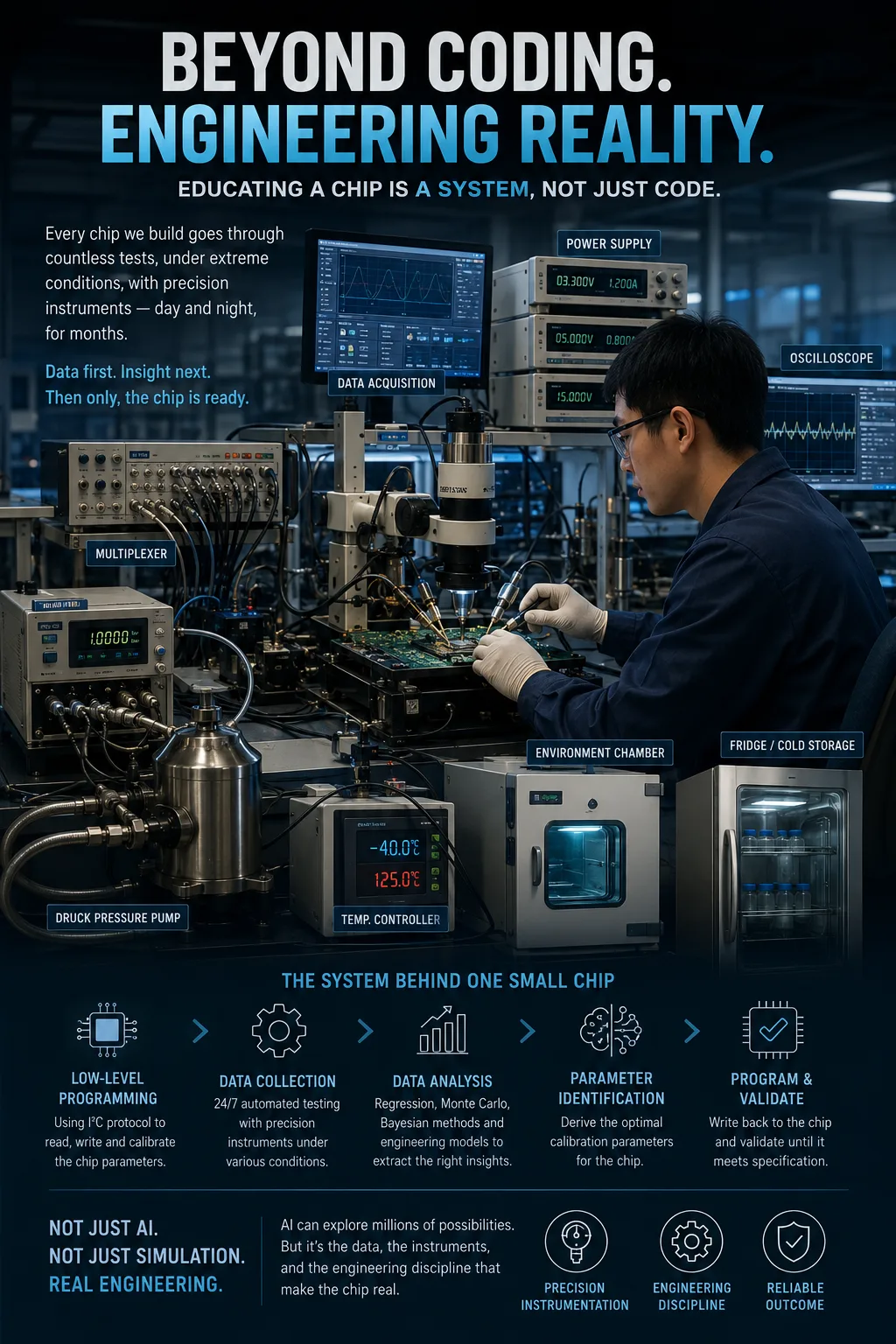
The hardest part was "teaching" the chip through low-level firmware. Over I²C, we streamed sensor data, watched how the device actually behaved, and wrote calibration parameters back into it, loop after loop.
But the real work was never just the firmware on the chip.
It was the automated validation environment we had to build and keep running. Test benches operated 24/7 for months, combining multiplexers, programmable power supplies, precision Druck pressure controllers and pumps, environmental chambers, refrigerators, ovens, temperature controllers, data acquisition systems, oscilloscopes, and whatever other measurement instruments we needed. That entire stack existed to characterise one tiny piece of silicon across a huge matrix of operating conditions.
Once we had collected enough data, the real engineering started.
We analysed enormous datasets using engineering equations, regression, statistical methods, repeated calibration runs, and countless iterations to extract the right parameters. Reaching production-ready calibration took months - sometimes years.
Today, AI and modern statistical computing can evaluate millions or even billions of possibilities in a fraction of that time. Regression still uncovers relationships, Monte Carlo still explores uncertainty through simulation, and Bayesian inference still refines probabilities as new evidence arrives.
The engineering principle, however, is unchanged.
The most effective production systems don't let AI handle every execution. They use AI to discover the optimal solution, validate it, and then bake it into deterministic processes executed by rules engines, parsers, and specialised subsystems.
AI accelerates discovery.
Deterministic systems ensure consistency.
Engineering discipline remains the foundation.
Technology has changed. The engineering mindset hasn't.
Official Cross-Network Resource















Ruang pembaca
Apa pendapat anda?
Komen baharu dihantar untuk semakan terlebih dahulu. Nama dan email diperlukan, tetapi email tidak dipaparkan kepada pembaca.
मुझे 24 वाला हिस्सा पसंद आया, यह बहुत सैद्धांतिक नहीं है।
24 वाले हिस्से ने मुझे सोचने पर मजबूर किया।
You can tell the writer actually worked on reaching production-ready calibration took.
Clear and short. Sharing regression still uncovers relationships, monte with my team.
The bit about however, is unchanged.The most effective is what I keep coming back to.
Sent this to two people already. temperature controllers, data acquisition is why. Need to read this part again.
Still thinking about watched how the device.
Useful. We are dealing with test benches operated 24/7 right now.
Sang-ayon ako sa 24, pero mahirap isagawa.
This is where loop after loop.But the real finally makes sense.
sometimes years.Today, AI and modern is the part I would forward to my boss.
I do not fully buy years ago, I was building yet, but it is a fair argument.
Good write-up. environmental chambers, refrigerators, ovens alone was worth teh read.