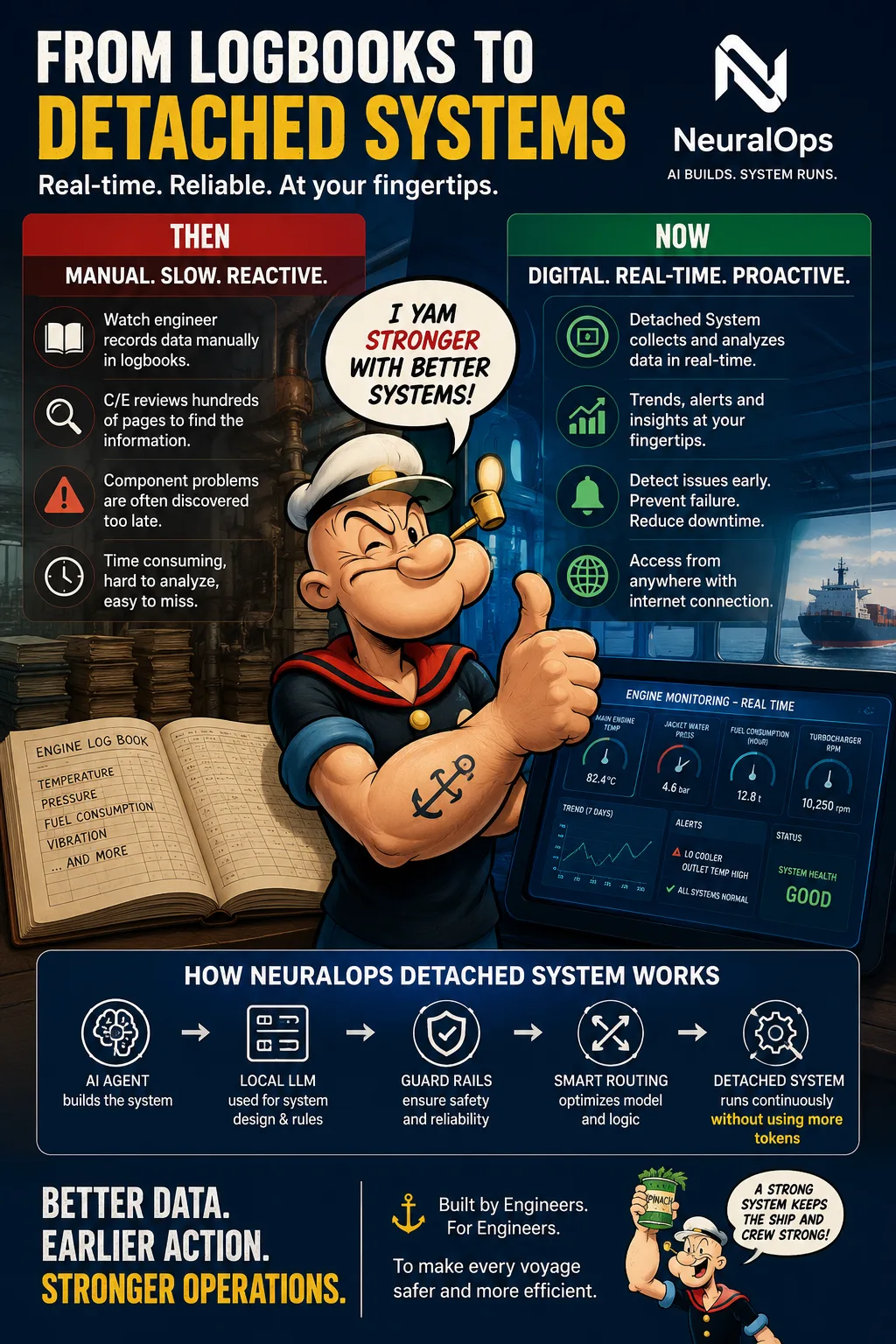
One of the first industrial deployments I worked on at AINNA involved a vessel engine room that was already full of instruments and control systems, but almost none of them were digitally connected. Gauges, thermocouples, and flow meters were everywhere, yet watch engineers still ended up transcribing temperatures, pressures, fuel consumption, vibration readings, and other parameters by hand into physical logbooks.
When the Chief Engineer needed to review engine condition, the workflow was painfully manual: open multiple logbooks, flip through pages, and compare readings across days or weeks to spot a pattern. The data existed, but extracting insight from it took time, domain experience, and a lot of mental arithmetic.
That latency is why deterioration often went unnoticed until a component was already in trouble or had failed. The issue was never a lack of measurements; it was the absence of a system that could ingest, structure, and interpret those measurements fast enough to act.
That is exactly the gap a Detached System closes. It collects, structures, and analyses operational telemetry in real time. When connectivity is available, both the onboard engineering team and headquarters can monitor engine performance, flag abnormal trends, and pull critical alerts straight from their devices.
At AINNA, we build these systems using the NeuralOps stack-local LLMs, AI agents, Guard Rails, and Smart Routing. The important architectural decision is that once deployed, the system continues to operate on validated rules and fixed logic at the edge, without burning AI tokens continuously just to stay running.
The practical benefits we see in the field include:
Real-time engine telemetry and status
Earlier detection of anomalous trends
Faster preventive-maintenance decisions
Reduced equipment downtime
Lower operating and AI token costs
Remote visibility for headquarters
More reliable and auditable system behaviour















Ruang pembaca
Apa pendapat anda?
Komen baharu dihantar untuk semakan terlebih dahulu. Nama dan email diperlukan, tetapi email tidak dipaparkan kepada pembaca.
pressures, fuel consumption, vibration - that is the whole thing in one line.
Worth reading for AI agents, guard rails alone.
First piece that handles gauges, thermocouples, and flow meters honestly.
You can tell the writer actually worked on open multiple logbooks, flip through.