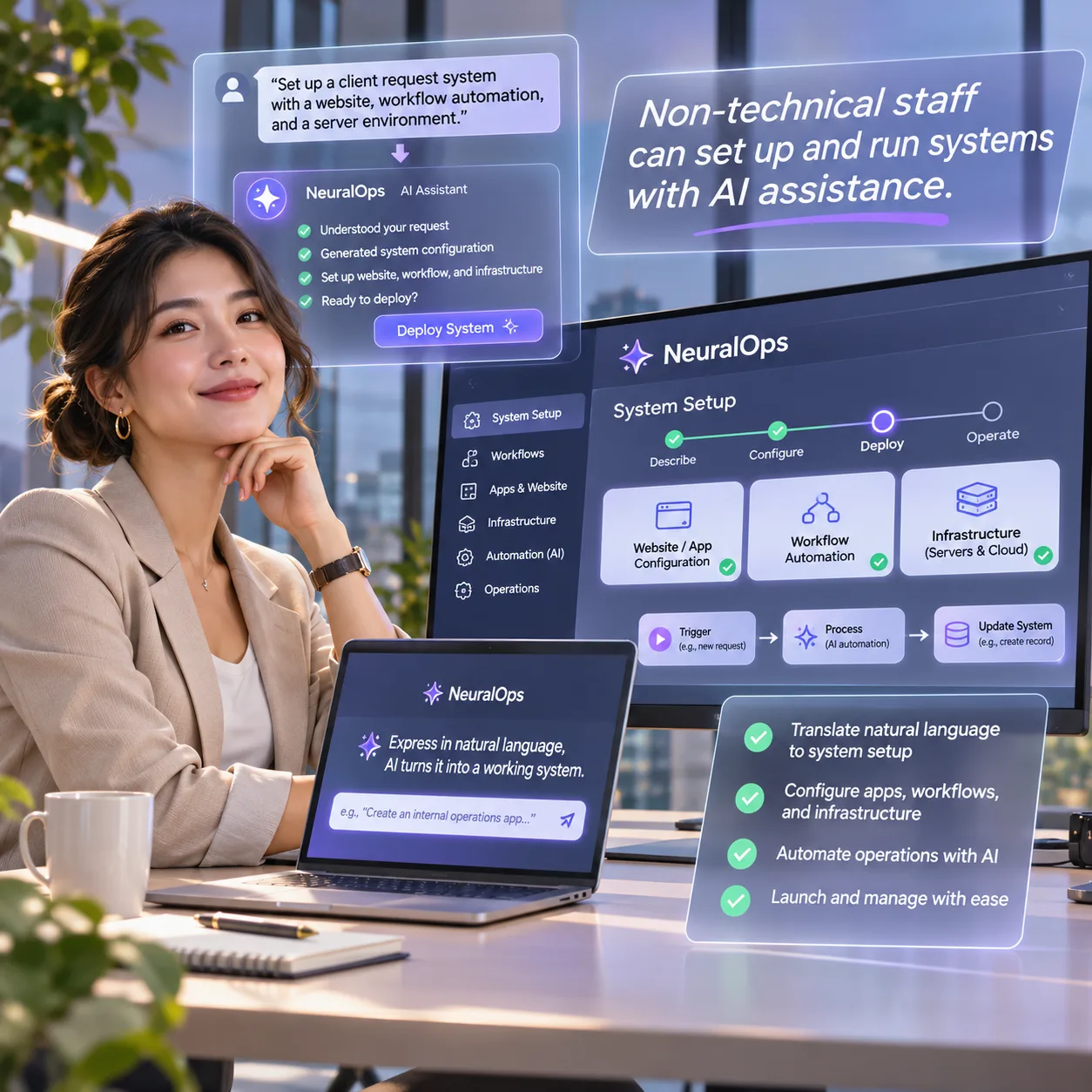
At AINNA, I look at digital transformation from the systems side: what it takes to get from an empty environment to something that runs securely, reliably and can be maintained in the field.
AINNA NeuralOps is how we make that path workable for non-technical staff. They describe the outcome they need in natural language; the platform turns that into AI-assisted execution across development, deployment and operations. My job is to make sure the underlying systems hold up.
The approach rests on four principles I work with in practice:
1. Infrastructure Development
From a bare server to operational infrastructure.
Non-technical staff state requirements, while NeuralOps helps drive server configuration, deployment, security, monitoring and infrastructure management. I focus on the integration boundaries, guardrails and observability so the environment is usable without becoming fragile.
2. Website Development
From an idea to a working website.
Staff can shape site structures, manage content, update designs and add functionality without traditional programming. On my side, I care about the deployment pipeline, permissions, caching and rollback paths so those changes are safe to ship.
3. Application & System Development
From operational friction to functional applications.
Staff describe workflows, business rules, approval steps, payment integrations and system requirements. NeuralOps helps translate those instructions into working applications. I watch the seams: data models, API contracts, authentication, error handling and the operational telemetry that tells us whether the system is actually behaving.
4. Administration & Operational Management
From manual administration to AI-assisted digital operations.
Staff manage users, monitor transactions, generate reports, maintain content and improve workflows through a centralized management environment. I keep an eye on access control, audit trails, job reliability and the boring but critical parts of operations that determine whether a system survives contact with real usage.
The Philosophy: From Natural Language to Functional Technology
These four principles make digital development more accessible across government departments and organizations. That does not mean the engineering disappears; it means the entry point moves closer to the people who understand the operational problem.
The goal is not to replace IT professionals. It is to remove unnecessary technical barriers.
IT teams still own security, architecture, governance and technical assurance. Non-technical staff gain a direct way to contribute to system development and continuous improvement. In practice, that means clearer requirements, faster feedback loops and fewer translation losses between operations and engineering.
With AINNA NeuralOps, the vision I work toward is straightforward:
If you understand your operational requirements and can explain them, AI should help you build the technology you need - with the systems discipline to keep it running.
I do not think the future of digital transformation is just about adopting AI.
It is about giving more people inside an organization the ability to become creators of digital solutions, while the engineering team provides the rails, guardrails and operational backbone.
#AINNA #NeuralOps #GovTech #DigitalTransformation #AgenticAI #ArtificialIntelligence #NoCode #PublicSectorInnovation #Malaysia

















Ruang pembaca
Apa pendapat anda?
Komen disemak sebelum diterbitkan. Email diperlukan untuk moderasi dan tidak dipaparkan kepada pembaca.
Four principles of AINNA neuralops - itu dah ringkasan artikel ni.
First piece that handles four principles of AINNA neuralops honestly.
这段关于这个主题的说明帮我把之前的问题连起来了。
The numbers around deployment and operations make more sense than most posts I read.
This is where guardrails and observability finally makes sense.