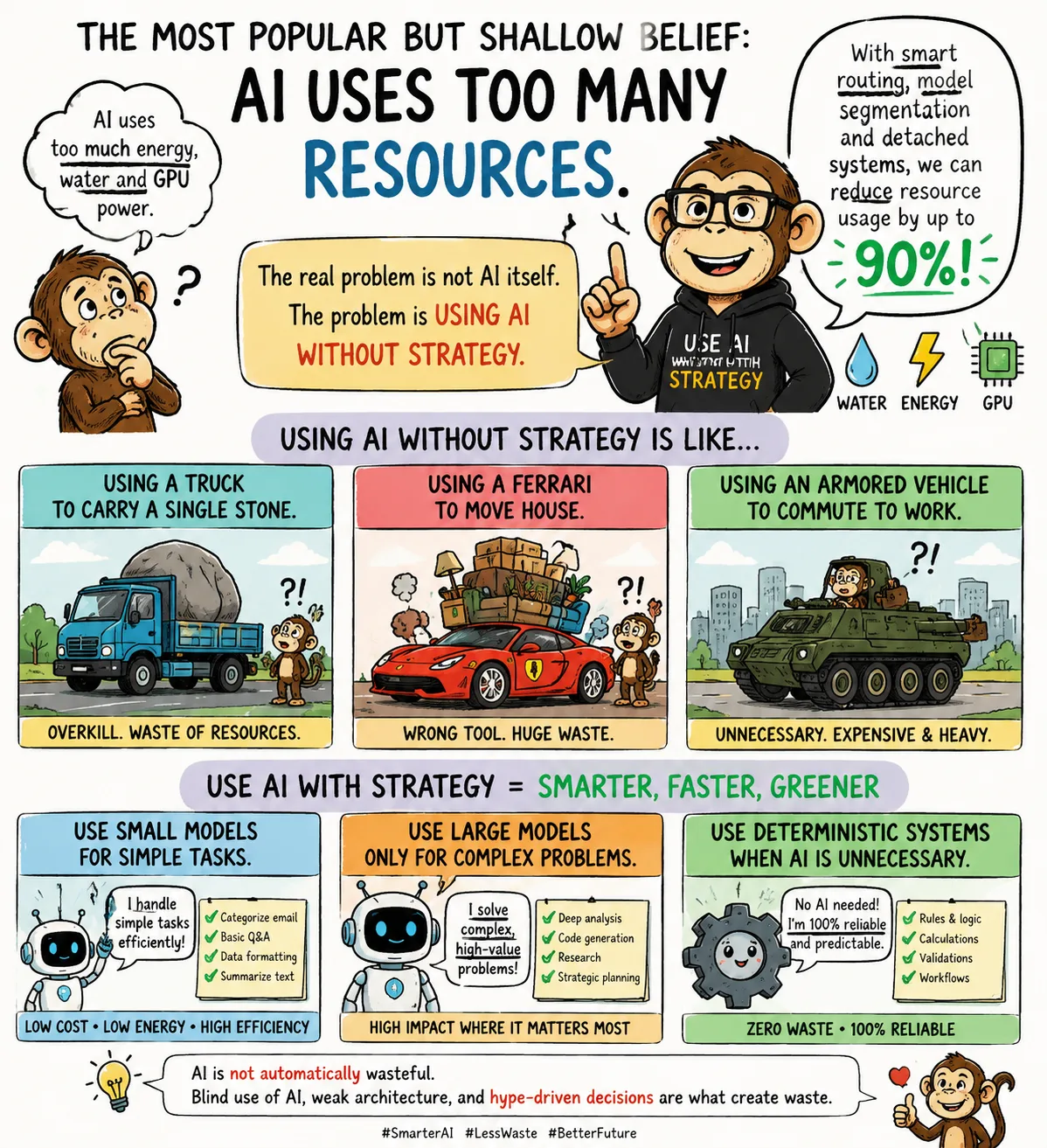
This is the take I hear most often in architecture reviews and client war rooms:
“AI consumes too much energy, water, and GPU power.”
It sounds like a technical objection, but it is usually a headline talking point repackaged as engineering judgment. What concerns me is when that talking point drives budget or policy decisions made by people who have never profiled an inference run, benchmarked token-per-watt, or sized a model against an edge device's thermal envelope.
The real problem is not AI.
The problem is deploying AI without an integration strategy.
At AINNA, we see this in production environments every week. With the right mix of smart routing, model segmentation, and detached edge systems, resource use can drop by up to 90% because the large model only wakes up when the input actually justifies the cost.
Using AI without that tiering is like:
🚛 Running a forty-tonne truck to deliver one paving stone.
🏎️ Choosing a track car to move house.
🛡️ Commuting daily in an armoured personnel carrier.
Capability and capacity are not the same thing. You match the asset to the workload.
Use small, task-specific models for low-complexity jobs.
Use large models only where ambiguity, reasoning, or generalisation justify the cost.
Use deterministic systems when the logic is rules-based and the output does not need to be learned.
AI is not automatically wasteful.
Waste comes from brittle architecture, missing telemetry, and governance that buys models from press releases instead of from latency, thermal, and CO₂e budgets.















Ruang pembaca
Apa pendapat anda?
Komen disemak sebelum diterbitkan. Email diperlukan untuk moderasi dan tidak dipaparkan kepada pembaca.
Ginagawa namin ito sa trabaho - 90%. Kapaki-pakinabang.
Naka-save, lalo na para sa 90%.
الأرقام حول 90% أكثر منطقية من معظم ما قرأت.
This is where AI consumes too finally makes sense.