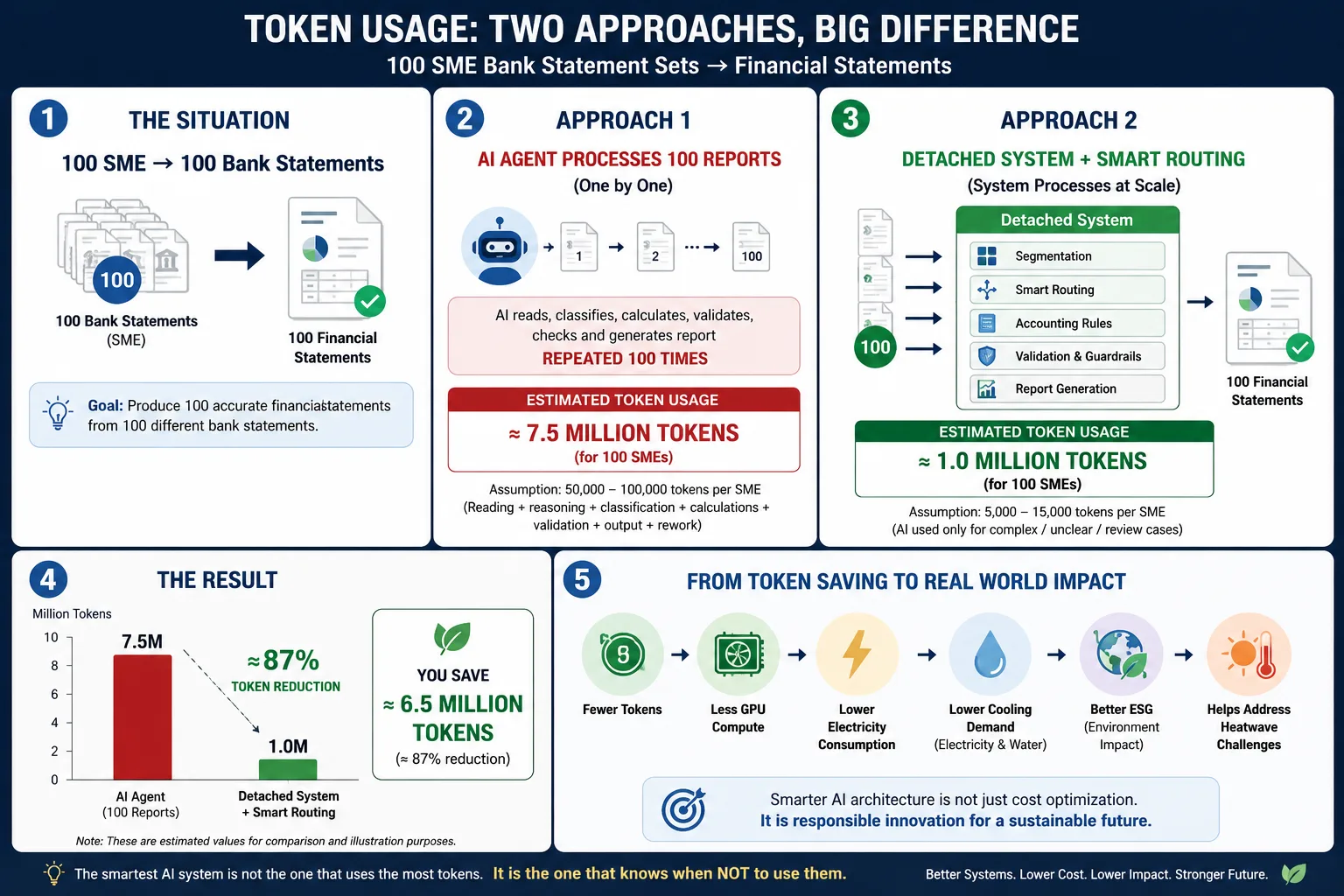
Most people underestimate how complicated SMqE bank statement automation can become.
Imagine 100 SMEs. Each SME uploads 100 pages of bank statements. That is not “100 files” only. That is 10,000 pages of financial data, possibly containing thousands of transactions, OCR noise, duplicate entries, internal transfers, bank charges, refunds, cash deposits, platform payouts, loan movements, and unclear descriptions.
If we use the first approach, the AI agent reads and reasons through everything directly. For a heavy 100-page SME file, a full AI workflow may consume around 200,000 to 500,000 tokens per SME, including extraction, classification, validation, correction, and report generation. For 100 SMEs, that becomes roughly 20 million to 50 million tokens.
Using Claude as the premium full-processing model, the cost can grow quickly. If we use a mid-range estimate of 35 million tokens, split as 80% input and 20% output, that means around 28 million input tokens and 7 million output tokens. At Claude Sonnet intro pricing of $2 input and $10 output per million tokens, that is about $126. At standard pricing of $3 input and $15 output, it becomes about $189.
The second approach is different. AI does not read everything repeatedly. A detached system first extracts the bank statement into structured transaction rows, cleans the data, detects duplicates, separates transfers, applies accounting rules, maps standard descriptions, validates the output, and only routes unclear or risky transactions to AI.
With this approach, Qwen or another lower-cost model can be used because the guardrails already control the workflow. The model is not asked to “understand everything from zero”. It only handles selected exceptions. If only 5% to 15% of transactions need AI review, total token usage may drop to around 3 million to 7 million tokens for all 100 SMEs.
Using a mid-range estimate of 5 million tokens, split as 80% input and 20% output, that means 4 million input tokens and 1 million output tokens. With a low-cost Qwen-style routed model, the AI inference cost could be below $1 in some pricing structures, excluding OCR, hosting, storage, engineering, and review cost.
So the real comparison is not simply Claude versus Qwen. That is too shallow. The real comparison is architecture. Claude processing everything directly may cost around $126 to $189 for this example. A detached system using Qwen only for routed exceptions may reduce the AI token cost to below $1, depending on provider pricing.
This is why smart routing, segmentation, and guardrails matter. The future of SME financial statement automation is not “send 10,000 pages to the biggest AI model”. The smarter model is: system handles what is structured, AI handles what is uncertain, and humans review what is risky.
That is where cost saving becomes serious.
#ArtificialIntelligence #AIAgents #DetachedSystems #SmartRouting #Guardrails #Accounting #SME #FinancialStatements #TokenEfficiency #Automation #ESG















Ruang pembaca
Apa pendapat anda?
Komen baharu dihantar untuk semakan terlebih dahulu. Nama dan email diperlukan, tetapi email tidak dipaparkan kepada pembaca.
The bit about estimate of 35 35 million is what I keep coming back to.
input and 20% 20% - sums the whole thing up.
Already sent this to two people. 200,000 to 500 500,000 is why.
Worth reading just for can become. imagine 100.
That is 10, 10,000 is what I would forward to my boss. Worth reading twice.
The framing around consume around 200 200,000 is better than I expected.