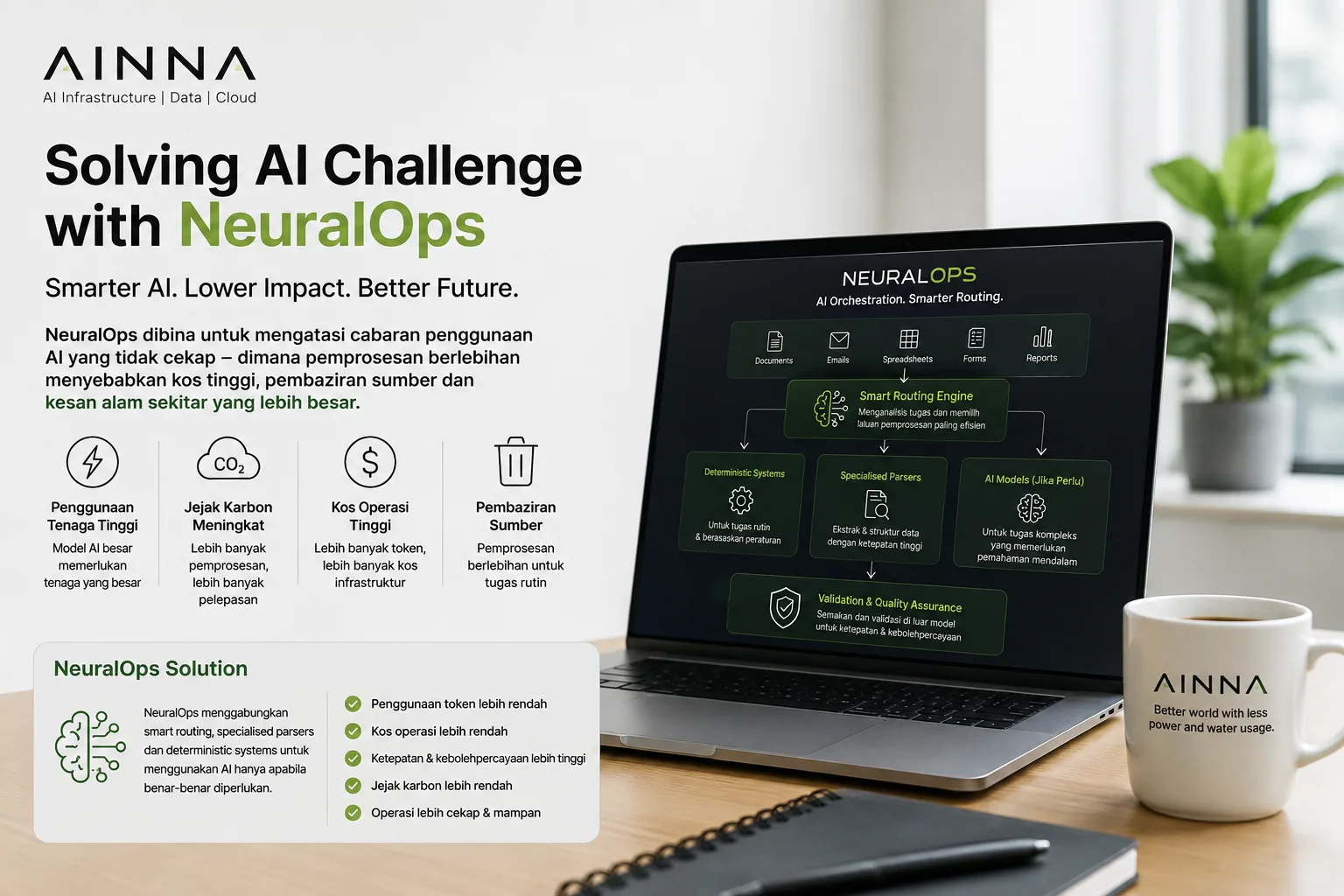
Most organisations are adopting AI to improve productivity.
But there is a challenge we rarely discuss:
The more AI we use, the more computing power, energy, tokens, and infrastructure we consume.
At AINNA, we realised that many routine business tasks were being sent to large AI models even when they did not require advanced reasoning. This increased operating costs, processing waste, and environmental impact.
That challenge led us to develop NeuralOps.
NeuralOps combines smart model routing, specialised parsers, workflow automation, and deterministic detached systems. It decides which tasks genuinely require AI and which can be completed more efficiently using conventional software.
In practice, NeuralOps is applied to document extraction, financial data processing, validation, reconciliation, reporting, and business analysis.
The result is a more efficient digital architecture:
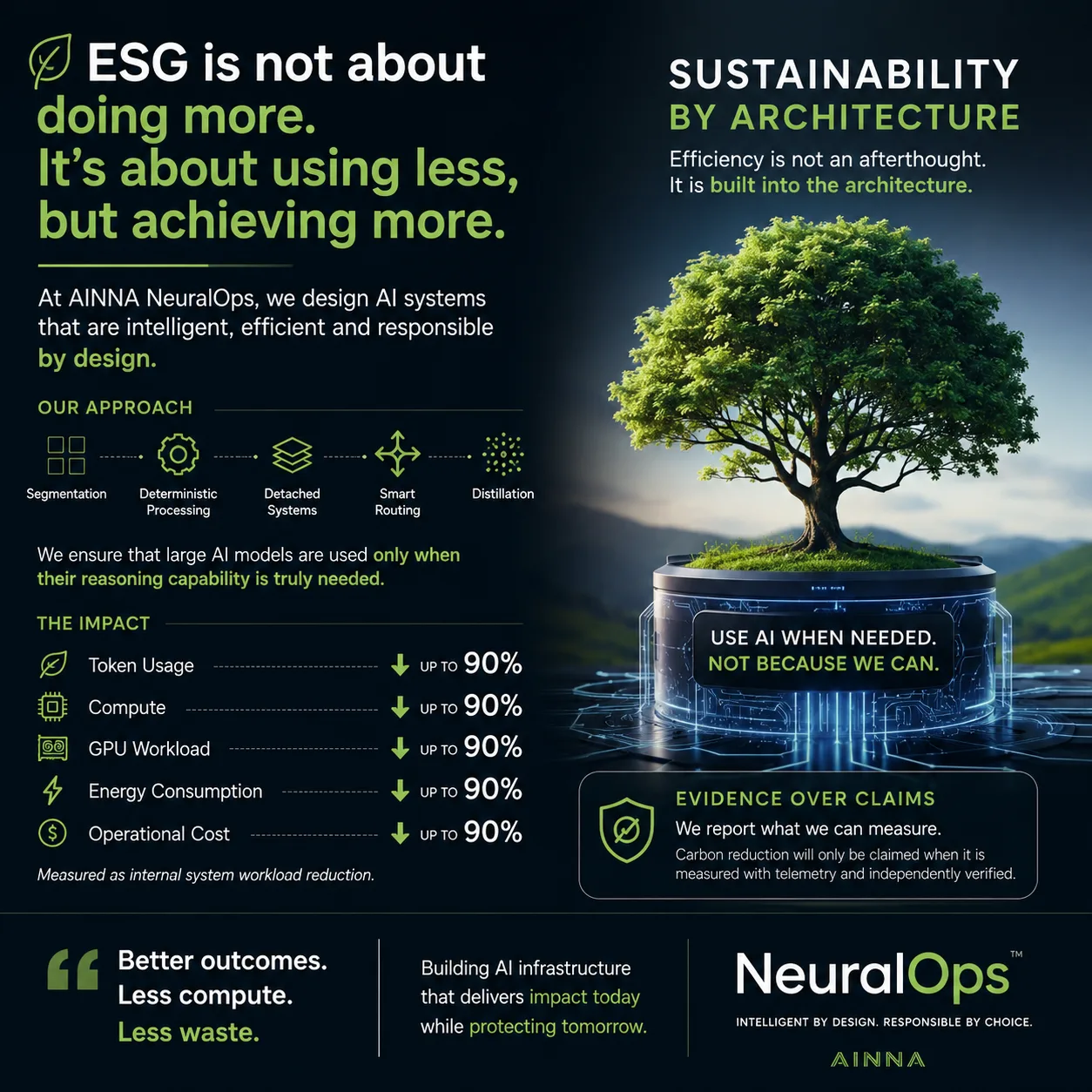
• Lower token consumption
• Reduced computing demand
• Lower operating costs
• Improved accuracy and validation
• More scalable and sustainable AI adoption
Our principle is simple:
Use advanced AI only when advanced intelligence is genuinely required.
Sustainable AI is not only about using smaller models.
It is about designing better systems.
#NeuralOps #ArtificialIntelligence #SustainableAI #GreenTechnology #Automation #DigitalTransformation #ESG #DataSovereignty #AINNA















Ruang pembaca
Apa pendapat anda?
Komen baharu dihantar untuk semakan terlebih dahulu. Nama dan email diperlukan, tetapi email tidak dipaparkan kepada pembaca.
Worth reading just for neuralOps is applied to document.
Useful. We are handling processing waste, and environmental right now.
The framing around financial data processing, validation is better than I expected.
Short and clear. energy, tokens, and infrastructure is worth sending to my team.
इस हिस्से वाले हिस्से ने मुझे सोचने पर मजबूर किया।
Honestly, specialised parsers, workflow automation surprised me. Still thinking this one through.