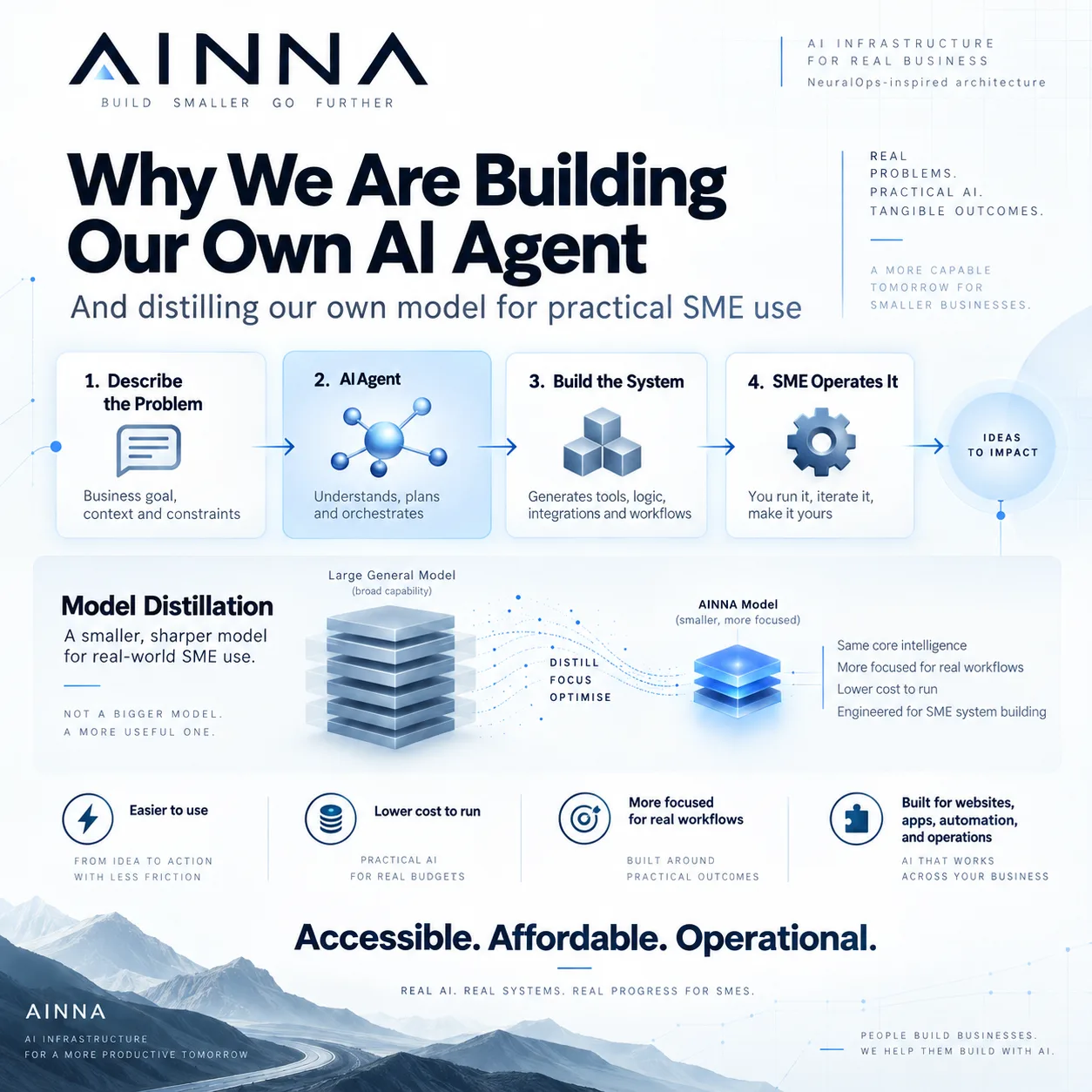
Because we believe the future of AI for SMEs in logistics is not just about access to powerful models. It is about making AI easier, cheaper, and more practical to use in real logistics operations.
Today, many AI tools are impressive, but the challenges remain: multiple subscriptions, rising token costs, workflows that do not fully fit our logistics operations, and heavy dependence on external providers.
That is why we are building our own AI agent as a development layer. The goal is simple: a logistics manager, warehouse supervisor, fleet coordinator, or any domain expert should be able to describe a real operational problem and use AI to help build a website, application, automation, or operational system that works for our logistics operations.
At the same time, we are working on model distillation to create a smaller, more focused model for practical SME logistics use cases. We are not trying to build the biggest model. We are trying to build one that is good enough for the task, cheaper to run, easier to deploy, and more controllable. For us, that means faster routing, better inventory prediction, and lower cloud costs.
Our direction is straightforward:
Describe the logistics problem → AI builds the system → SME operates it.
If AI is going to create real value for SMEs in logistics, it has to become accessible, affordable, and operational - not just impressive in a demo. It has to work on the ground, in our warehouses, and on our delivery routes.
That is why we are building our own stack.
#AI #AgenticAI #AIAgent #LLM #ModelDistillation #SME #Automation #AINNA #NeuralOps #SovereignAI














Ruang pembaca
Apa pendapat anda?
Komen baharu dihantar untuk semakan terlebih dahulu. Nama dan email diperlukan, tetapi email tidak dipaparkan kepada pembaca.
Not fully sold on multiple subscriptions, rising token costs, but the rest is solid.
Whoever wrote this actually did the work on affordable, and operational.
Honestly, cheaper to run, easier surprised me.
Good write-up. warehouse supervisor, fleet coordinator alone was worth the read.
I read this twice. cheaper, and more practical is the part that stuck.
Ngayon lang ako nakabasa ng tapat tungkol sa artikulong ito. Dapat itong basahin muli.
Useful. We are dealing with application, automation, or operational system right now.
I have watched workflows that do not fully go wrong in practice. Good to see it written down.
The framing around better inventory prediction, and lower is better than I expected. It make the point easier to understand.
affordable, and operational is the part I would forward to my boss.
I do not fully buy multiple subscriptions, rising token costs yet, but it is a fair argument.
Worth reading just for affordable, and operational.
Tulisan pertama yang cerita workflows that do not fully dengan jujur. Patut ditelusuri lagi.
Lebih jelas daripada dek vendor yang saya terima pasal workflows that do not fully.
cheaper, and more practical - sums the whole thing up.