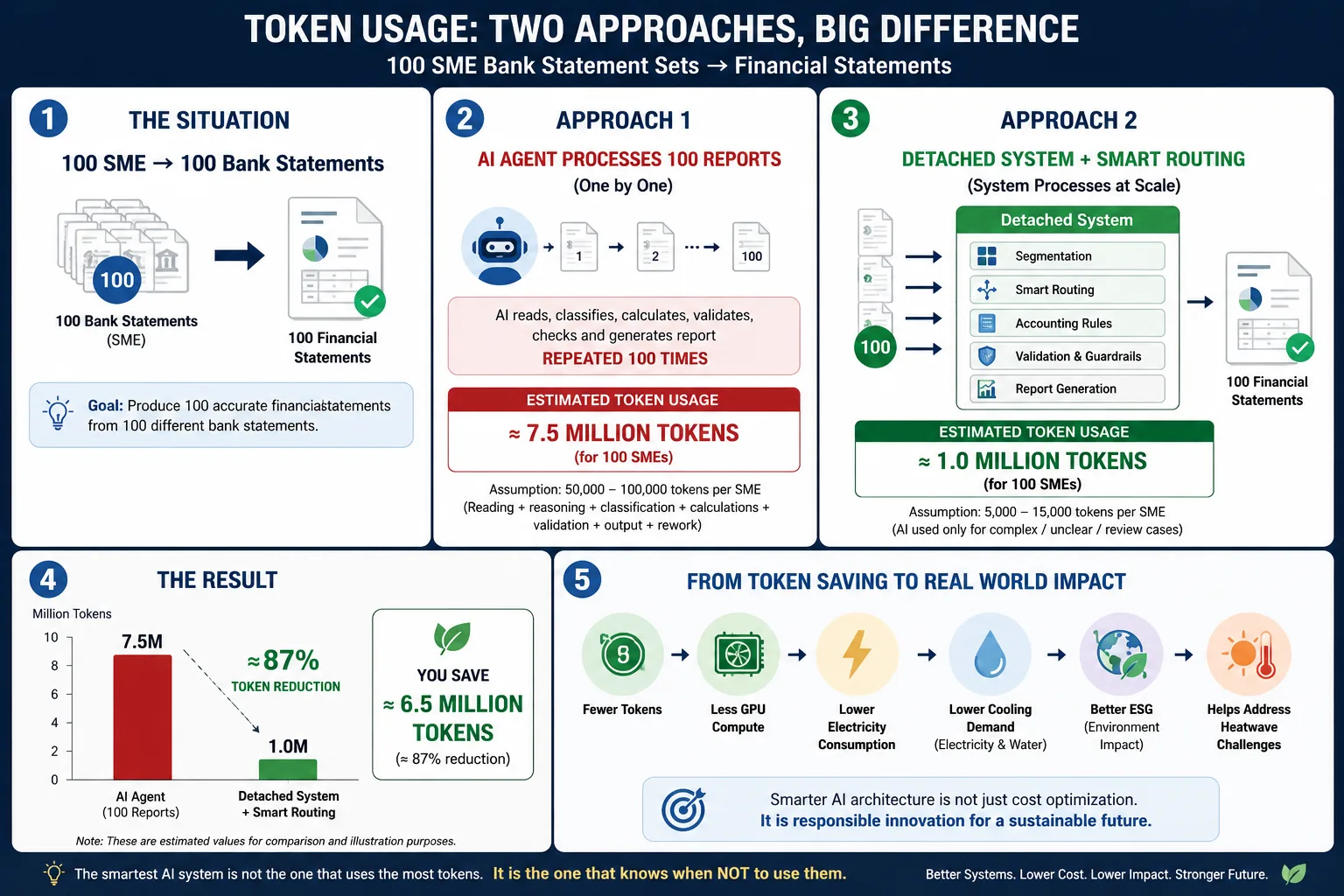
From a finance-operations perspective, bank-statement automation for SMEs is more complex than the typical AI headline suggests.
Take 100 Malaysian SMEs. Each uploads 100 pages of bank statements. The accounting team is not looking at 100 files; it is looking at 10,000 pages of transactions, OCR noise, duplicate entries, internal transfers, bank charges, refunds, cash deposits, platform payouts, loan movements, and unclear descriptions.
If the system passes every page to a large language model for end-to-end reasoning, the token bill compounds fast. A dense 100-page SME file can burn through 200,000 to 500,000 tokens once extraction, classification, validation, correction, and reporting are included. Across 100 SMEs, that is 20 million to 50 million tokens before anyone posts a single journal entry.
Using a premium model such as Claude for the entire workflow illustrates the cost. At a mid-range 35 million tokens, with the usual 80/20 input/output split, that implies 28 million input tokens and 7 million output tokens. Claude Sonnet intro pricing of $2 input and $10 output per million tokens puts the inference bill near $126; at standard $3 input and $15 output pricing, it climbs to about $189-roughly RM600 to RM900 at current rates.
The second approach detaches the deterministic work from the probabilistic work. The system first extracts structured transaction rows, cleans the data, detects duplicates, separates internal transfers, applies accounting rules, maps standard descriptions, validates the output, and only routes unclear or risky transactions to AI.
Because the guardrails already control the workflow, a lower-cost model such as Qwen can be used for the exception queue. It is no longer asked to understand everything from zero; it only handles selected exceptions. If only 5% to 15% of transactions need AI review, total token usage for all 100 SMEs may drop to around 3 million to 7 million tokens.
Using a mid-range estimate of 5 million tokens, split as 80% input and 20% output, that means 4 million input tokens and 1 million output tokens. With a Qwen-style routed model, the AI inference cost could fall below $1 in some pricing structures-under RM5-excluding OCR, hosting, storage, engineering, and review cost.
So the real comparison is not simply Claude versus Qwen. That comparison is too superficial. The real comparison is architecture. Claude reading every page directly may cost around $126 to $189 in this scenario. A detached, routed system using Qwen only for exceptions can bring the AI token cost below $1, depending on provider pricing.
This is why smart routing, segmentation, and guardrails matter. The future of SME financial-statement automation is not "send 10,000 pages to the biggest AI model". The smarter operating model is: the system books what is structured, AI resolves what is uncertain, and the accountant reviews what is risky.
That is where the cost saving becomes measurable-and where AINNA delivers real business value to Malaysian SMEs.
#ArtificialIntelligence #AIAgents #DetachedSystems #SmartRouting #Guardrails #Accounting #SME #FinancialStatements #TokenEfficiency #Automation #ESG
















Ruang pembaca
Apa pendapat anda?
Komen disemak sebelum diterbitkan. Email diperlukan untuk moderasi dan tidak dipaparkan kepada pembaca.
Me gustó la parte de 20 porque no es demasiado teórica.
You can tell the writer actually worked on 20 million to 50 million.
This is where intro pricing of $2 finally clicks.
Nice one. input tokens and 7 million alone worth the read.
The direction on the usual 80/ 20 is spot on.
Clearer than the vendor decks I get about with the usual 80.