OpenClaw
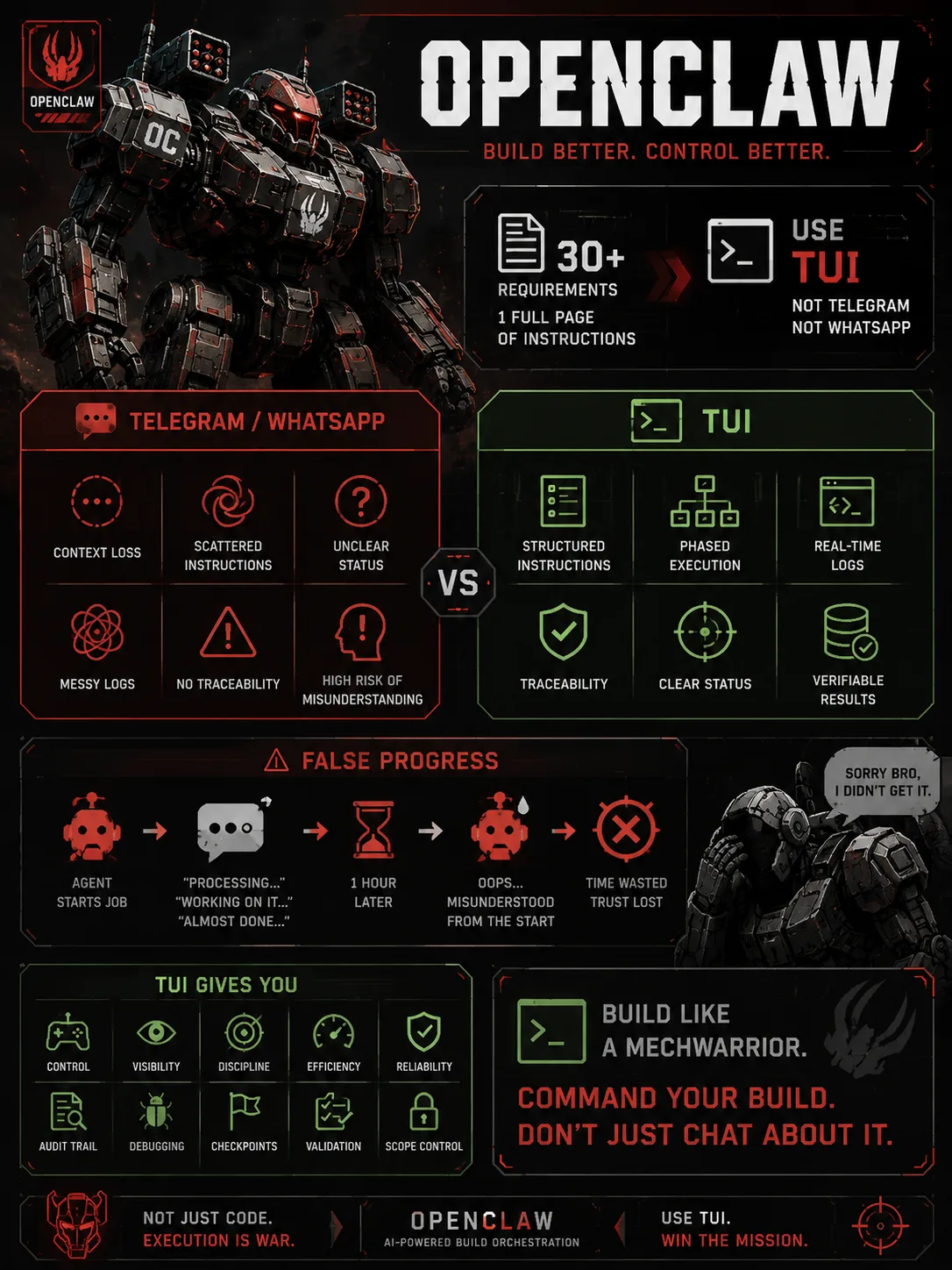
When capital is allocated to a technology asset with a large instruction set-for example, a full-page requirement document containing 30+ technical requirements-the interface layer is not just a UI preference. It becomes part of the capital control architecture.
For complex AI-assisted builds, a TUI is more suitable than Telegram or WhatsApp as the primary execution-control interface. Messaging apps are useful for notifications, alerts, summaries, and escalation messages. However, they are not designed to govern structured software delivery workflows involving requirement decomposition, execution phases, scope control, logs, error traces, validation checkpoints, rollback decisions, and audit trails.
Once the instruction set becomes large, the financial and operational risk increases:
Budget leakage from requirement drift
Loss of decision context and audit history
Ambiguous project status for reporting
Weak traceability for compliance and review
Unclear cost-center accountability
Poor visibility into rework cost
No milestone-based budget release
No structured validation layer before acceptance
The biggest issue is false progress. In a messaging app, an agent can spend an hour replying with updates like "processing", "working on it", "fixing now", or "almost done". That is billable effort with no verifiable output. Then, after repeating the same status, it finally admits it misunderstood the original instruction from the beginning.
At that point, it is no longer an AI capital project. It is unbudgeted rework wrapped in confidence.
A proper TUI gives better financial and operational control. It allows requirements, task queues, phase execution, logs, errors, system responses, debugging output, approval gates, and final results to be displayed in a structured and traceable environment-exactly what I look for from an accounting and asset-management standpoint. At AINNA, we apply this control standard when helping Malaysian SMEs turn AI-assisted development into balance-sheet-ready assets.
For AI-assisted builders like OpenClaw, the real challenge is not only code generation. The real challenge is execution governance.
Decision context management
Scope and budget discipline
Prompt-to-requirement alignment
Cost-to-requirement traceability
Rework cost visibility
Milestone-based capital release
Human-in-the-loop approval gates
Verification before execution
Post-execution audit trail
Telegram and WhatsApp should remain as communication channels. The actual build orchestration layer should be handled through a proper TUI.
Because when the system becomes complex, "still processing bro" is not a capital status report.














Ruang pembaca
Apa pendapat anda?
Komen disemak sebelum diterbitkan. Email diperlukan untuk moderasi dan tidak dipaparkan kepada pembaca.
เซฟไว้ก่อน เพราะ3
The section on once the instruction set becomes is the strongest part for me.
Honestly, budget leakage from requirement drift surprised me.
The case for document containing 3 30 is well made.