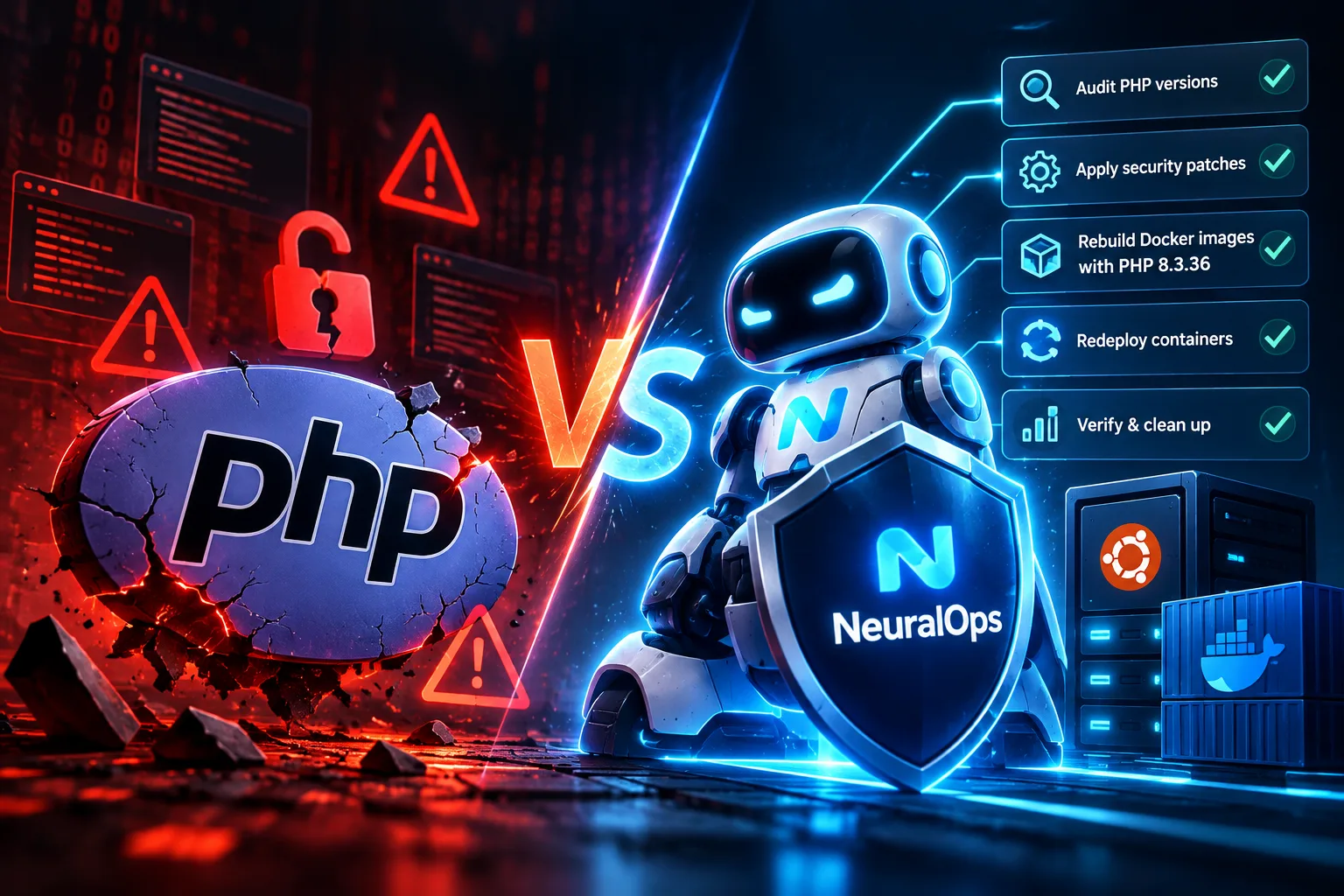
When a PHP security advisory landed on our desk, we treated it the way we treat any other liability: quantify the exposure first, then move to close it. Our instruction to the NeuralOps AI agents was to audit and secure our Ubuntu servers and Docker environments.
Here is what NeuralOps actually executed, and why each step matters on the books:
Audited installed PHP versions and identified affected environments - a fixed-asset register check in practice, so remediation cost was scoped to what was genuinely exposed rather than the whole fleet.
Upgraded Ubuntu PHP security packages - a direct, low-cost remediation instead of a delayed-patch incident carrying far heavier downstream costs.
Rebuilt affected Docker images with PHP 8.3.36 - standardised versions mean predictable support overhead instead of open-ended maintenance spend.
Redeployed affected containers and preserved rollback images - our contingency provision, held in place until verification cleared.
Performed post-patch verification and cleaned up Docker build cache - confirmation that the control worked, plus reclaimed storage that would otherwise sit on the infrastructure bill.
All executed through AI agents under human supervision, with safeguards to minimise operational risks - the same internal control logic we apply to any transaction: execution, review and sign-off kept separate.
We set the objective and the risk tolerance. NeuralOps planned and executed the technical work. We supervised, validated and retained the audit trail.
That is what practical Agentic AI looks like in real IT operations - and, for a Malaysian SME, what it looks like when an unplanned security cost becomes a closed line item instead of a write-off.
#NeuralOps #AgenticAI #CyberSecurity #DevOps #AIAutomation















Ruang pembaca
Apa pendapat anda?
Komen disemak sebelum diterbitkan. Email diperlukan untuk moderasi dan tidak dipaparkan kepada pembaca.
إذا كان هناك جزء آخر عن هذا الموضوع فسأقرأه.
Sent this to two people already. validated and retained the audit is why.
First piece I have read that treats confirmation that the control worked honestly.
Clearer than the vendor decks I get about low-cost remediation instead.