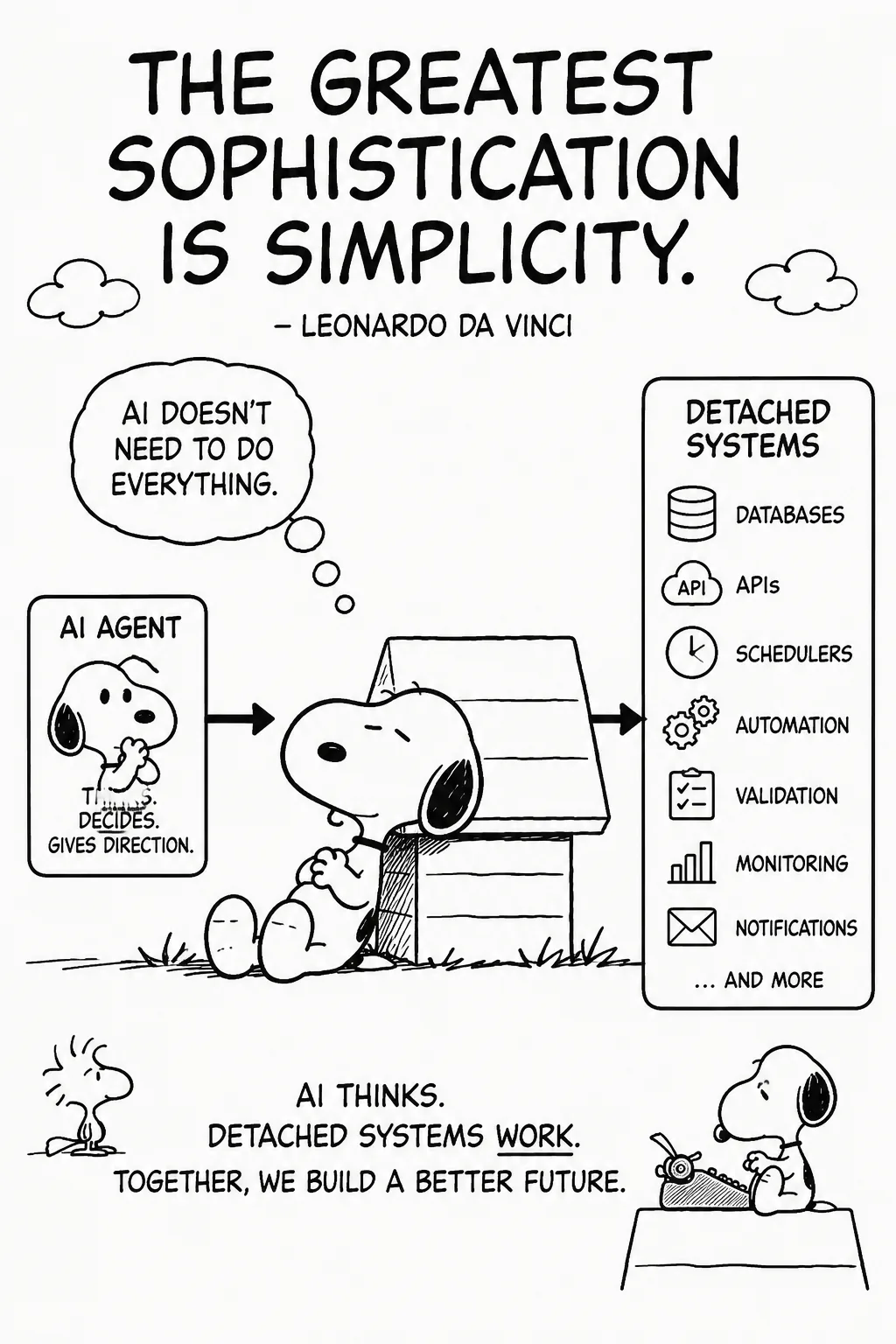
"The greatest sophistication is simplicity." Leonardo da Vinci's observation applies directly to how Malaysian SMEs should evaluate AI investments today. There is a common assumption that progress means larger models, bigger GPU clusters, and heavier infrastructure spend. From a finance and accounting perspective, that assumption is risky. The more defensible position is that the highest return on investment comes from architectures that are leaner, more modular, and easier to cost-control.
This is exactly what a Detached System offers. It separates the reasoning layer from the execution layer. AI handles decision-making, direction, and complex inference, while existing operational assets-databases, APIs, automation scripts, schedulers, and monitoring tools-carry out the actual transactions and workflows. In accounting terms, you are matching the right resource to the right cost category.
At first, this can look counterintuitive. Why deploy AI at all if it is not doing the bulk of the work? The answer is asset utilization. Premium AI compute should be treated as a scarce, higher-cost input and reserved for tasks that genuinely require reasoning. Routine operational work should sit on lower-cost systems. It is the same logic that prevents a finance leader from processing every supplier invoice personally: the role adds value through oversight and judgment, not through repetitive execution.
For Malaysian SMEs, the business case is clear. A Detached System lowers the barrier to adoption because it does not require massive capital expenditure on GPU infrastructure or enterprise-grade AI subscriptions. At AINNA, we design this separation so SMEs can use AI for forecasting, planning, and decision support while leaner systems handle daily operations. The result is a measurable improvement in productivity without a proportional increase in operating expenditure.
It also improves the sustainability of the technology budget. Every unnecessary AI request carries a direct unit cost in compute and energy. When a deterministic system can complete a task accurately, routing it through an AI model is simply unproductive spend. Detached Systems help finance teams ensure that AI consumption is tied to value creation rather than convenience.
Looking ahead, the companies that extract the most value from AI may not be those that use it everywhere. They will be the ones that allocate AI spend with discipline. True sophistication lies in designing systems that are financially clean, operationally transparent, and built to scale without inflating fixed costs. That is why Detached Systems matter-not only for technology strategy, but for building a more cost-efficient and sustainable SME business model.













Ruang pembaca
Apa pendapat anda?
Komen disemak sebelum diterbitkan. Email diperlukan untuk moderasi dan tidak dipaparkan kepada pembaca.
Sang-ayon ako sa paksang ito, at malinaw ang direksyon.
بصراحة، هذا المقال فاجأني.
I read this twice. decision-making is the part that stuck.
この内容をここまで正直に書いた記事は初めてです。
Detached systems help finance teams is the part I would forward to my boss.
Bahagian why deploy AI tu yang paling kena dengan saya.
Nice one. Why deploy AI alone worth the read.
Orang yang tulis ni memang buat kerja rumah pasal why deploy AI.