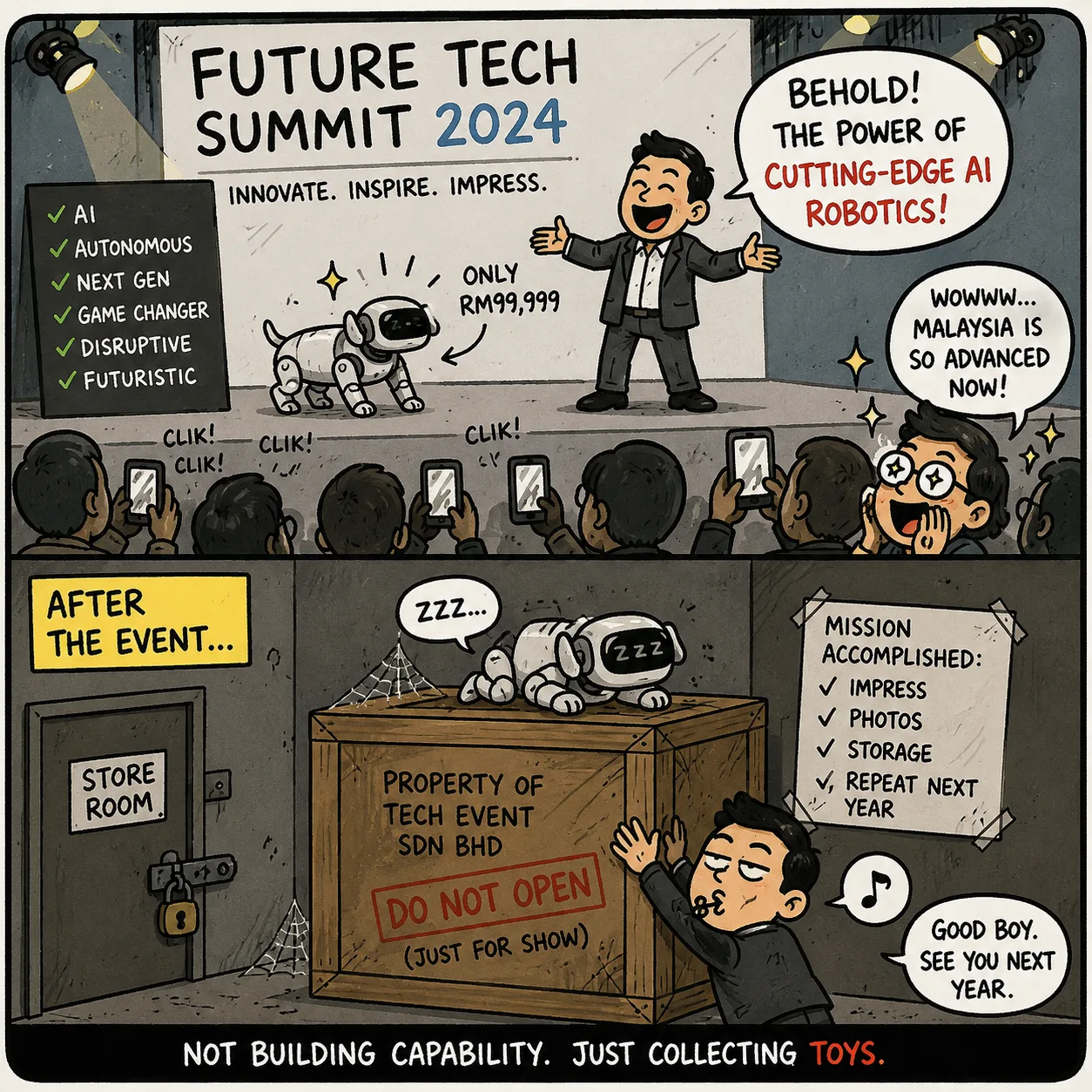
When I walk through a technology event with an SME client, the first thing I assess is not the demo, but whether the asset will ever be capitalised and depreciated productively. It is discouraging when the headline attraction is a robot dog or humanoid sourced from Yiwu, booked as an impressive fixed asset, and then treated as a one-off marketing expense with no depreciation policy tied to business output.
What concerns me more is the post-event process. Instead of a proper asset handover, maintenance schedule, and training log, the unit is packed away and forgotten. From an accounting standpoint, that capital outlay becomes a non-performing asset: it sits on the balance sheet, accumulates depreciation, incurs storage cost, and produces no measurable cash flow or capability uplift.
At AINNA, we see this pattern among Malaysian SMEs far too often. If a business only purchases, exhibits, photographs, and stores technology without implementation, training, and process integration, it is not adopting technology; it is acquiring expensive, idle inventory. Asset ownership is not the same as technology capability. Real value is created only when the asset is operationalised and its return can be tracked against revenue, cost savings, or productivity gains.












Ruang pembaca
Apa pendapat anda?
Komen disemak sebelum diterbitkan. Email diperlukan untuk moderasi dan tidak dipaparkan kepada pembaca.
Tulisan pertama yang cerita booked as an impressive fixed dengan jujur.
Worth reading for booked as an impressive fixed alone.
Asset ownership - that is the whole thing in one line.