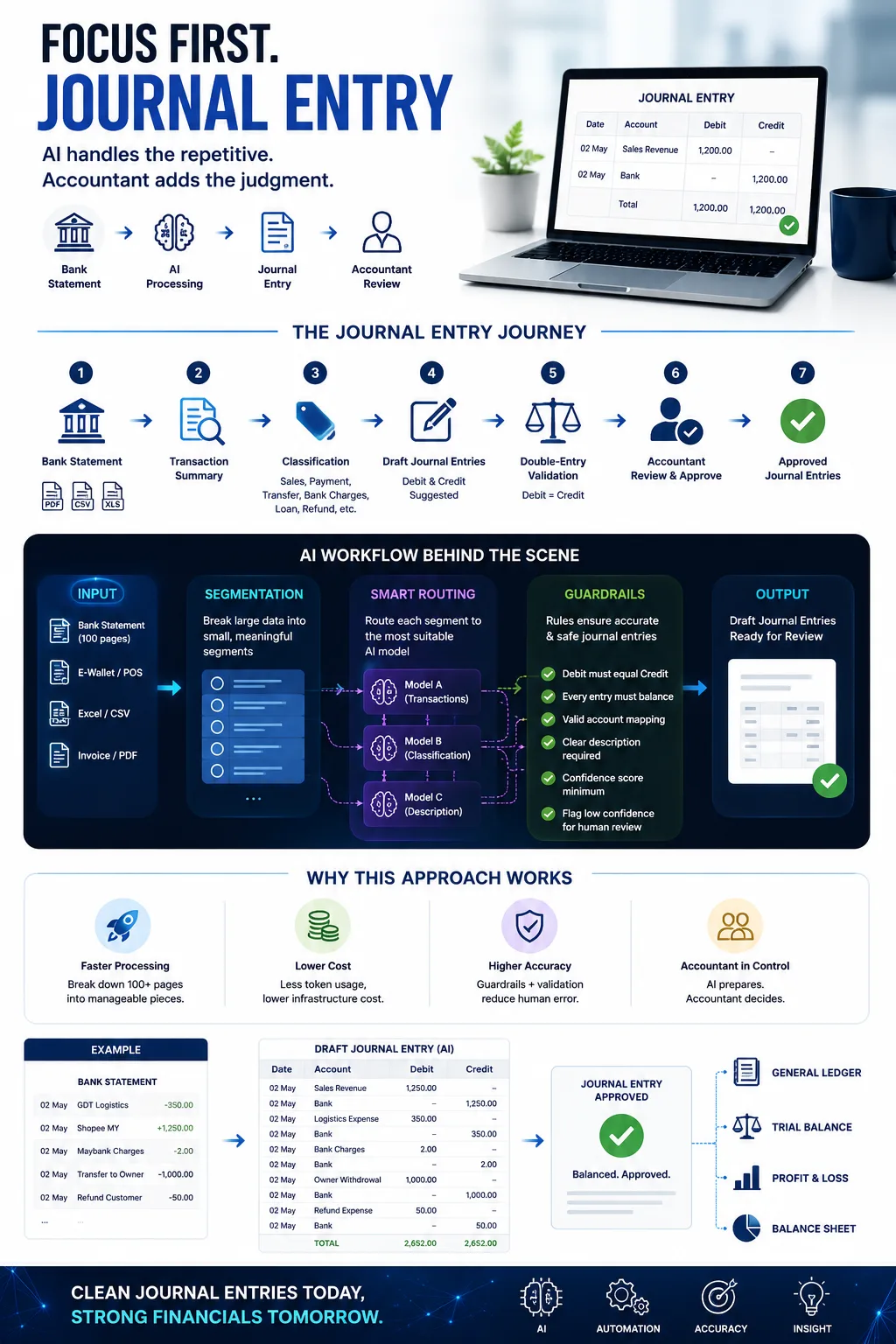
Start with the Journal Entry Pipeline. Reports Are Downstream Artifacts.
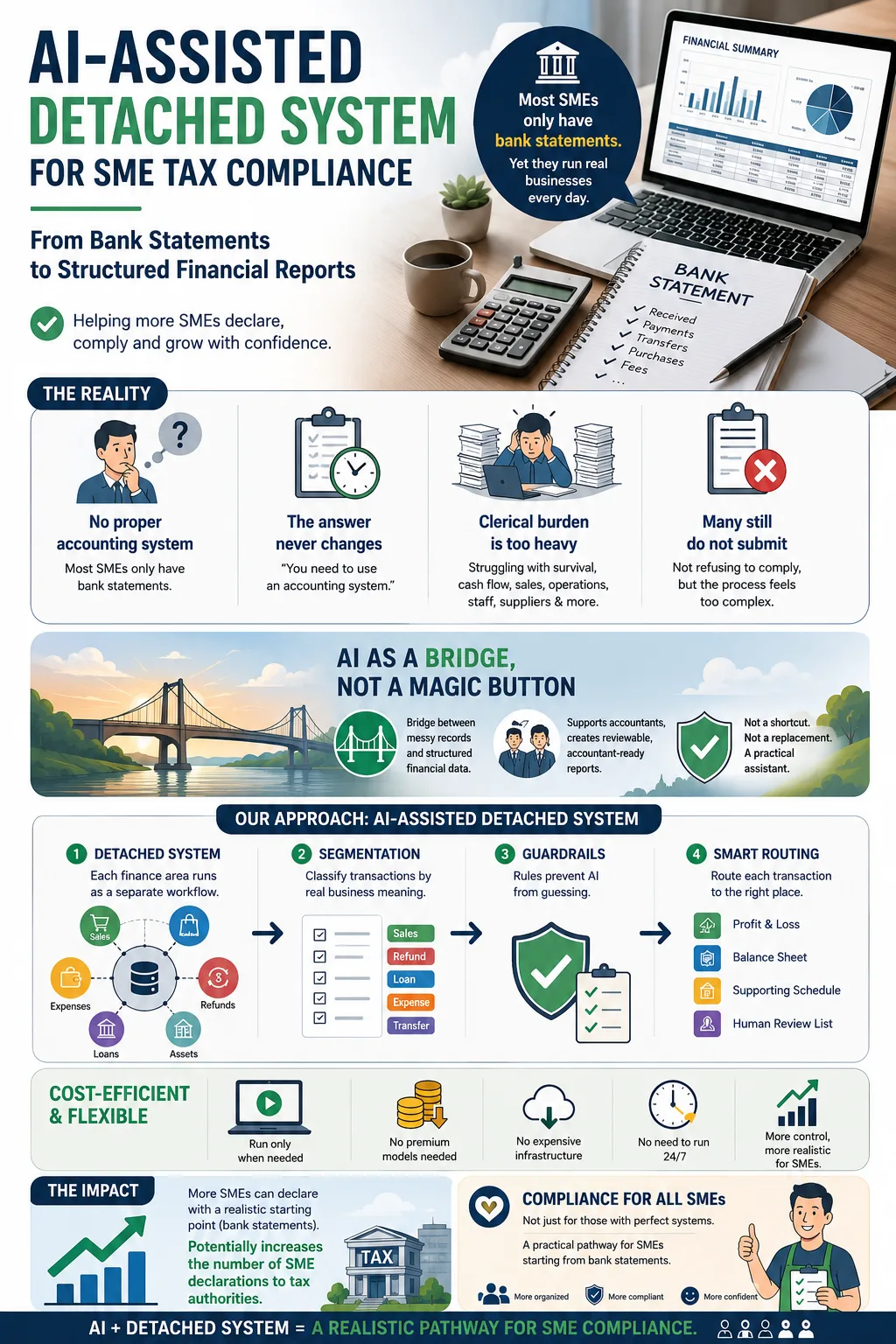
Most SMEs don't run a complete accounting system yet. What they run are bank feeds, payment records, spreadsheets, and invoices-heterogeneous data sources that don't naturally align to a ledger.
Instead of trying to synthesize full financial statements on day one, build the foundational data flow first: journal entries.
A clean pipeline looks like this:
Bank Statement → Transaction Summary → Transaction Classification → Draft Journal Entries → Double-Entry Validation → Accountant Review
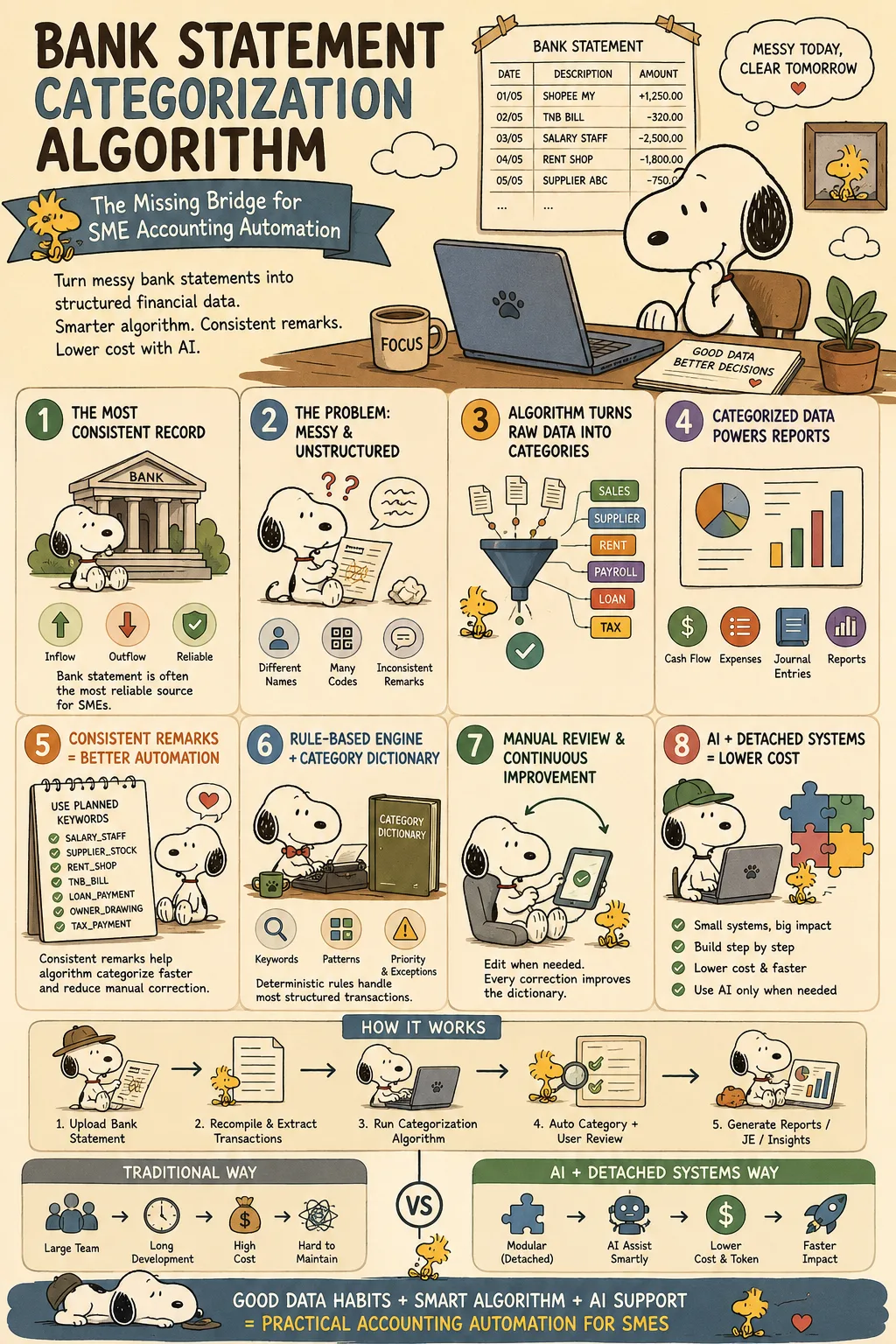
From a systems standpoint, the AI layer is a classifier and mapping engine. It detects recurring transaction signatures-sales receipts, supplier payments, bank charges, loan repayments, transfers, refunds, owner withdrawals-and emits structured draft journal entries with account codes, amounts, and descriptions.
The engineering priority isn't just generation; it's validation and observability.
Every emitted journal entry must pass strict guardrails:
- Total Debits must equal Total Credits
- Every transaction must balance to zero
- Each entry needs a meaningful, auditable description
- Confidence scores must flag entries for human review before they hit the ledger
This design doesn't replace accountants. It removes low-variance bookkeeping work and routes edge cases to the human-in-the-loop while keeping final approval authority with finance professionals.
From my experience deploying these systems, journal entry automation is the most pragmatic beachhead for AI in accounting. Once you have clean, validated journal entries flowing into the General Ledger, the Trial Balance, Profit & Loss, and Balance Sheet become deterministic outputs-not one-off manual builds.
Build the ingestion and validation pipeline first. The reporting layer follows automatically.
#Accounting #JournalEntry #DoubleEntry #Bookkeeping #AI #Automation #SME #Finance #DigitalTransformation













Ruang pembaca
Apa pendapat anda?
Komen disemak sebelum diterbitkan. Email diperlukan untuk moderasi dan tidak dipaparkan kepada pembaca.
Tulisan pertama yang cerita journal entries dengan jujur.
Useful. We are handling start with the journal entry right now.
The numbers around it's validation and observability make more sense than most posts I read.
Clearer than the vendor decks I get about journal entries.
Good write-up. Bank statement alone was worth the read.