How AINNA NeuralOps is Wired: Private vLLM Server, VPN Segmentation, VPS Agent Layer, Detached Systems and Hermes
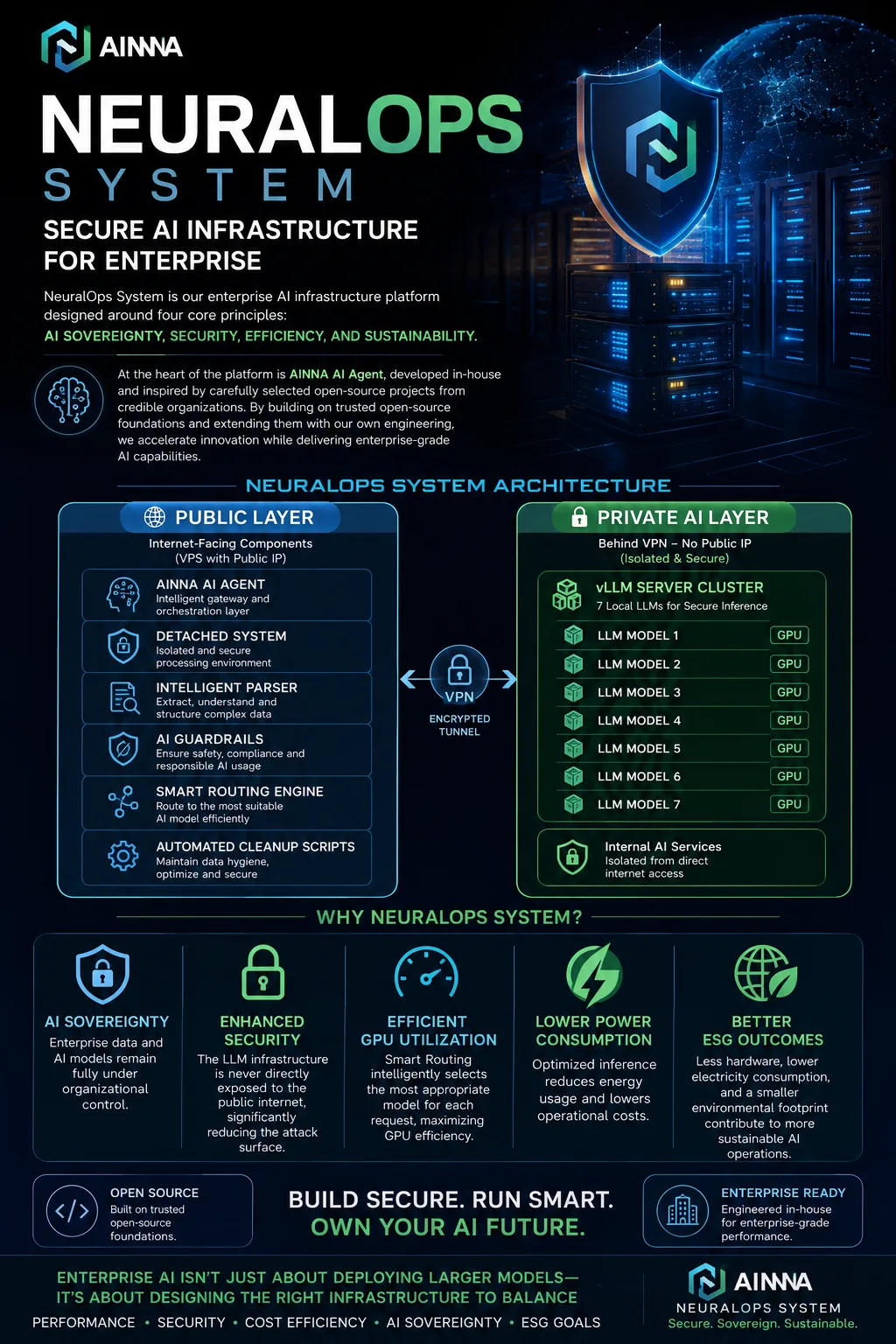
From the engineering side, we built NeuralOps as a segmented, modular AI stack. The LLM server is deliberately not reachable from the public internet.
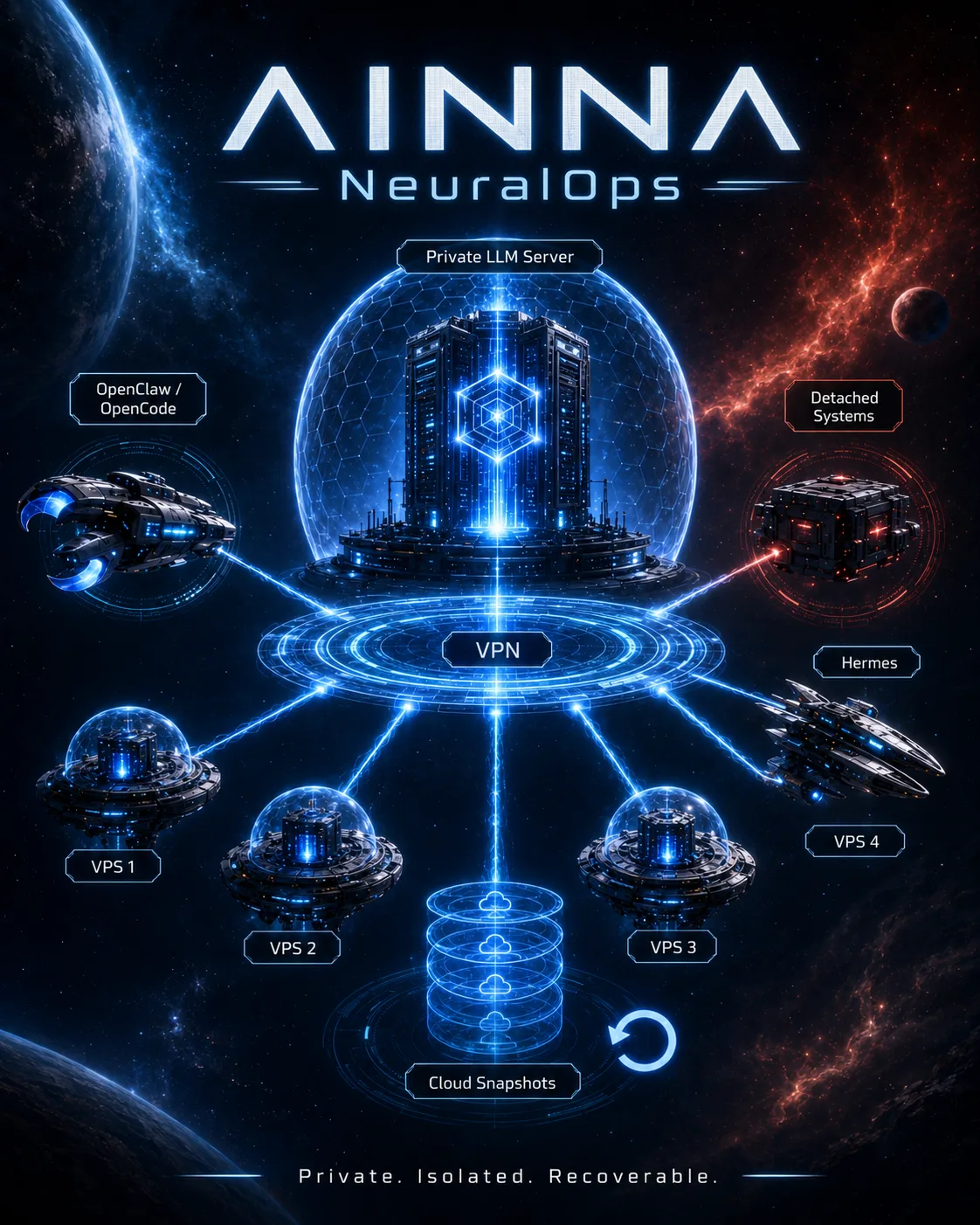
The inference backbone is a private LLM server running vLLM, loaded with up to 7 LLM models to cover different operational workloads. It sits entirely inside a VPN-secured private network, and admin access is gated to authorized users only through that VPN tunnel.
Public internet has zero direct path into the LLM server.
No public admin panel.
No exposed model backend.
No open inference ports.
No direct GPU access.
No extra attack surface we do not need.
The VPS layer is not there to serve models to the internet.
It acts as the agent execution layer. That is where we run OpenClaw or OpenCode agents, alongside Detached Systems and Hermes operational workflows.
Each VPS is isolated at the cloud level from every other VPS. That separation keeps workloads from bleeding into each other and lets each agent, service or operational process live inside its own bounded environment.
Snapshots are part of the recovery playbook. Before a big deployment or an agent-driven system change, we snapshot the VPS. If something breaks, we roll back to the last known-good state fast. That makes experimentation, automation and agent execution safer without putting the wider infrastructure at risk.
The VPS layer runs controlled execution tasks such as:
OpenClaw / OpenCode agent execution
system auditing
website monitoring
automation workflows
Detached System operations
Hermes integration
logs and reporting workflows
lightweight orchestration between services
snapshot-based recovery and rollback
The LLM server stays behind the VPN. The VPS talks to it over a controlled private route, hitting a restricted inference API with a narrow access policy. The agents can request model output, but they never get broad access to the LLM server environment.
That separation gives every layer a clear job.
The LLM server is the inference layer.
The VPS is the agent execution layer.
The Detached System is the operational workflow layer.
The Hermes system is the internal business operations layer.
The VPN is the security boundary.
The cloud snapshot is the recovery layer.
By keeping those responsibilities apart, NeuralOps gets more secure, more scalable and easier to run. One bad VPS does not poison the others. A broken agent workflow gets rolled back from snapshot. A VPS-layer incident never touches the LLM server behind VPN. When Hermes needs automation, reporting or operational processing, it routes through the Detached System instead of calling the LLM backend directly.
AINNA NeuralOps is not a chatbot bolted onto a server.
It is a modular AI operations stack built for real business workflows:
Private LLM Server + vLLM + VPN + Isolated VPS Agent Layer + Cloud Snapshots + Detached System + Hermes
This stack gives us tighter control over AI execution, model access, operational automation, system recovery, security boundaries and long-term scalability.
Good AI infrastructure is not only about benchmark scores.
It is about control.
It is about isolation.
It is about auditability.
It is about maintainability.
It is about recoverability.
And most importantly, it is about keeping the crown jewels off the public internet.
https://ainna.bond/ainna-ai/ - Our LLM Server