
I've never watched the movie, but "Ghost in the Machine" always made me imagine a different thing. The reality I see coming is that almost every physical object-lighting fixtures, escalators, CCTV nodes, fans, refrigeration units, vehicles, even our tooling-will carry its own digital identity, sensor array, small language model, memory buffer, and network stack. They won't be sentient, but they'll run autonomous decision loops and respond to contextual cues.
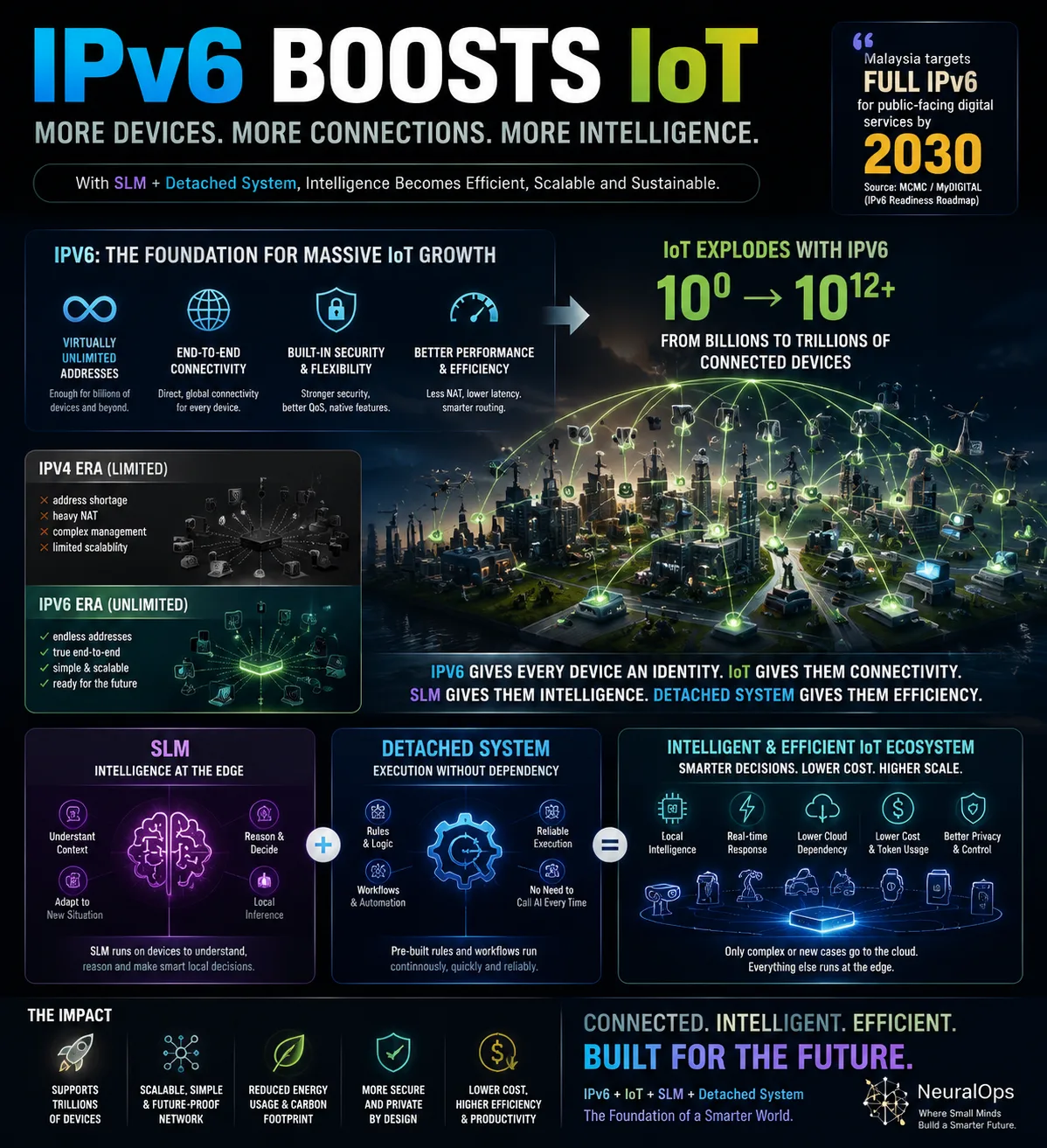
With IPv6 giving us astronomical address space, 5G providing low-latency connectivity, SLMs running on sub-watt silicon, and agentic AI frameworks that can coordinate actions across fleets, this is no longer a thought experiment. The part that gets my engineering pulse going is P2P compute pooling. Picture billions-eventually trillions-of devices each donating spare cycles to a shared pool. Instead of every inference request hairpinning to a centralised cloud and back, we route it to the nearest capable node-your neighbour's smart speaker, the sensor hub in the stairwell, the gateway in the office-and only escalate to a hyperscale data centre when the task actually needs that level of capacity.
If we can mature this architecture, the answer to our compute hunger isn't just building more megawatt-scale facilities. It's realising that the compute capacity we need is already distributed across the physical world-embedded in the machines and endpoints we've already deployed.
At AINNA NeuralOps, we're applying this principle today, at a smaller scale but with the same philosophy. Our runtime optimises for local inference first: we only invoke a 70B-parameter model when a 3B model fails to meet confidence thresholds. We tier our models, route tasks intelligently, and never send a simple classification job to a powerful GPU cluster if a quantized SLM on a microcontroller can handle it. It's compute on demand, but with a bias for doing it as close to the source as possible.
We're still early in this journey, but I'm convinced the future of AI isn't solely about scaling model parameters. It's about where intelligence lives, how computation flows through a heterogeneous mesh of nodes, and how we design systems that degrade gracefully and cooperate efficiently.
So maybe the real ghost is not a solitary, omniscient AI. Maybe intelligence will coalesce from millions of small, distributed agents-and that's the system I'm building for.
#ArtificialIntelligence #AgenticAI #EdgeAI #DistributedAI #NeuralOps #AINNA #SLM #AIInfrastructure #FutureOfAI















Ruang pembaca
Apa pendapat anda?
Komen baharu dihantar untuk semakan terlebih dahulu. Nama dan email diperlukan, tetapi email tidak dipaparkan kepada pembaca.
ที่ทำงานกำลังเจอ70Bอยู่พอดี มีประโยชน์
The framing around invoke a 70B-parameter 70B is better than I expected. Still thinking this one through.
This is where we're applying this principle finally makes sense.
Short and clear. route tasks is worth sending to my team.
I read this twice. how computation flows through is the part that stuck.
ما زلت أفكر في 70B. ، يستحق المزيد.
The numbers around escalators, CCTV nodes, fans, refrigeration make more sense than most posts I read.
I would push back slightly on sensor array, small language model, but the direction is right.
Belum yakin sepenuhnya pasal 70B, tapi hujah dia munasabah. Kena baca ulang bahagian ini.
I've never watched the movie is what I would forward to my boss.
It's compute on demand - sums the whole thing up.
Lebih jelas daripada dek vendor yang saya terima pasal 70B.
The bit about 3B model fail 3B is what I keep coming back to.
Sent this to two people already. 5G providing low-latency connectivity, SLMs is why.
मुझे 70B वाला हिस्सा पसंद आया, यह बहुत सैद्धांतिक नहीं है।
Bookmarked, mostly for it's about where intelligence lives. Need to read this part again.
You can tell the writer actually worked on picture billions-eventually trillions-of.