
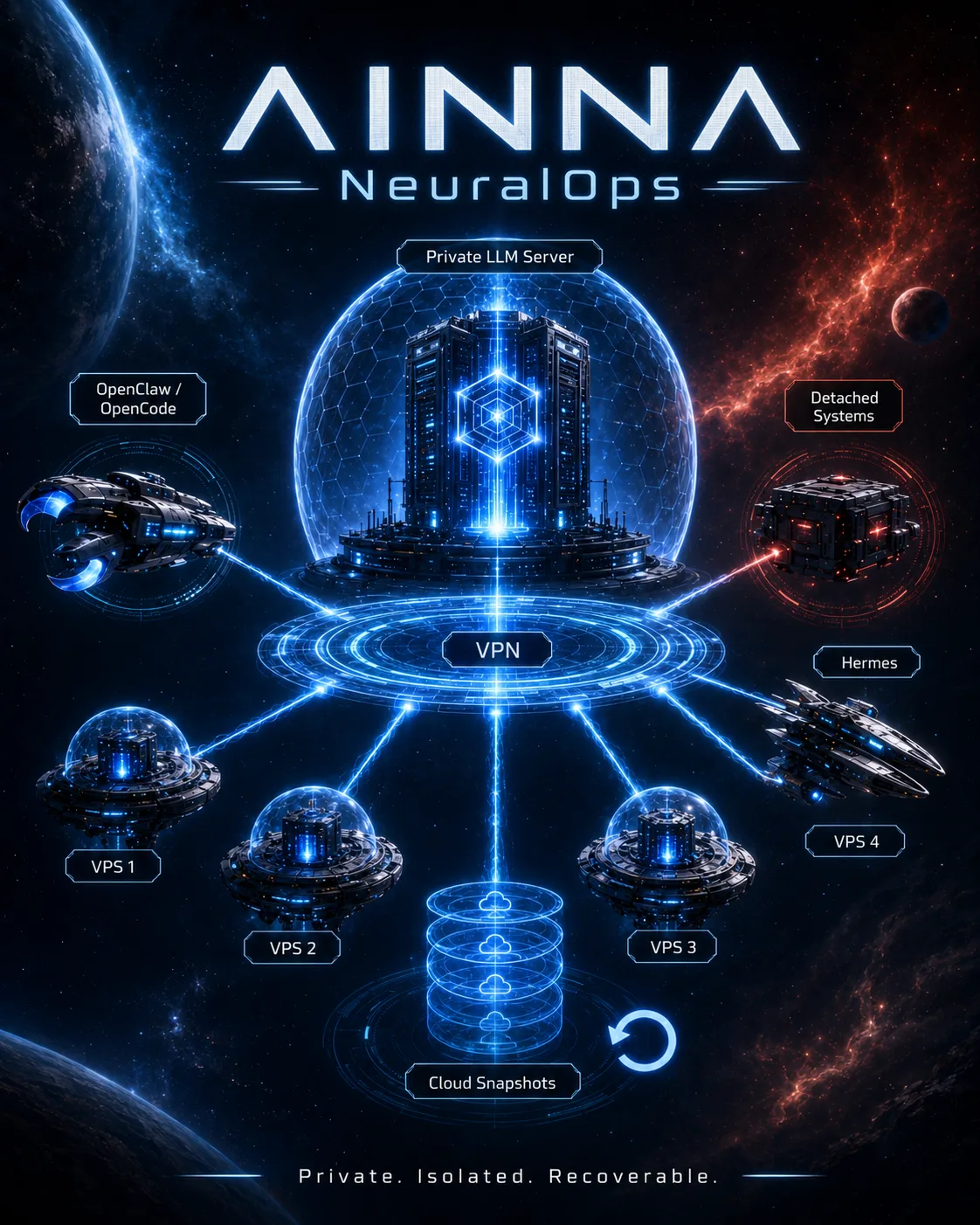
Why is AINNA NeuralOps different from agent frameworks such as Grokbot, Hermes, OpenClaw, Claude Code, or Dots?
A simple analogy:
Imagine an employee wants a cup of tea.
A conventional agent may immediately execute the task: go out and buy the tea.
AINNA NeuralOps first checks whether the tea already exists in the office pantry.
If it does, there is no reason to leave the office.
If it does not, the system then determines the most appropriate resource to handle the task.
It does not send the CEO to buy tea when an office assistant can complete the same task efficiently.
That is the core principle behind AINNA Smart Routing.
NeuralOps is designed to match each task with the lowest-cost, lowest-complexity resource capable of completing it reliably.
Deterministic tasks can be handled by rules, parsers, workflows, or detached systems.
Lightweight reasoning can be routed to smaller models.
Only genuinely complex tasks are escalated to larger, more expensive models.
The objective is not simply to make an AI agent more capable.
The objective is to make the entire AI infrastructure more economically efficient, operationally scalable, and architecturally disciplined.
In enterprise AI, intelligence alone is not the advantage.
Resource allocation is.
AINNA NeuralOps is being built around that principle.
















Ruang pembaca
Apa pendapat anda?
Komen baharu dihantar untuk semakan terlebih dahulu. Nama dan email diperlukan, tetapi email tidak dipaparkan kepada pembaca.
I have watched lowest-complexity resource capable go wrong in practice. Good to see it written down. Have a few questions left here.
Useful. We are dealing with hermes, openclaw, claude code right now.
lowest-complexity is the part I would forward to my boss.
Sa totoo lang, nakakagulat ang artikulong ito.
Honestly, parsers, workflows, or detached surprised me.
الأرقام حول هذا الموضوع أكثر منطقية من معظم ما قرأت.
とりあえず保存しました。この内容のためです。
Still thinking abot lowest-cost.