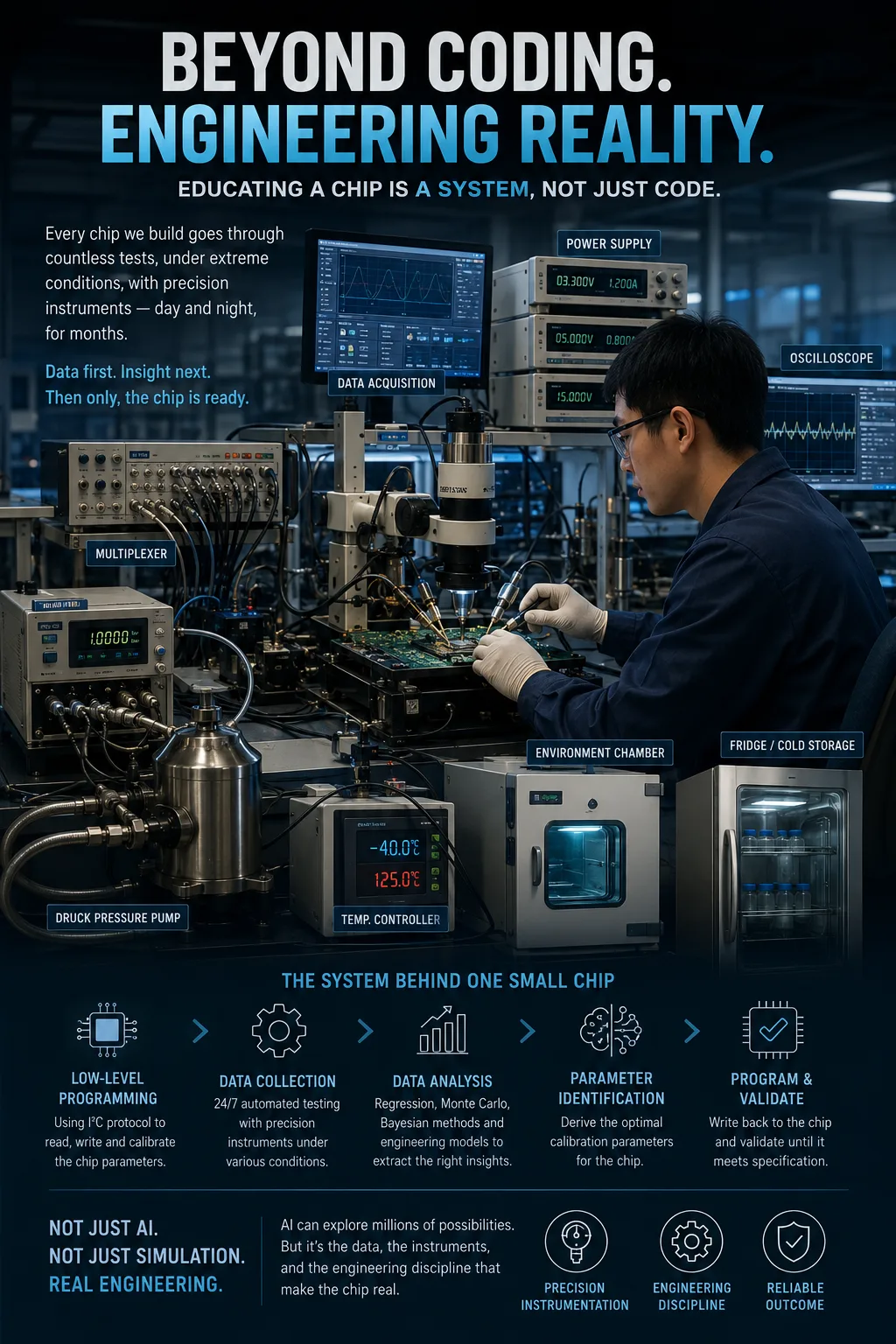
One of the hardest tasks was "educating" the chip through low-level programming. Using communication protocols such as I²C, we continuously collected sensor data, analysed the chip's behaviour, and programmed calibration parameters back into the device.
The challenge was never just programming the chip.
It was building and operating an entire automated validation environment. Test benches ran 24/7 for months, integrating multiplexers, programmable power supplies, precision Druck pressure controllers and pumps, environmental chambers, refrigerators, ovens, temperature controllers, data acquisition systems, oscilloscopes, and various measurement instruments to characterise a tiny piece of silicon under countless operating conditions.
Once sufficient data had been collected, the real engineering work began.
We analysed massive datasets using engineering equations, regression analysis, statistical methods, repeated calibration, and countless iterations to derive the correct parameters. Reaching production-ready calibration often required months, and sometimes years.
Today, AI and modern statistical computing can evaluate millions or even billions of possibilities within a fraction of the time. Regression identifies relationships, Monte Carlo explores uncertainty through simulation, and Bayesian inference continuously updates probabilities as new evidence becomes available.
The engineering principle, however, remains the same.
The most effective systems don't rely on AI for every execution. They first discover the optimal solution, validate it, and then convert it into deterministic processes executed by rules, parsers, and specialised systems.
AI accelerates discovery.
Deterministic systems ensure consistency.
Engineering discipline remains the foundation.
Technology has changed. The engineering mindset hasn't.
Official Cross-Network Resource