One question I get quite often is:
"Why do you still use a CLI when AI is available on WhatsApp or Telegram?"
My answer is simple.
I use both.
Not because one is better than the other, but because each excels in a different environment.
When I'm building systems, reviewing thousands of lines of code, debugging infrastructure, or orchestrating multiple AI agents, nothing beats the Command Line Interface (CLI).
A CLI provides speed, precision, reliability, and direct access to the underlying system. It minimizes distractions and gives complete control over complex workflows. For engineering and development, it remains the most productive interface I have used.
However, work doesn't only happen in front of a computer.
Ideas appear while driving, during meetings, walking between locations, or travelling. That's where conversational interfaces like WhatsApp and Telegram become incredibly valuable.
With voice input, I can assign tasks, request research, trigger automations, review summaries, or continue ongoing discussions without opening a laptop. The conversation itself becomes the interface.
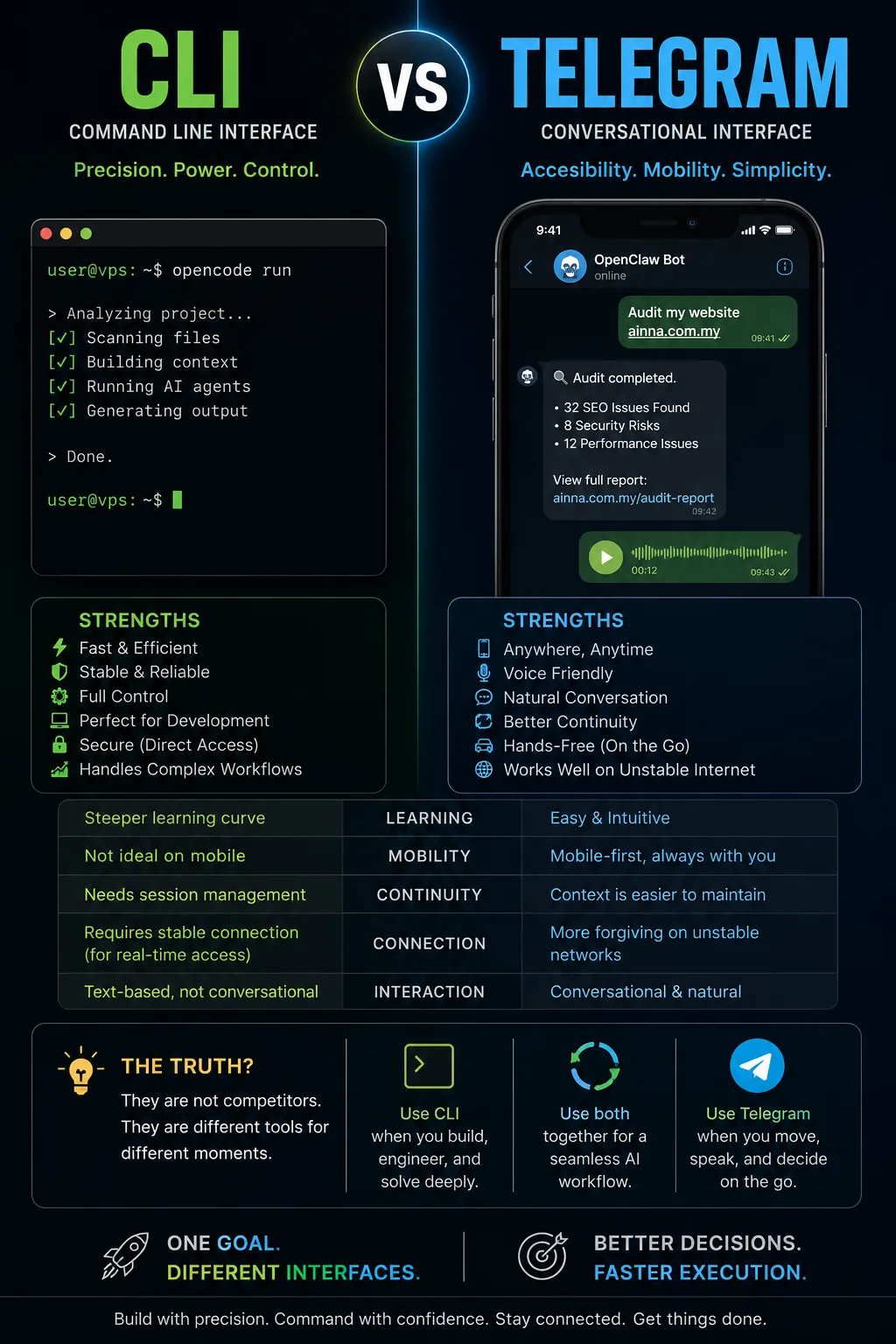
Interestingly, each platform has different strengths.
CLI
Fast execution
Reliable for technical work
Excellent for development and automation
Better control over complex workflows
Session continuity may require additional context management
WhatsApp / Telegram
Accessible anywhere
Natural voice interaction
Easier long-term conversational continuity
Ideal for mobile decision making
Dependent on messaging infrastructure and network conditions
I don't see these as competing interfaces.
I see them as complementary.
The real evolution isn't replacing the CLI with chat, or replacing chat with the CLI.
It's allowing AI agents to move seamlessly between both.
Imagine starting a task from your phone using your voice, letting an autonomous agent continue processing in the background, then reviewing and refining the results later from a CLI. The interface changes, but the work continues without interruption.
That, in my opinion, is where agentic AI becomes truly useful-not because it's more intelligent, but because it adapts to how humans actually work.
The future isn't CLI.
The future isn't WhatsApp.
The future is having the right interface at the right moment, while your AI agents continue working in the background regardless of where the conversation started.