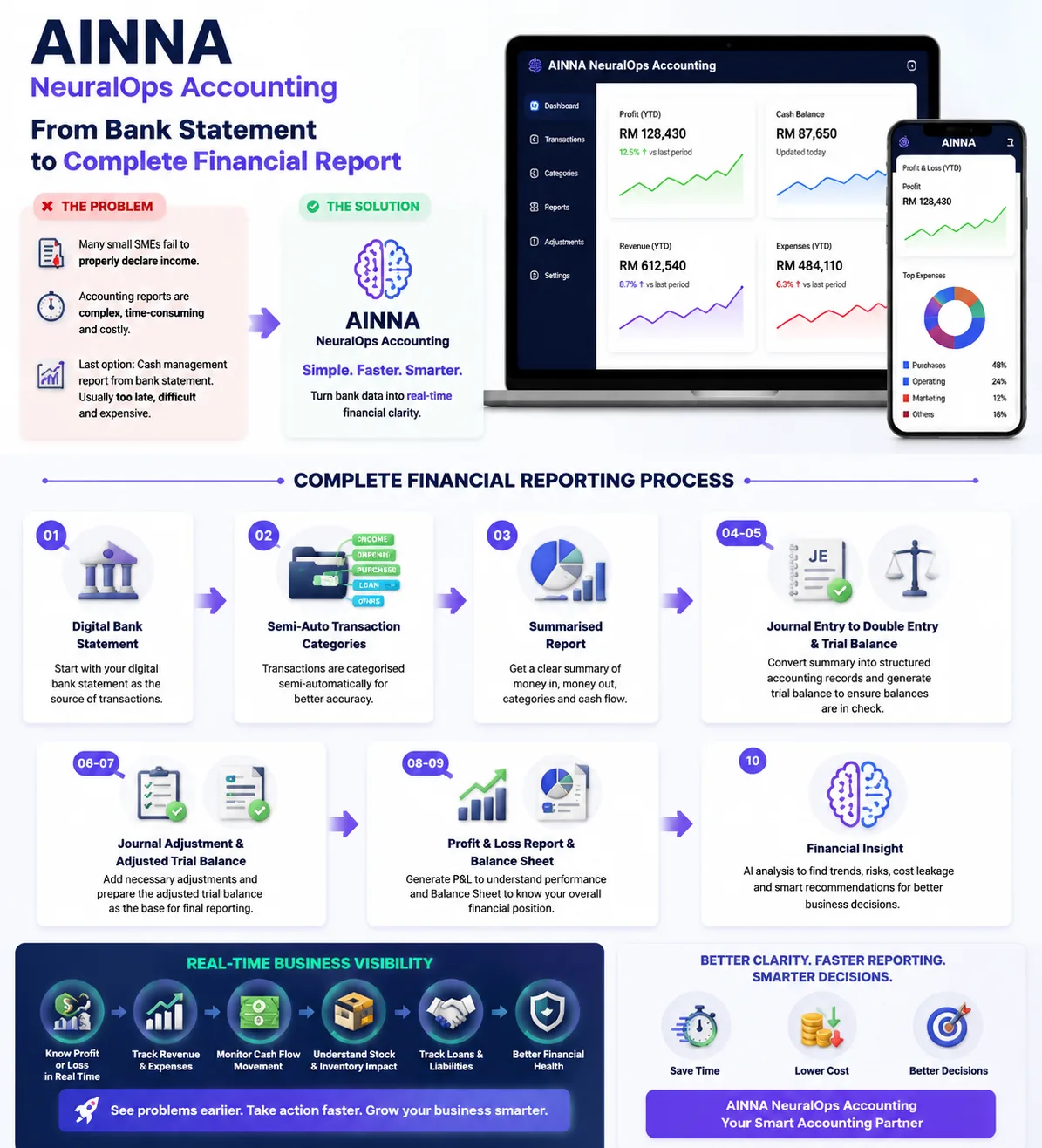
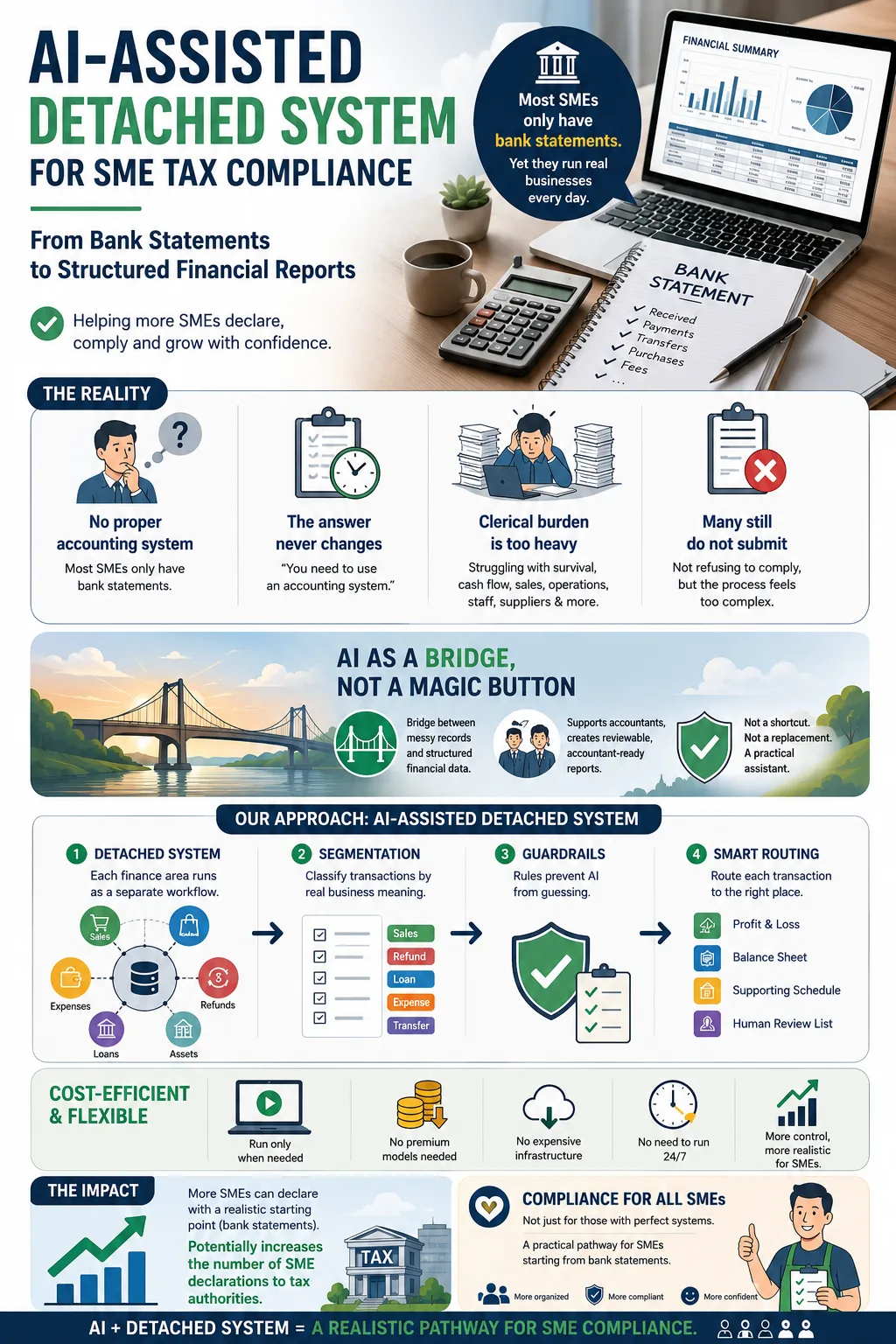
From a finance operations standpoint, many small Malaysian SMEs under-declare business income and only face tax authority pressure once the shortfall becomes unavoidable. In most cases the root cause is not evasion but a reporting process that is fragmented, slow, and disproportionately costly for the size of the business.
Without an accurate ledger, the fallback is usually a rudimentary cash-based reconciliation built from bank statements. By then the data is messy, adjustments multiply, and remediation cost often exceeds what timely compliance would have cost.
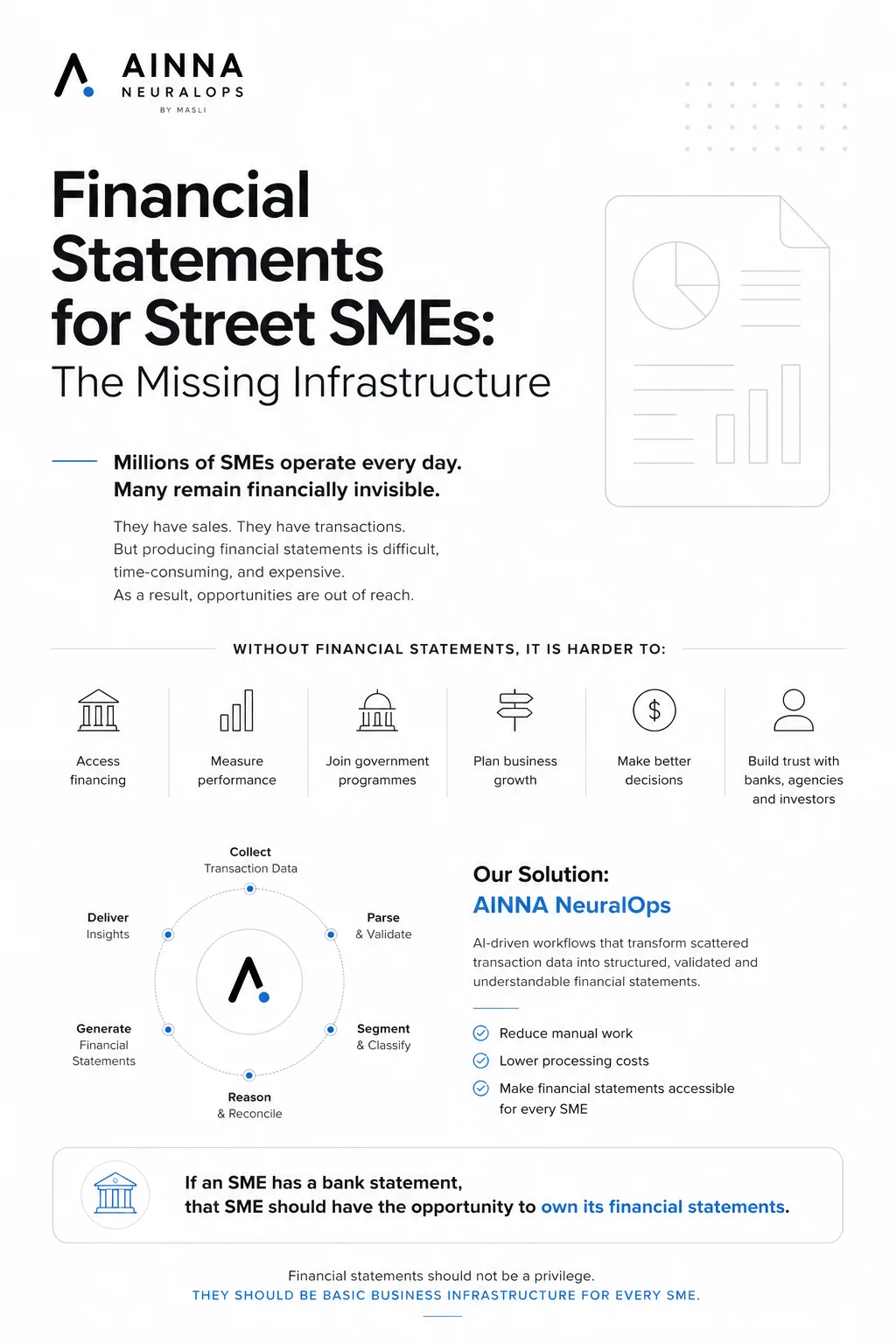
AINNA NeuralOps Accounting is designed to remove that friction.
It converts digital bank statements into a structured, auditable financial reporting workflow that is faster, more accurate, and easier to maintain.
From Source Data to Management-Ready Reports
- Source: Digital Bank Statement
Every accounting period starts with the digital bank statement. It is the most objective, transaction-level record of cash movement in the business. - Semi-Automated Transaction Classification
Transactions are classified semi-automatically so that revenue, operating expenses, purchases, refunds, financing, drawings, and other cash movements are grouped logically from the start. - Cash Movement Summary
The classified bank data is summarised into a report of money in, money out, account categories, and net cash position. - Structured Journal Entries (Double Entry)
The summary is posted as structured double-entry records, giving each transaction a clear debit-credit trail. - Trial Balance
The double-entry records feed a Trial Balance that verifies ledger arithmetic before any final reporting step. - Adjusting Journal Entries
Accruals and adjustments are recorded where required, for example inventory movements, loan interest, depreciation, bank overdrafts, tax provisions, and other verified items. - Adjusted Trial Balance
After adjustments are included, the Adjusted Trial Balance becomes the authoritative base for final financial reporting. - Profit & Loss Report
The system generates a Profit & Loss report showing revenue, cost of sales, operating expenses, and net profit for the period. - Balance Sheet / Statement of Financial Position
The Balance Sheet is built by combining the current-year Profit & Loss, the prior-year closing position as opening equity, and the Adjusted Trial Balance. - Financial Insight
Finally, AI analytics interpret the reports, flagging trends, excess costs, cash leakage, weak cost categories, and practical actions for management.
Real-Time Business Visibility
Used continuously, the system removes the traditional year-end delay. Owners can see whether the business is profitable without waiting for a manual closing cycle.
As transactions are processed regularly, AINNA NeuralOps Accounting refreshes reports continuously, delivering a near real-time view of financial performance.
This helps SME owners understand:
- Current profit or loss position
- Revenue performance and concentration
- Expense trends and variances
- Cash flow movement
- Stock and inventory impact
- Loan commitments
- Overall financial health
Rather than discovering issues months after they have materialised, management can detect variances early and intervene before they erode cash or profitability.
Why It Matters
Most SMEs only learn their true profit or loss once the books are closed. AINNA NeuralOps Accounting makes the financial position visible throughout the year.
It repositions accounting from a backward-looking compliance exercise to a forward-looking management control.
The financial operations objective is straightforward:
Cleaner financial data.
Faster month-end and year-end reporting.
Lower operating cost.
Better capital and cost decisions for every SME.















Ruang pembaca
Apa pendapat anda?
Komen disemak sebelum diterbitkan. Email diperlukan untuk moderasi dan tidak dipaparkan kepada pembaca.
Ringkas dan jelas. AINNA neuralops accounting boleh kongsi dengan team saya.
This is where digital bank statement every accounting finally clicks.
Adjusting journal entries accruals is what I would forward to my boss.
That point about semi-Automated transaction classification is well put.