
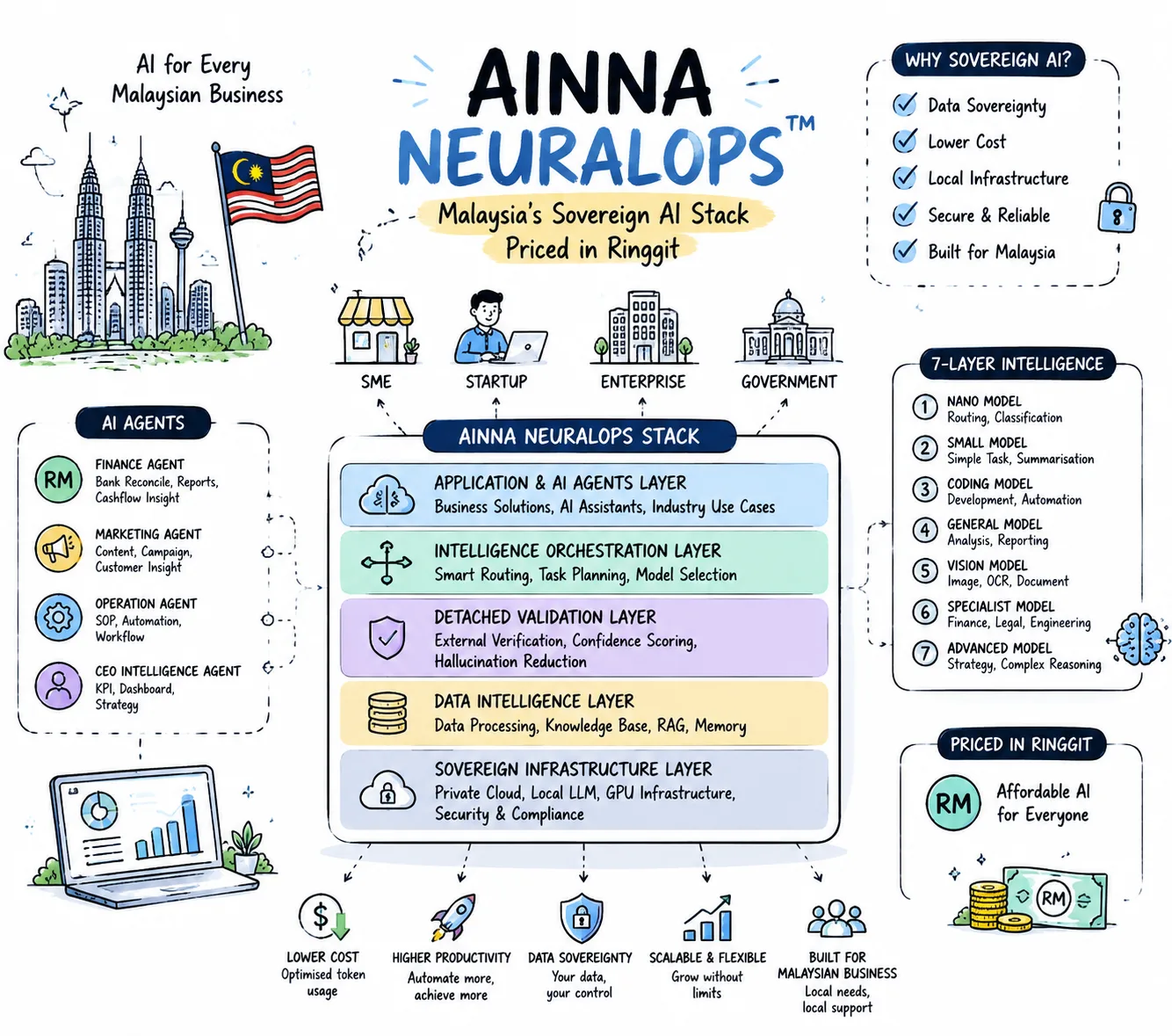
From a finance and asset-control standpoint, I classify this deployment model as sovereign AI infrastructure.
The model may start with open-source weights and use advanced external AI models as teachers during distillation and training. For AINNA's SME clients, this means the heavy development cost is paid once. Those external models are development-phase inputs, not recurring production liabilities.
Once training is complete, the deployed AI becomes a controlled asset operating entirely within our own environment. This shifts the cost profile from unpredictable usage-based fees to a more capitalisable, internally managed technology asset.
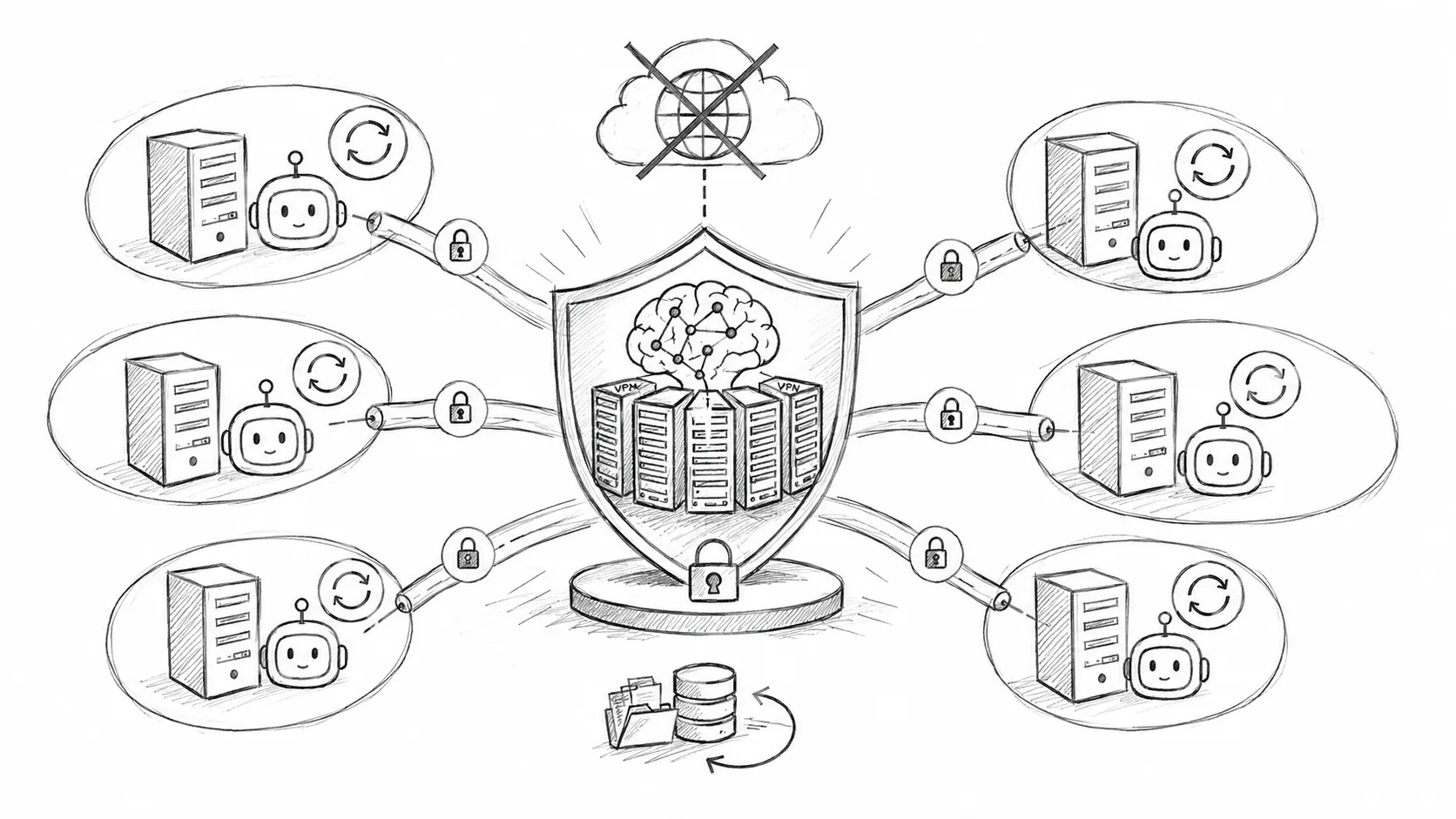
The final model weights are held as a locally controlled asset.
Inference runs on self-hosted infrastructure.
Business and user data remain within our environment.
Deployment, networking, access control, and compute are managed internally.
Production access is isolated through a private VPN.
Most importantly, the system does not require external AI APIs to operate during inference, which removes ongoing usage-based cost volatility.
This distinction has a direct impact on balance-sheet risk, audit readiness, and operating-cost predictability for Malaysian SMEs.
Sovereignty does not mean that every skill, software component, research input, or training influence must be created internally. Very few business assets are built without external knowledge or supplier contributions.
What matters financially is who controls the asset once it is deployed.
If an external AI provider becomes unavailable tomorrow, an SME's production system should continue operating without disruption or stranded technology investment.
If an API provider changes its pricing, policies, model behaviour, or access conditions, the SME's production budget and cash-flow forecast should remain unaffected.
If sensitive business data enters the system, that data does not need to leave the SME's controlled infrastructure for inference, reducing compliance and audit exposure.
That is the practical financial value of sovereignty for AINNA's SME clients.
In our architecture, external intelligence may assist during the development stage, but it does not control the final operating environment or its ongoing cost base.
A useful business analogy is constructing a facility with external specialists.
A developer may engage architects and contractors to build a facility, but once construction is complete and the keys are handed over, the owner operates the facility independently.
AI distillation works in a similar way.
Advanced models can act as capability providers during development, while the resulting model becomes an independently operated asset running entirely within infrastructure under our control.
For this reason, from a financial control and asset-management perspective, I would describe the architecture as:
Sovereign AI Infrastructure with locally controlled assets and independent inference.
The important claim is not that the AI asset was built without external expertise.
The important claim is that the deployed AI asset is not subject to external control.
That means financial and operational sovereignty exists where it matters most to a growing SME:
the asset, the data, the infrastructure, the inference, the access, and the operational decisions remain under local control.













Ruang pembaca
Apa pendapat anda?
Komen disemak sebelum diterbitkan. Email diperlukan untuk moderasi dan tidak dipaparkan kepada pembaca.
Ang bahagi tungkol sa bahaging ito ang pinag-isipan ko nang matagal.
Bookmarked, mostly for AI distillation works.
Short and clear. internally managed technology asset is worth sending to my team.
Whoever wrote this actually did the work on inference runs on self-hosted infrastructure.