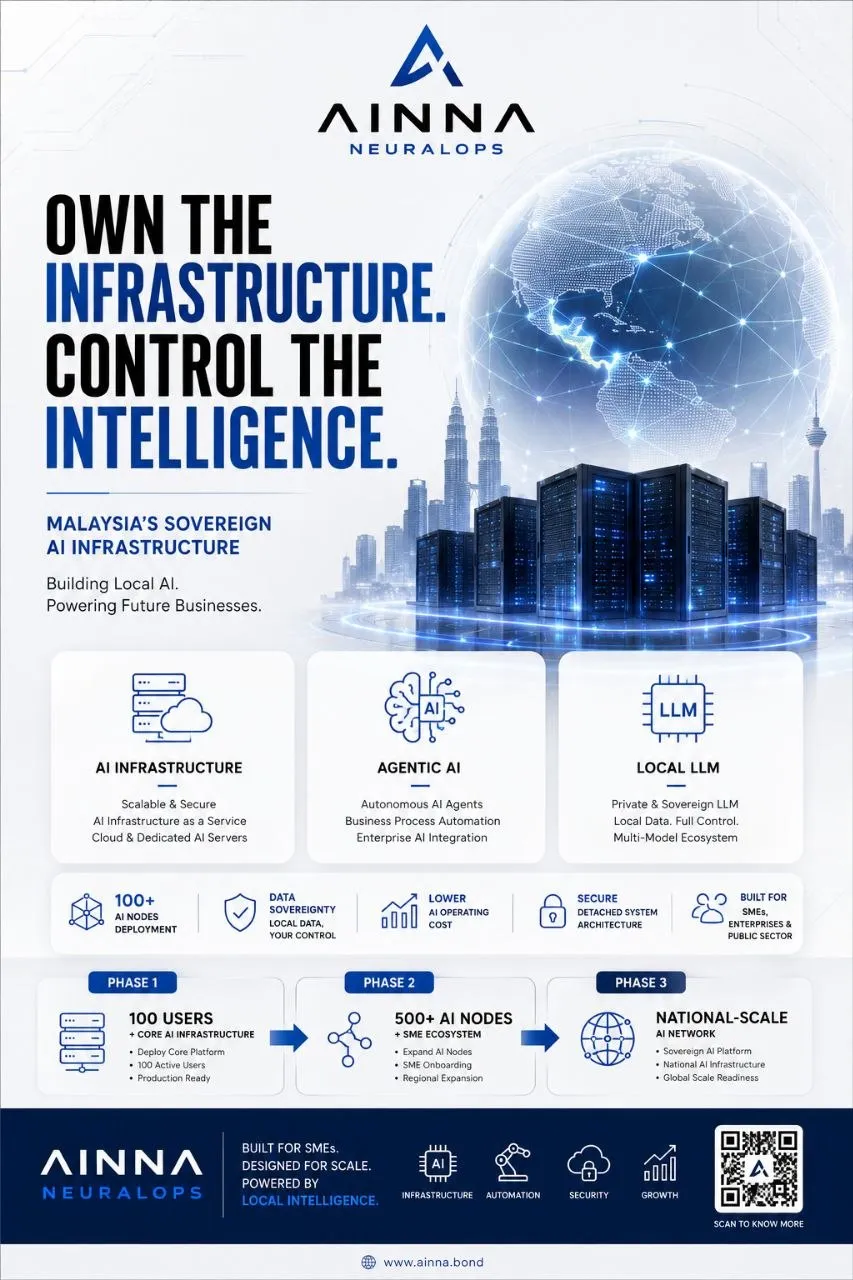
AINNA Network 76 sites
Core8
AINNA
Homepage & company hub
ESG
Sustainability & impact
new
Carbon Emulator
Carbon footprint calculator & smart routing emulator
new
GTM AI
Go-to-market operating system
NeuralOps Accounting
AI-assisted accounting
new
Time Core
Unified Chrony time layer for all NeuralOps systems
new
AINNA Agent
Private autonomous agent hub
new
Government
Secure national institutional intelligence infrastructure
NeuralOps Platform10
AINNA NeuralOps
AI Ecosystem
new
SME Street
Street SME financial portal
new
NeuralOps Scenario
135 detached system use cases
Infrastructure
Managed cloud & servers
enterprise
NeuralOps Platform
Enterprise AI architecture platform
ISO Compliance
AI-powered ISO compliance OS
LLM Hub
Local AI Models
beta
Model Orchestra
vLLM model routing & serving
NeuralOps CI
Control & Instrumentation
enterprise
Enterprise Assessment
Request NeuralOps enterprise evaluation
AI Services12
Detached System
AI-built, independently run
Segmentation Architecture
Task triage, routing and execution layers
Smart Routing
Select the right model for each task
AI Agent
Build complete AI systems
new
AI Compliance
Agent & LLM audit / QA
new
CySec
Legacy security audit hub
Database Agent
AI database management
Edge AI
IoT & embedded Linux
Data Services
Big data analytics
new
Smart Farming
Agri NeuralOps platform
Partner & R&D
Apply to collaborate with us
E-Commerce
Cross-border marketplace
Industry20
new
Marine Detached Systems
AI-built rule-based systems for ship operations
new
Palm Oil Mill
AI-powered detached systems for POM operations
new
Oil & Gas
AI-powered detached systems for O&G operations
new
Logistics & Supply Chain
AI-powered detached systems for fleet, warehouse & delivery ops
new
IT Solutions
AI-powered managed IT services for cloud, security & DevOps
new
Manufacturing
AI-powered detached systems for smart factory operations
new
Construction
AI-powered detached systems for construction operations
new
Mining & Resources
AI-powered detached systems for mining & resources ops
new
Healthcare & Hospitals
AI-powered detached systems for hospital operations
new
Education
AI-powered detached systems for school & university ops
new
Retail & Kedai Runcit
AI-powered inventory, checkout & customer analytics for SME retail
new
F&B / Makanan & Minuman
AI-powered kitchen ops, food safety & delivery for restaurants
new
Bengkel / Workshop
AI diagnostics, parts management & scheduling for automotive workshops
new
Farmasi / Pharmacy
AI dispensing, expiry tracking & drug safety for pharmacies
new
Pertanian / Agriculture
AI crop monitoring, irrigation & yield prediction for farms
new
Hospitaliti / Hospitality
AI guest experience, dynamic pricing & energy management for hotels
new
Perkhidmatan Profesional
AI document automation, compliance & client management for firms
new
Pengurusan Hartanah
AI tenant management, maintenance & energy optimization for properties
new
E-Dagang / E-Commerce
AI product recommendations, order management & fraud detection
new
Fleet & Penghantaran
AI route optimization, driver monitoring & fuel management for fleets
Featured Demos2
featured
Trial Bal
Trial balance generation & validation
featured
Grad Audit
Graduation audit & verification
Live Demos1
hub
Browse All Demos
142 interactive NeuralOps scenarios · filter by domain
People11

CEO
Nur Ain Syuhada

Director of Customer Strategy
Rozni Enana
CTO
Masli Yahaya

CFO
Fatin Suniza

Head of Logistics
Hakim Hafizi

Logistic And RND
Muhammad Hakam Hafizul

Operations & Biz Dev
Muhammad Firdaus Bin Nordin

E-Commerce Ops
Mohd Shafiq Haiqal

AI System Developer
Agent TC

Research Lead
Dr. Abd Razzif
Special Projects
Hasdey Inspired
General2
Tools
Free online utilities catalog
Games
Arcade, puzzle & card games hub
Market Intelligence8
new
Bursa Saham
Live KLSE quotes, FBMKLCI, top movers & interactive charts
new
Emas Spot
Live gold proxy with chart and forecast
new
Silver Spot
Live silver proxy with chart and forecast
new
Forex Malaysia
ECB rates, USD/MYR candlestick OHLC & regression sim
new
Cyber Security
Autonomous security audit
new
Brent Intelligence
Live Brent USD & RM, Malaysia fuel board, AI forecast
Bank Recompiler
Multi-bank PDF statement compiler (Maybank, CIMB, CCMBB) → XLSX + JSON. Zero file storage, SME-ready.
featured
BRSA
Bursa Rapid Sentiment Analytics — National election data analytics, Monte Carlo simulation, GPT regression
Content2
AI Blog
Articles on AI & ML
Tech Blog
Product & engineering