AI governance is often discussed at the policy level.
But in practice, governance only becomes effective when it is translated into system architecture.
A regulation may require reliability, auditability, monitoring and independent validation. The more important question is how these requirements are implemented before an AI output becomes a business decision.
From our own development experience, we believe three architectural components are essential:
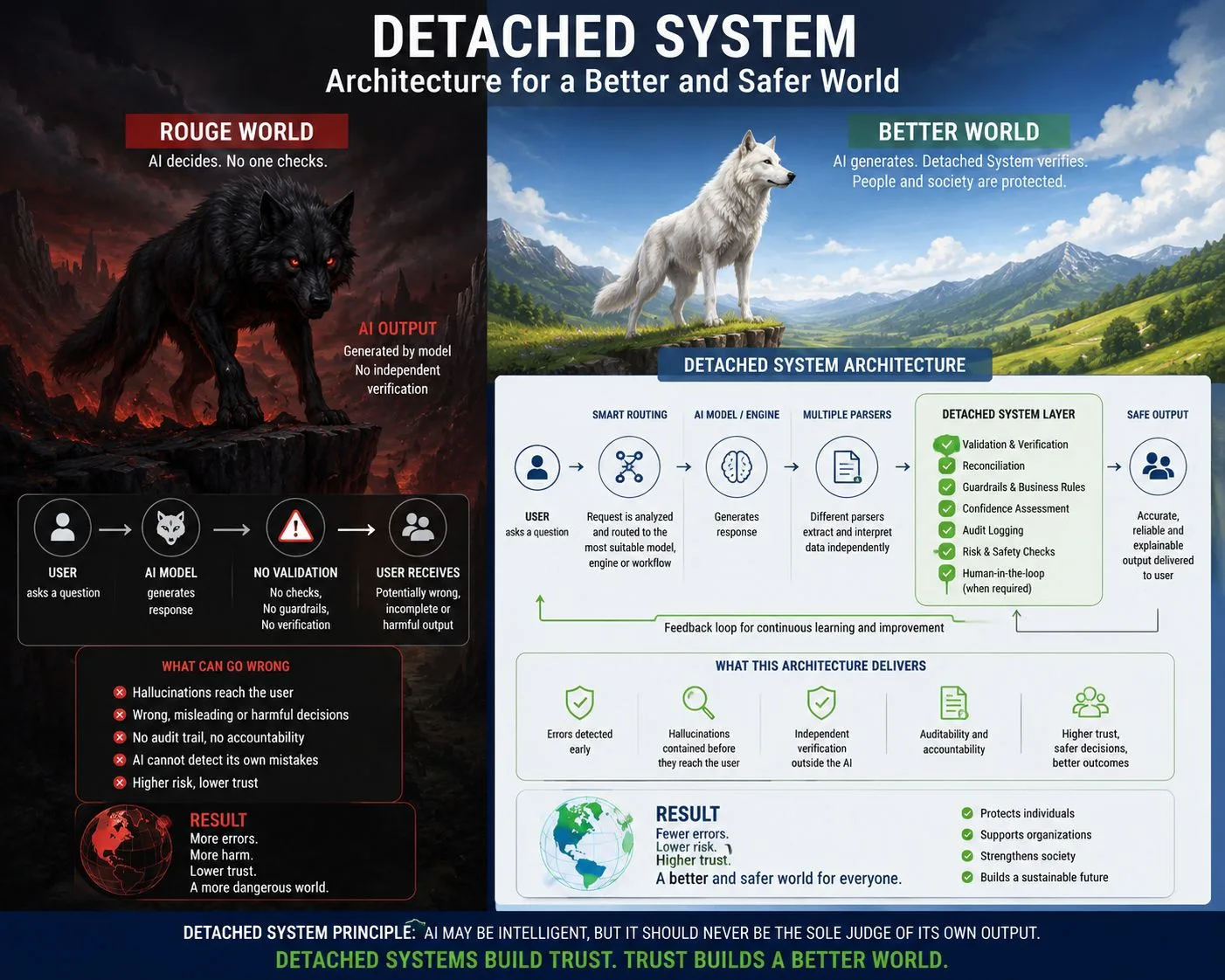
Smart Routing
Not every task should be sent to the same AI model.
The system should first classify the request based on task type, complexity, data format, risk level and required accuracy. It can then route the request to the most suitable AI model, deterministic engine, rule-based workflow or specialised parser.
This means risk is managed at the beginning of the process, not only after the answer has already been generated.
Multiple Specialised Parsers
A single parser creates a single point of failure.
Different parsers can extract and interpret the same input through separate methods. Their outputs can then be compared, reconciled and validated before the system accepts the result.
When the outputs disagree, the system can stop, reroute or flag the transaction instead of silently allowing an unreliable result to continue.
Detached Systems
The AI model should not be responsible for approving its own output.
Validation, reconciliation, guardrails, business rules, confidence assessment and audit logging should operate outside the model through independent system components.
The principle is simple:
AI generates. The system verifies.
With this architecture, hallucination risk is not managed only at the final stage. It is controlled throughout the workflow, from routing and parsing to validation and acceptance.
This does not mean hallucinations can be eliminated completely. It means unreliable outputs can be detected, contained and prevented from reaching the final decision layer.
Most importantly, this architecture can also support better ESG performance.
Smart Routing prevents every request from being sent to the largest and most expensive model. Deterministic processes, specialised parsers and smaller models can handle simpler tasks, while advanced models are used only when genuinely required.
This reduces unnecessary token usage, GPU processing, electricity consumption, cooling requirements and infrastructure costs.
Trustworthy AI should therefore not depend only on a powerful model.
It should depend on an architecture that is measurable, independently verifiable, resource-efficient and designed to control risk from the beginning.
Governance must exist in policy.
But prevention, verification and ESG efficiency must exist in the system.
#AIGovernance #ResponsibleAI #AIInfrastructure #SmartRouting #DetachedSystems #AIValidation #ESG #GreenAI #MalaysiaAI #DigitalTransformation
From Policy to Architecture: Building AI Governance Into the System