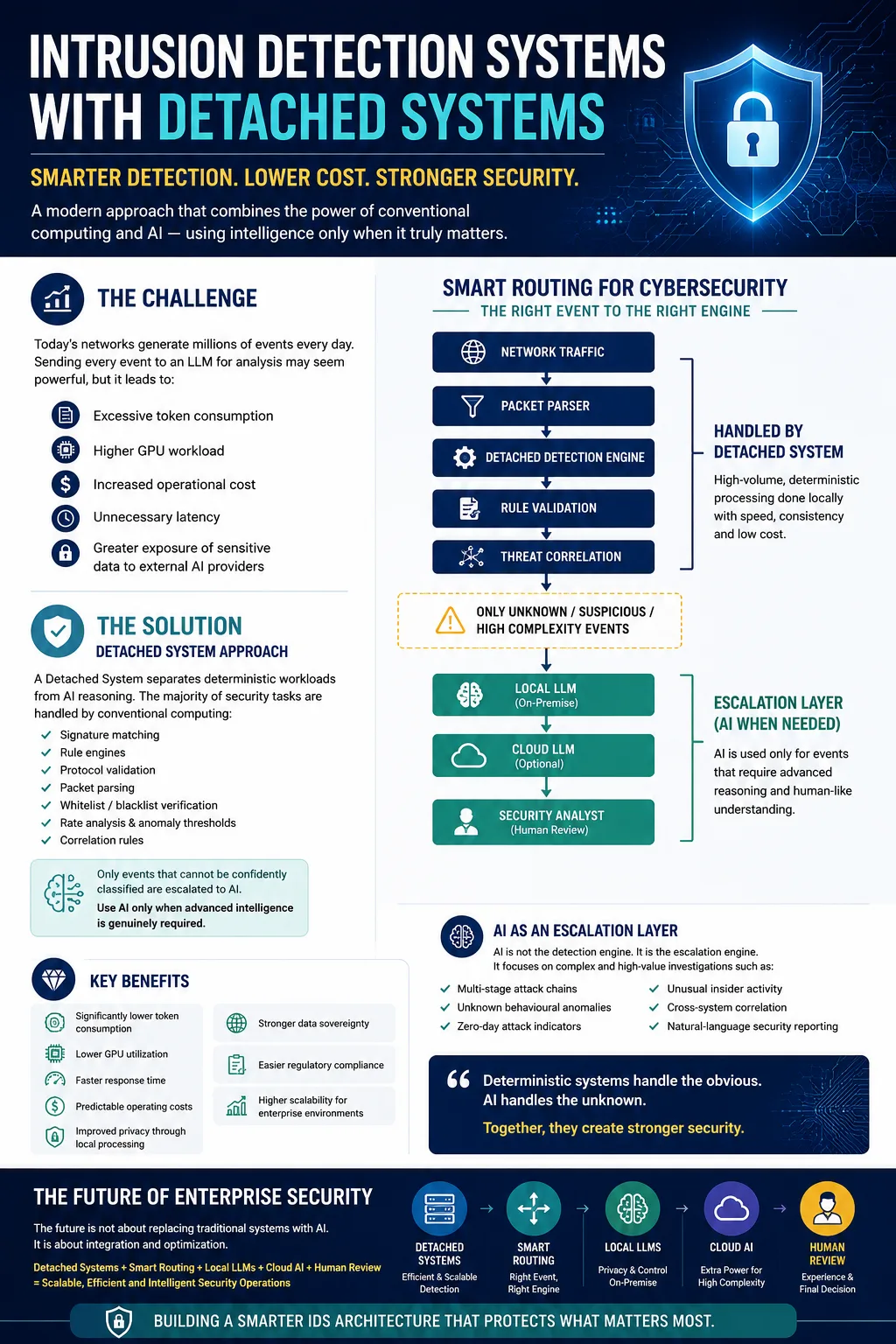
Traditional Intrusion Detection Systems, or IDS, are increasingly overwhelmed by the massive volume of network activity generated by modern enterprise environments. Every packet, login attempt, API request, DNS query and application event may require inspection. As AI adoption grows, some systems attempt to send nearly every security event directly to an LLM for analysis. Although this may appear advanced, it creates significant operational challenges, including excessive token consumption, higher GPU workload, increased infrastructure cost, slower response times and greater exposure of sensitive security data to external AI providers.
A Detached System offers a more efficient approach by separating deterministic security workloads from AI reasoning. Instead of relying on an LLM to inspect every event, the majority of network activity is processed using conventional computing methods such as packet parsing, signature matching, protocol validation, whitelist and blacklist verification, rate analysis, anomaly thresholds and predefined correlation rules. These tasks can be executed rapidly, consistently and at scale without continuous AI inference.
Within this architecture, Smart Routing determines how each event should be processed. Normal and clearly identifiable traffic remains within the Detached System, while suspicious, unknown or highly complex events are escalated to a local LLM, cloud-based AI or a human security analyst. This ensures that advanced AI is used only when advanced intelligence is genuinely required.
The main advantage of this approach is that AI becomes an escalation layer rather than the primary detection engine. The Detached System handles repetitive, deterministic and high-volume detection, while AI focuses on complex cases such as multi-stage attacks, unusual behavioural patterns, potential zero-day indicators, insider threats, cross-system correlation and natural-language security reporting.
By combining IDS with Detached Systems, organizations can reduce token usage, lower GPU demand, improve response time and maintain more predictable operating costs. Sensitive security data can also remain within controlled local infrastructure, strengthening privacy, cybersecurity, regulatory compliance and data sovereignty.
The future of enterprise security is therefore not based on replacing conventional cybersecurity systems with AI. Instead, it involves integrating Detached Systems, Smart Routing, local LLMs, cloud AI and human review into a coordinated security architecture. This approach allows organizations to scale their security operations efficiently while using AI only where it provides measurable operational value.