Twenty years ago, technology vendors told us IPv6 would become mainstream within one or two years.
The technology was ready. The ecosystem was not.
At the time, IoT was still limited, Edge AI was not practical, and there was little reason for billions of everyday objects to have their own unique IP addresses. As a result, IPv6 adoption progressed far more slowly than predicted.
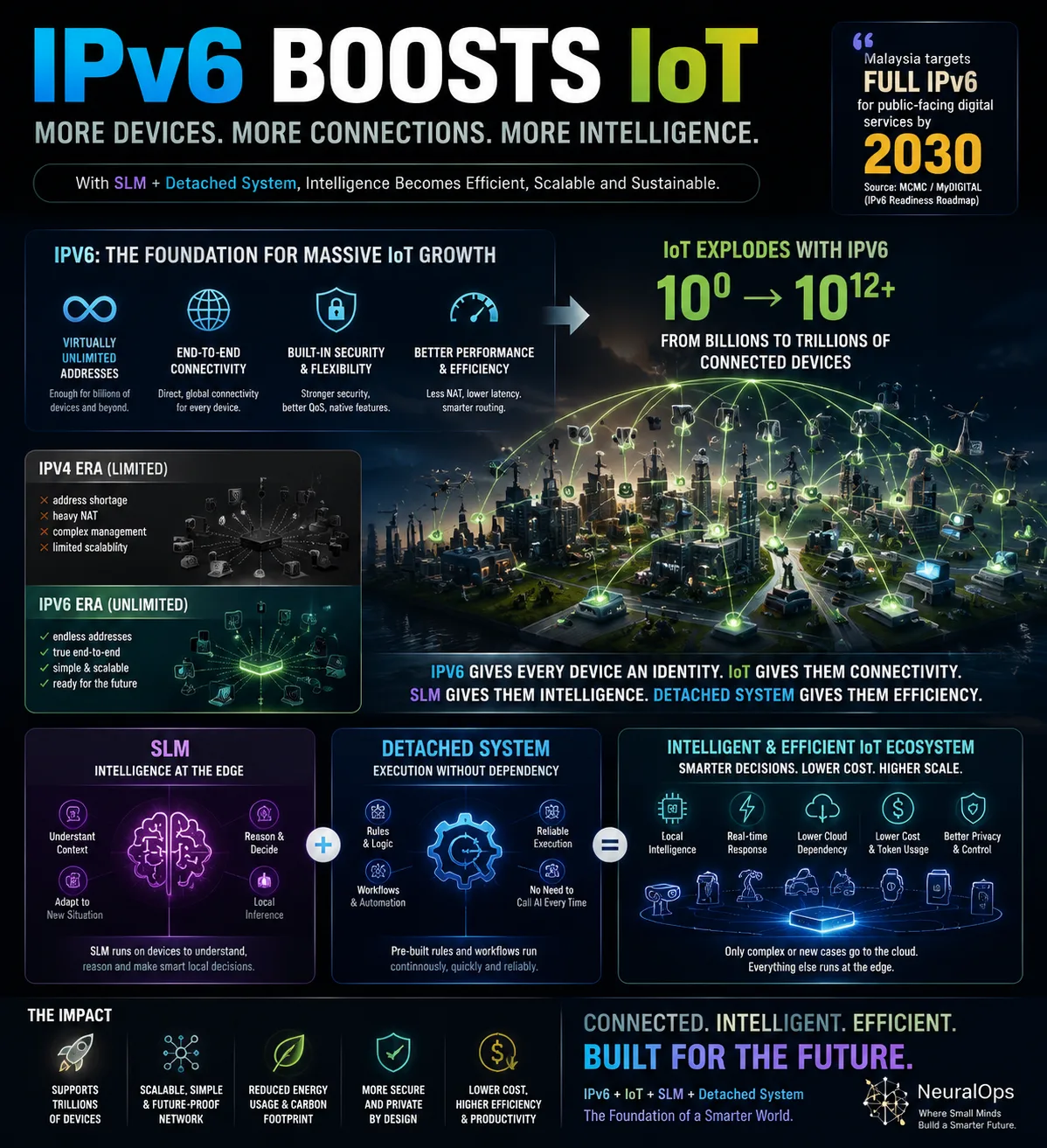
Fast forward to today. Malaysia is now working towards full IPv6 adoption, with a proposed national direction for complete migration by 2030.
The real opportunity, however, is not IPv6 alone. It is the convergence of IPv6, IoT, Small Language Models and Detached Systems.
An SLM can act as the local reasoning layer. It can understand context, interpret unfamiliar situations and decide which action should be taken. The Detached System then becomes the operational layer, executing validated rules, algorithms and workflows continuously without repeatedly calling the AI model.
This combination changes the economics of Edge AI.
The SLM does not need to control every routine action. It is activated only when reasoning, adaptation or exception handling is required. Once the correct logic has been established, the Detached System carries out the repetitive work reliably and at a much lower computing cost.
IPv6 gives each device an identity. IoT provides connectivity. SLMs provide local reasoning. Detached Systems provide efficient and repeatable execution. Peer-to-peer networking allows devices to collaborate directly.
A smart cup, factory sensor, vehicle component or household appliance could therefore handle most routine decisions locally. Only unfamiliar or complex cases would need to be escalated to a larger model or cloud GPU infrastructure.
This architecture could significantly reduce cloud workload, GPU dependency, token consumption, bandwidth, latency and operating costs.
The future of AI may not be one giant brain inside a data centre.
It may be billions of small intelligent devices, each with its own IPv6 address, combining an SLM with a Detached System and working together through a distributed peer-to-peer network.
Cloud infrastructure will remain important for model training, large-scale coordination and highly complex workloads. But everyday intelligence and execution may increasingly move towards the edge.
What appeared to be merely a networking upgrade twenty years ago may ultimately become one of the foundations of distributed intelligence.
#IPv6 #SLM #SmallLanguageModels #DetachedSystem #EdgeAI #IoT #DistributedAI #PeerToPeer #ArtificialIntelligence #NeuralOps