Most small SME owners ask the same question every year: “How do I submit my business accounts?” In this era of digitalisation, many small SMEs are already selling online, receiving payments digitally, and running real businesses. But the irony is, many of them still do not have proper accounting systems. Their most consistent business record is often only their bank statement.
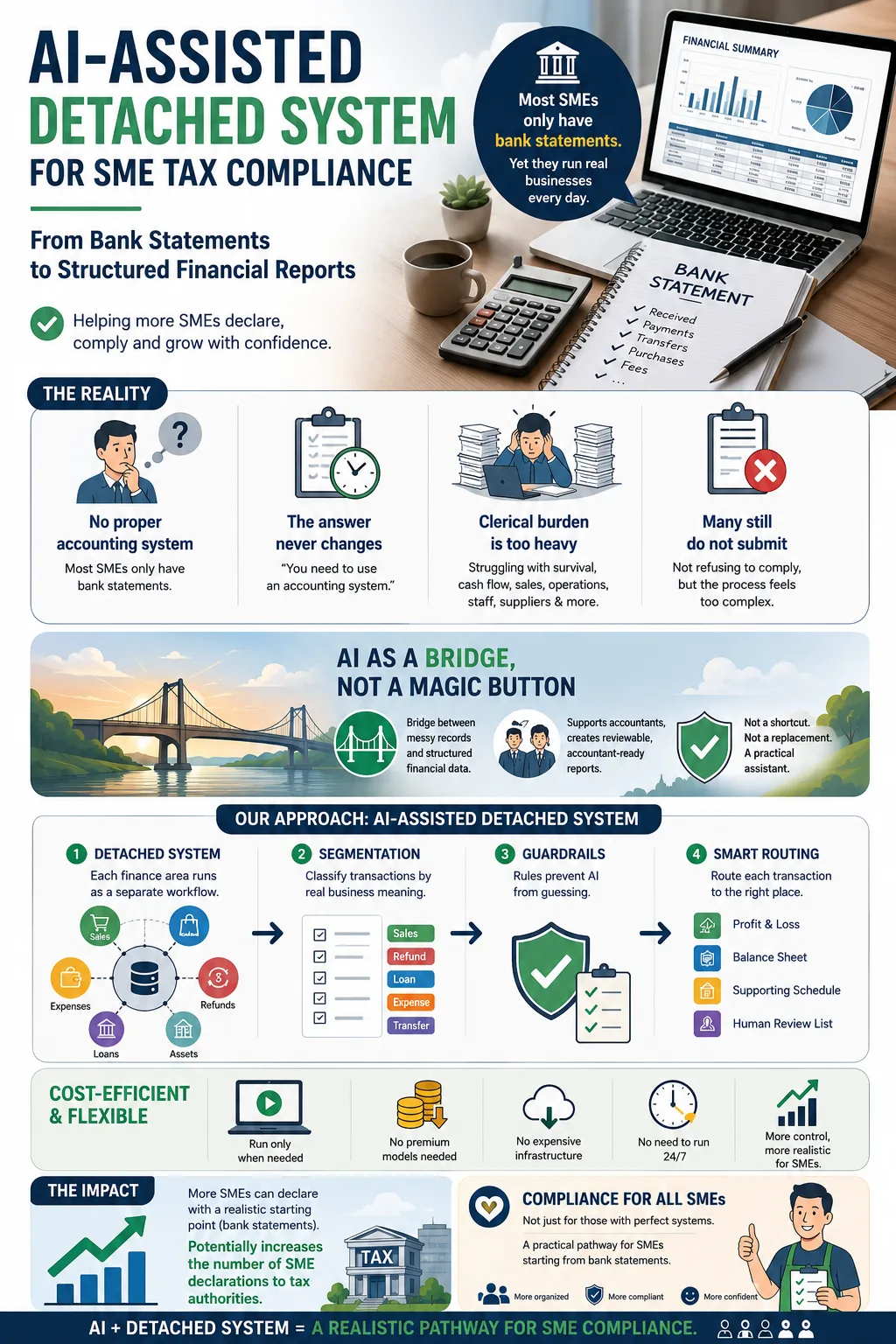
The common answer has always been the same: “You need to use an accounting system.” That answer is technically correct, but it does not solve the real problem. Many small businesses have already been operating for years without a system, and they are still busy selling, buying stock, paying suppliers, handling refunds, managing cash flow, and solving daily business problems.
So when the answer never changes, the outcome also never changes. Many of them still do not submit at all. Not because they refuse to comply, but because the clerical burden is too heavy. They are not only struggling with paperwork, but also with survival, cash flow, sales, operations, staff, platforms, suppliers, and daily business pressure.
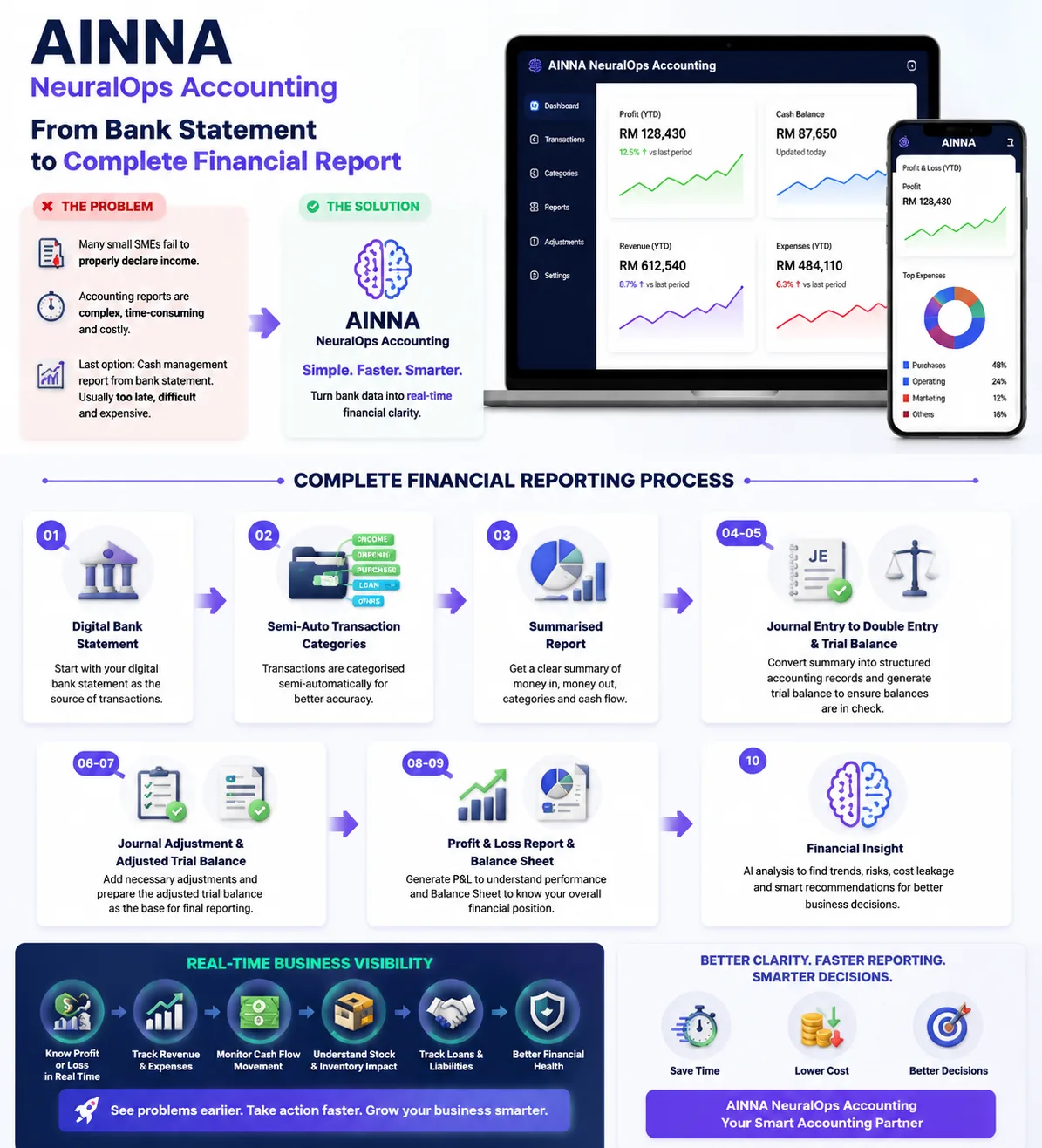
This is where I believe AI can play a very practical role for SMEs. Not as a magic button, not as a replacement for accountants, and not as a shortcut to avoid proper compliance. AI should become a bridge between messy bank-statement-based records and structured, reviewable, accountant-ready financial data.
For one of our internal projects, I explored how AI can support finance preparation using a detached system approach:
Detached system: each finance area runs as a separate workflow, such as sales, refunds, purchases, expenses, loans, assets, inventory, owner movements, and internal transfers.
Segmentation: transactions are classified based on real business meaning, not only bank descriptions.
Guardrails: predefined rules prevent AI from guessing, especially for loan principal, refunds, fixed deposits, internal transfers, and unclear transactions.
Smart routing: each transaction is routed to the correct place Profit & Loss, Balance Sheet, supporting schedule, or human review list.
The important point is this: this kind of AI workflow does not always require premium models, expensive infrastructure, or a system that runs 24 hours a day. With a detached system, the process only runs when needed, and the AI model is called based on specific tasks. This makes it more cost-efficient, more controlled, and more realistic for small SMEs.
With this approach, more small SMEs may finally have a realistic pathway to declare their business properly, especially if structured cash-basis reports prepared from bank statements can be accepted as a starting point, supported by proper review. Compliance should not only be designed for SMEs that already have perfect systems. It must also create a practical pathway for SMEs that are still starting from bank statements. For me, this is the real opportunity: using AI-assisted detached systems to help SMEs become more organized, more compliant, and more confident.