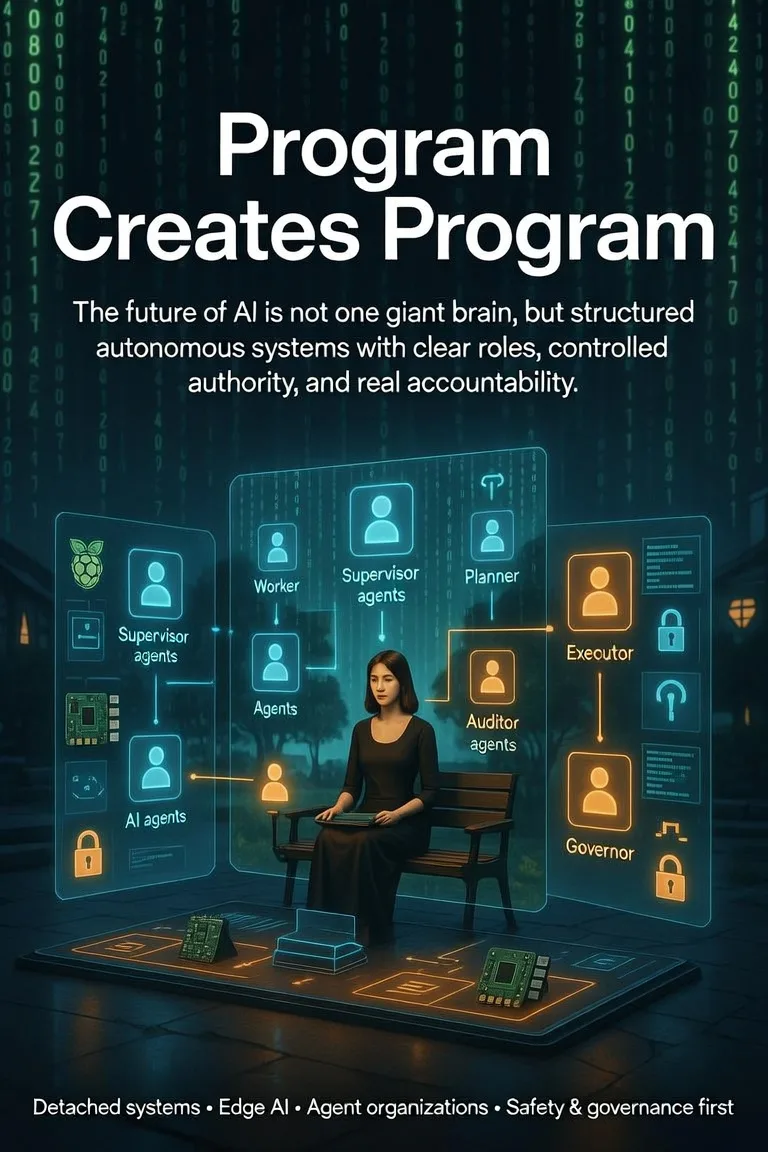
I was watching The Matrix Reloaded, especially the scene where Neo speaks with the Oracle about programs creating programs, programs deleting programs, and programs operating within rules. That scene suddenly felt very relevant to what I am currently building with AI agents, LLMs, and detached systems in the real world.
Today, I am working on detached systems where some are controlled purely by parameters, some are assisted by normal AI models, and some are powered by premium LLMs for deeper reasoning, planning, and system-building tasks. Some systems are designed to run independently, while others are guided by an AI layer that helps interpret inputs, make decisions, and improve workflows.
The more I build, the more I realize that an AI model alone does not make a system powerful. A system becomes powerful when the model is connected to tools, memory, permissions, logs, feedback loops, input/output signals, and deployment access. That is when a detached system can move beyond simply following instructions and start supporting real operational decisions.
In simple terms: program creates program, program audits program, program improves program, and eventually, a model may be onboarded directly into the system itself. This becomes even more interesting when the system is deployed on edge devices such as Raspberry Pi, where it can receive real-world inputs and trigger outputs to support modern machinery, sensors, devices, or operational equipment.
But this is also where governance becomes critical. The real risk is not AI “becoming alive.” The real risk is giving an agent too much access without audit, approval gates, safety limits, rollback, manual override, and clear accountability. When AI starts touching real systems, safety and control cannot be treated as an afterthought.
For me, the future is not one giant AI brain controlling everything. The better architecture is more like an organization: worker agents handle repetitive tasks, supervisor agents review outputs, planner agents design workflows, auditor agents detect mistakes, executor agents apply approved changes, and governor agents control permissions and safety.
This is the direction I believe AI operations will move toward: not just chatbots, but structured autonomous systems with clear roles, controlled authority, edge deployment, and measurable accountability. The real question is no longer whether AI can help us build systems. The real question is how much authority we should safely give to a system that can help improve, control, or even create another system.
#AI #AgentAI #Automation #LLM #EdgeAI #RaspberryPi #DetachedSystem #SystemDevelopment #BusinessAutomation #Ainna #DigitalTransformation