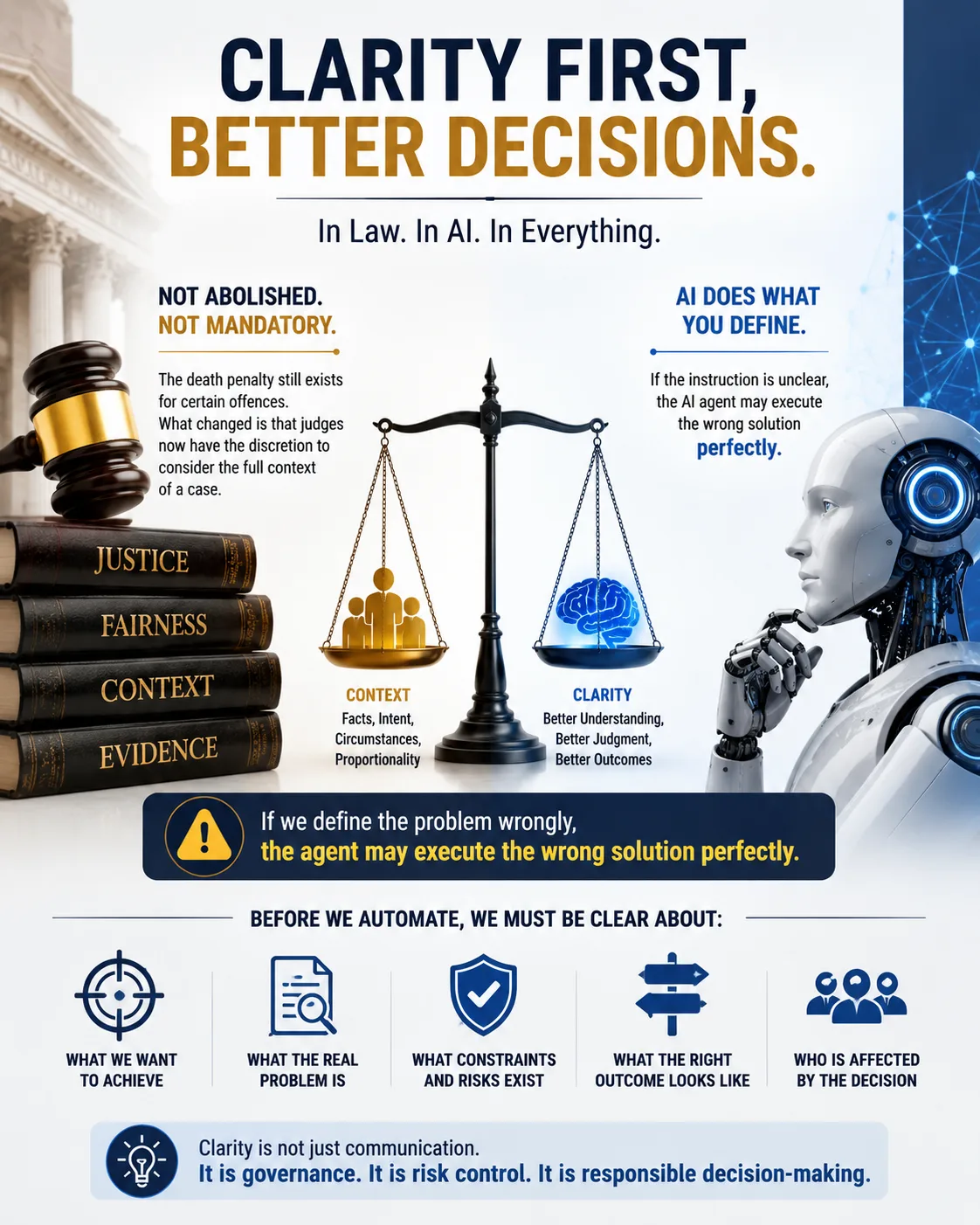
Every time a murder case or major crime happens, we often see comments like, “This is what happens when the death penalty is abolished.” But this is where clarity matters. What was abolished was not the death penalty itself, but the mandatory death penalty. That distinction is not small. It changes the entire meaning of the discussion. The death penalty still exists for certain offences, but judges now have more room to evaluate the full context of a case before deciding the appropriate sentence.
This is not about defending criminals. It is about ensuring that justice is not reduced to a fixed command without considering facts, intent, circumstances, evidence, and proportionality. In law, one word like “mandatory” can change the power of a judge. The same principle applies directly to AI. If our understanding of a matter is unclear, incomplete, or emotionally driven, the output from an AI agent will also reflect that weakness.
AI agents do not magically create clarity from confusion. They operate based on the instructions, context, parameters, and guardrails we provide. If we define the problem wrongly, the agent may execute the wrong solution perfectly. That is actually more dangerous, because a wrong decision made manually is already risky, but a wrong decision automated by an AI agent can scale very fast.
This is why human understanding must come before automation. Before we ask AI to decide, recommend, classify, approve, reject, escalate, or execute, we must first be clear about what we actually mean. Clarity is not just good communication. Clarity is governance. Clarity is risk control. Clarity is the difference between an AI agent that helps the business and an AI agent that creates a new problem at machine speed.
Whether in public policy, law, or artificial intelligence, the lesson is the same. Do not automate what you do not understand. Do not let emotion replace definition. And do not expect an AI agent to make the right decision when the human instruction behind it is already unclear.
When Humans Misunderstand the Law, AI Will Misread the Decision✎ Edit
Official Cross-Network Resource
Explore This Topic
Artificial Intelligence
Related Articles
Related Articles
Related Videos