AINNA NeuralOps Infrastructure: Private LLM Server, VPN-Secured vLLM, VPS Agent Layer, Detached Systems and Hermes
AINNA NeuralOps is designed around a secure and modular AI infrastructure where the LLM server is not publicly exposed.
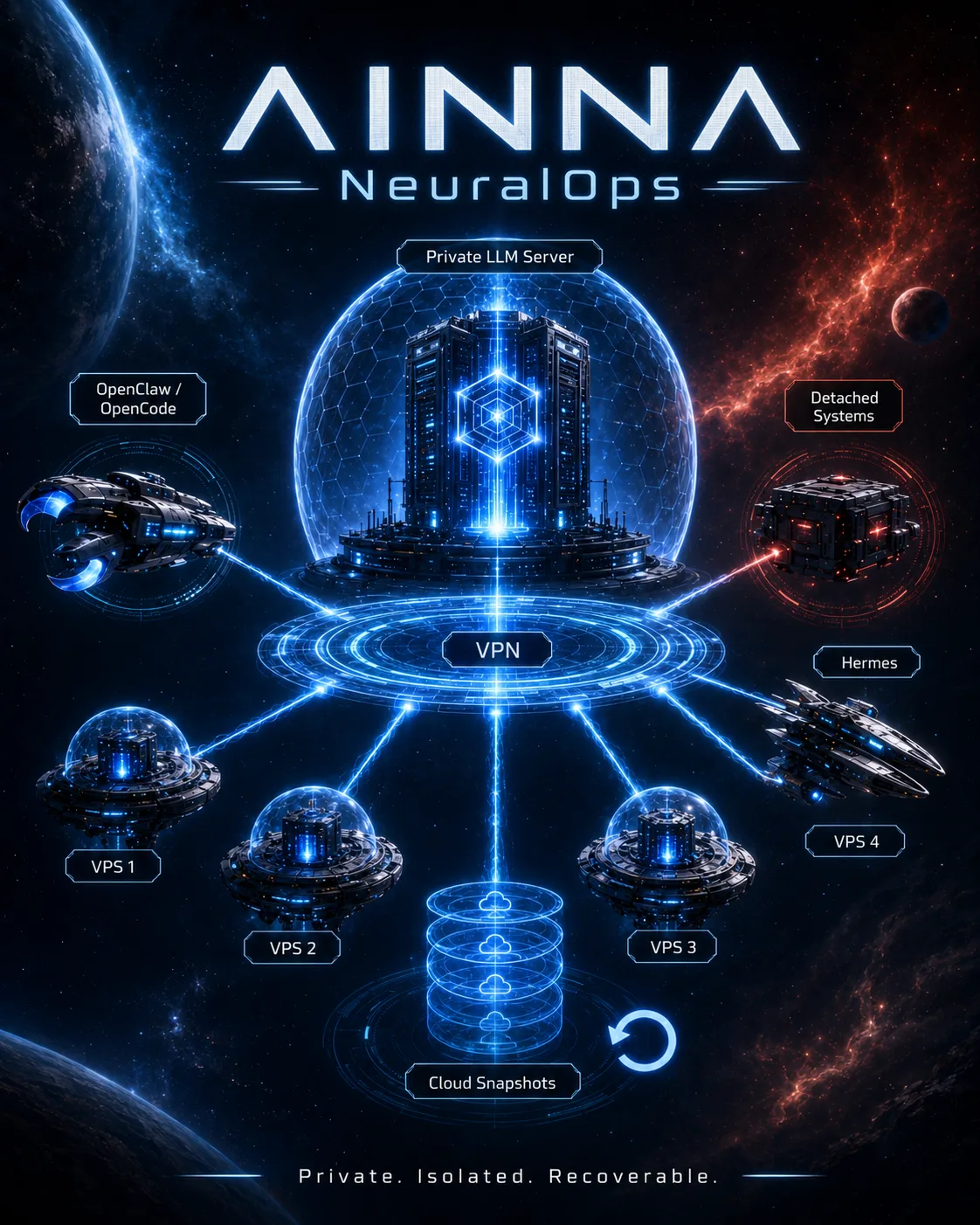
At the core of this architecture is a private LLM server running vLLM, capable of serving up to 7 LLM models for different operational workloads. The server operates fully behind a VPN-secured private network, with administrative access restricted only to authorized users through VPN.
The public internet has no direct visibility into the LLM server.
No public admin panel.
No exposed model backend.
No open inference ports.
No direct access to GPU resources.
No unnecessary attack surface.
The VPS layer has a very specific role in this infrastructure.
The VPS functions as an agent execution layer, not as a public LLM exposure layer. It is used for OpenClaw or OpenCode agents, together with Detached Systems and Hermes operational workflows.
Each VPS is isolated from other VPS instances at the cloud infrastructure level. This separation prevents one workload from directly affecting another and allows different agents, systems or operational services to run in their own controlled environments.
Snapshots are used as part of the recovery strategy. Before major changes, deployments or agent-driven system modifications, the VPS environment can be snapshotted. If an issue occurs, the system can be reverted quickly to a previous stable state. This makes experimentation, automation and agent execution safer without risking the entire infrastructure.
The VPS layer handles controlled execution tasks such as:
OpenClaw / OpenCode agent execution
system auditing
website monitoring
automation workflows
Detached System operations
Hermes integration
logs and reporting workflows
lightweight orchestration between services
snapshot-based recovery and rollback
The LLM server remains isolated behind the VPN. The VPS communicates with the LLM server through a controlled private route, using a restricted API access policy for model inference only. The agent layer can request model output, but it does not have unrestricted access to the LLM server environment.
This separation gives each layer a clear responsibility.
The LLM server is the inference layer.
The VPS is the agent execution layer.
The Detached System is the operational workflow layer.
The Hermes system is the internal business operations layer.
The VPN is the security boundary.
The cloud snapshot is the recovery layer.
By separating these responsibilities, AINNA NeuralOps becomes more secure, more scalable and easier to maintain. If one VPS has an issue, other VPS instances remain isolated. If an agent workflow breaks something, the affected VPS can be reverted using snapshots. If the VPS layer has a problem, the LLM server remains protected behind VPN. If Hermes requires automation, reporting or operational processing, it works through the Detached System instead of touching the LLM backend directly.
AINNA NeuralOps is not a simple chatbot setup.
It is a modular AI operations stack built for real business workflows:
Private LLM Server + vLLM + VPN + Isolated VPS Agent Layer + Cloud Snapshots + Detached System + Hermes
This infrastructure gives AINNA better control over AI execution, model access, operational automation, system recovery, security boundaries and long-term scalability.
AI infrastructure is not only about model performance.
It is about control.
It is about isolation.
It is about auditability.
It is about maintainability.
It is about recoverability.
And most importantly, it is about protecting the crown jewels from public exposure.
https://ainna.bond/ainna-ai/ - Our LLM Server